

Composite gates are boundary access structures manufactured from bonded wood fibre, thermoplastic polymers, and UV stabilisers, compressed under high heat and pressure into a single, dimensionally stable panel. Composite gates serve as a direct structural replacement for timber, metal, and PVC gates across residential and commercial properties in the United Kingdom.
Composite gates last 25–30 years under standard UK outdoor conditions, require no painting, staining, or sealing, and reduce annual maintenance costs to £0–£20 compared to £150–£400 for equivalent timber gate upkeep. Composite gate panels achieve a density of 1,100–1,300 kg/m³, resist water uptake to below 1% under BS EN 15534 standards, and maintain structural integrity across temperatures from -20°C to +60°C.
Available in 8 gate types including single swing, double swing, sliding, bi-fold, and pedestrian configurations, composite gates cover openings from 700mm to 6,000mm across standard UK driveway and boundary dimensions. Panel styles range from solid and slatted to framed and boarded, with surface finishes in wood grain, smooth, brushed, and grooved textures across colours including anthracite grey, black, charcoal, and natural wood tones.
Composite gates start from £200 for entry-level pedestrian gates and reach £6,500 for large automated driveway configurations. Installation follows a 15-step process from site survey and post setting through to automation commissioning and safety sensor testing. Planning permission is not required for most residential composite gate installations, with gates up to 1,000mm fronting a highway and up to 2,000mm on non-highway boundaries falling within UK permitted development rights.
Incorporating 50–70% recycled wood fibre and thermoplastic polymer content, composite gates generate 30–40% fewer carbon emissions than virgin timber gate production and require no chemical treatment across their full service lifespan.
Table of Contents
What Are Composite Gates?
Composite gates are boundary access structures engineered from combined organic and synthetic components, compressed into a single, dimensionally stable panel. Composite gates serve as a direct structural replacement for traditional timber and metal gates in residential and commercial boundary applications across the United Kingdom.
The term “composite” in gate manufacturing refers to the bonding of two or more distinct material classes under heat and pressure, producing a panel with mechanical properties exceeding those of either constituent material in isolation. According to the Building Research Establishment (BRE), composite construction methods increase structural longevity by 40–60% compared to single-material equivalents under equivalent UK weathering conditions.
Composite gates function across 3 primary boundary settings in UK properties:
- Residential Driveways: Providing vehicle access control with consistent dimensional stability across seasonal temperature variations.
- Garden and Side-Access Boundaries: Securing pedestrian entry points along lateral property perimeters.
- Commercial Perimeters: Managing controlled access for business premises requiring durable, low-maintenance boundary solutions.
Composite gates record a service lifespan of 25–30 years under standard UK climatic exposure, compared to 10–15 years for untreated softwood timber gate equivalents.
What Materials Are Composite Gates Made From?
Composite gates are manufactured from a bonded combination of wood fibre, thermoplastic polymers, and stabilising additives, compressed under high heat and pressure into a single, uniform panel structure.
Wood Fibre Core
The wood fibre core forms the structural foundation of a composite gate panel.
- Composition: Comprising 50–70% of total panel weight, sourced from recycled timber particles and sawmill by-products.
- Function: Providing internal rigidity and dimensional stability across the full panel surface.
- Benefit: Reducing virgin timber consumption by 60–70% compared to solid timber gate production.
Thermoplastic Polymer Shell
The thermoplastic polymer shell encases the wood fibre core across all panel surfaces.
- Material Type: High-density polyethylene (HDPE) or polyvinyl chloride (PVC).
- Bonding Pressure: Applied at pressures exceeding 200 bar during panel compression.
- Panel Density: Producing 1,100–1,300 kg/m³, exceeding softwood timber panels by 15–20%.
- Moisture Resistance: Reducing water uptake to below 1% under BS EN 15534 composite gate material standards.
UV Stabilisers and Binding Resins
UV stabilisers and binding resins are integrated directly into the panel matrix during compression.
- UV Stabilisers: Preventing solar degradation and surface colour fading across prolonged outdoor exposure.
- Binding Resins: Maintaining structural cohesion between wood fibre and polymer layers throughout the gate lifespan.
How Are Composite Gates Manufactured?
Composite gates are manufactured through a 4-stage production process: raw material preparation, material blending, extrusion, and surface finishing.
Stage 1: Raw Material Preparation
Before production begins, each material is cleaned and prepared separately.
- Wood Fibre Drying: Recycled timber particles are dried below 3% moisture content to prevent damage during heating.
- Polymer Granulation: HDPE or PVC polymers are broken into small, uniform granules for even mixing.
- Additive Measuring: UV stabilisers, resins, and colour pigments are pre-mixed with polymer granules in precise quantities.
Stage 2: Material Blending
Wood fibre and polymer granules are combined into a single, consistent mixture.
- Blending Ratio: 50–70% wood fibre is mixed with 30–50% polymer by weight.
- Mixing Temperature: The mixture is heated to 160–200°C, softening the polymer and bonding it to the wood fibre particles.
Stage 3: Extrusion and Compression
The blended mixture is pushed through a mould and pressed into a solid gate panel.
- Extrusion: The heated mixture is forced through a shaped die at pressures exceeding 200 bar, forming a continuous panel.
- Compression: Hydraulic pressure compresses the panel to a final density of 1,100–1,300 kg/m³.
- Cooling: Panels pass through a cooling system, locking final dimensions to tolerances of ±0.5mm.
Stage 4: Surface Finishing
The final stage gives composite gates their appearance and weather protection.
- Embossing: Mechanical rollers press wood-grain or smooth textures directly onto the panel surface.
- Co-Extrusion Capping: A secondary polymer layer seals all 4 panel edges, blocking moisture from entering the wood fibre core.
- Through-Body Colouring: Colour pigments added during blending run through the full panel depth, eliminating the need for surface paint throughout the gate lifespan.
What Types of Composite Gates Are Available in the UK?
Composite gates are available in 8 main types across the UK market, grouped by how they open and how they look.
Single Swing Gates
Single swing gates are one-panel gates that open inward or outward from a single post.
- Opening Width: From 900mm to 1,800mm.
- Operation: Manual or automated with a single motor arm.
- Best Suited For: Narrow driveways and side entries on residential properties.
Double Swing Gates
Double swing gates are two matching panels that open from the centre, one panel per side.
- Opening Width: From 2,400mm to 4,000mm.
- Operation: Manual or automated with one motor arm per panel.
- Best Suited For: Wide residential driveways and commercial vehicle entrances.
Sliding Gates
Sliding gates are single large panels that slide horizontally along a ground track or overhead rail.
- Opening Width: From 2,000mm to 6,000mm.
- Operation: Motor-driven along a rack-and-pinion or belt-drive system.
- Best Suited For: Properties without enough space in front for swing gates to open.
Bi-Fold Gates
Bi-fold gates are two-section panels that fold in half on a central hinge when opening.
- Opening Width: From 2,400mm to 5,000mm.
- Operation: Automated via hydraulic or electromechanical folding actuators.
- Best Suited For: Driveways with limited forecourt depth needing wide access.
Pedestrian Gates
Pedestrian gates are narrow single-panel gates installed separately for foot traffic access.
- Opening Width: From 700mm to 1,200mm.
- Operation: Manual latch, key lock, or keypad entry.
- Best Suited For: Garden boundaries, side entries, and commercial pedestrian access points.
Solid Panel Gates
Solid panel gates are fully boarded gates with no gaps between panels, providing complete privacy.
- Panel Coverage: 100% surface coverage with no visible gaps.
- Privacy Level: Blocking full sightlines from street level to property interior.
- Best Suited For: Front driveways and rear gardens requiring maximum privacy.
Slatted Gates
Slatted gates are gates built with evenly spaced horizontal or vertical slats, allowing partial visibility and airflow.
- Gap Width: Slat spacing ranges from 20mm to 50mm between boards.
- Airflow Benefit: Reducing wind load pressure on gate posts by 30–40% compared to solid panel gates.
- Best Suited For: Exposed or coastal properties where wind resistance is a priority.
Framed and Boarded Gates
Framed and boarded gates are gates built with a visible outer frame and boarded infill panels within the frame structure.
- Frame Material: Aluminium or steel subframe with composite board infill.
- Structural Benefit: The outer frame adds rigidity across wide gate spans exceeding 2,000mm.
- Best Suited For: Large driveway openings and commercial boundary entrances requiring additional structural support.
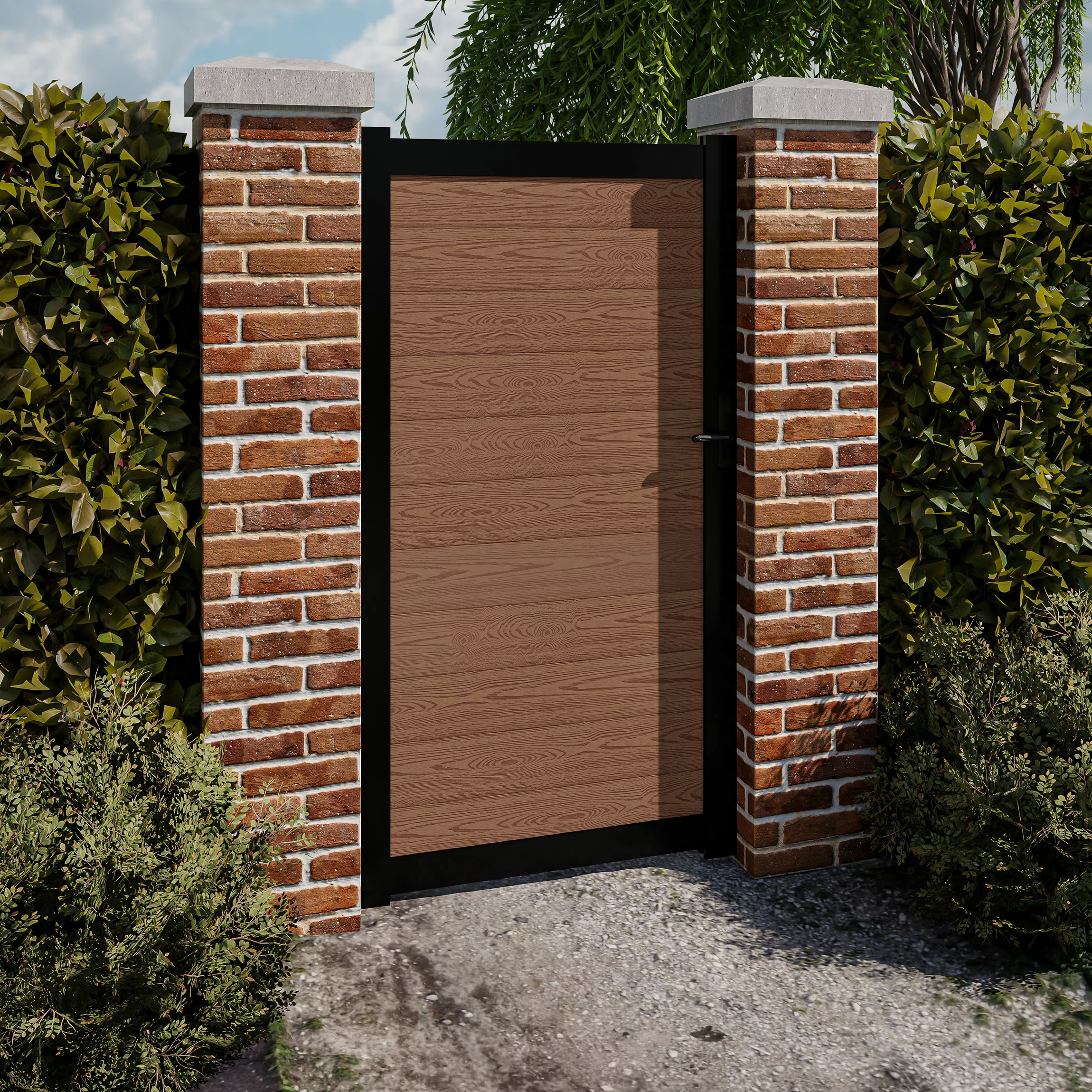
What Are the Pros and Cons of Composite Gates?
Composite gates offer clear advantages in durability and low maintenance but carry higher upfront costs and limited repair options compared to timber and metal alternatives.
Pros of Composite Gates
- Low Maintenance: No painting, staining, or sealing required, with annual upkeep costs averaging £0–£20.
- Long Lifespan: Lasting 25–30 years under standard UK outdoor conditions, compared to 10–15 years for timber.
- Weather Resistance: Resisting rot, warping, splitting, and corrosion across all UK climates.
- Moisture Resistance: Reducing water uptake to below 1% under BS EN 15534 composite material standards.
- Strength: Achieving a panel density of 1,100–1,300 kg/m³, exceeding softwood timber by 15–20%.
- Privacy: Solid panel configurations block full sightlines from street level to property interior.
- Security: Supporting automated locking systems including electromagnetic locks and keypad entry.
- Aesthetic Versatility: Available in multiple colours, textures, and finishes without surface treatment.
- Colour Retention: Through-body colouring retains original appearance for 15–20 years without fading.
- Sustainability: Incorporating 50–70% recycled wood fibre, reducing virgin timber consumption.
- Wind Resistance: Slatted configurations reduce wind load pressure on gate posts by 30–40%.
- Temperature Stability: Maintaining dimensional tolerances of ±0.5mm across -20°C to +60°C.
- Splinter-Free Surface: Eliminating the splintering risk present in natural timber gate panels.
- Insect Resistance: Resisting woodworm, termites, and wood-boring insect damage throughout the lifespan.
- Fire Resistance: Composite panels carry a Class B fire rating under EN 13501-1 European standards.
Cons of Composite Gates
- Higher Upfront Cost: Ranging from £800 to £3,500, compared to £200 to £1,200 for equivalent timber gates.
- Limited Repairability: Damaged panels require full replacement rather than localised board repair.
- Heat Expansion: Expanding by 2–3mm per linear metre above 30°C, requiring 5–10mm installation expansion gaps.
- Heavier Weight: Weighing 15–25% more than equivalent aluminium panels, requiring stronger post foundations.
- Deeper Post Foundations: Requiring concrete bases of 600mm depth minimum to support panel weight.
- Restricted Customisation: Panel dimensions are factory-set, limiting on-site cutting and reshaping options.
- Colour Range Limitations: Available colours are fixed at manufacturing stage, excluding on-site repainting.
- Automation Motor Requirements: Heavier panels require higher-rated automation motors, increasing installation costs.
- Recycled Material Variability: Recycled wood fibre content produces minor surface texture variations between panel batches.
What Styles and Designs Do Composite Gates Come In?
Composite gates are available in a wide range of styles, designs, finishes, and colours to suit residential and commercial properties across the UK.
Panel Styles
- Solid Panel: Full-boarded design with no gaps, providing maximum privacy.
- Slatted Horizontal: Evenly spaced horizontal boards with 20–50mm gaps between slats.
- Slatted Vertical: Evenly spaced vertical boards replicating a traditional close-board fence aesthetic.
- Framed and Boarded: Visible outer frame with composite board infill for a structured, traditional appearance.
- Diagonal Boarded: Boards arranged at 45-degree angles for a contemporary geometric design.
- Chevron: Mirror-image diagonal boards meeting at a central point, forming a V-shaped pattern.
- Louvred: Angled fixed slats allowing airflow and partial visibility without full sightline exposure.
Surface Finishes
- Wood Grain Embossed: Mechanical texture replicating natural timber grain across the full panel surface.
- Smooth Finish: Flat, contemporary surface texture with no visible grain pattern.
- Brushed Finish: Subtle linear texture providing a modern, architectural appearance.
- Grooved Finish: Evenly spaced surface grooves adding depth and shadow lines to the panel face.
Colours
- Classic Colours: Black, charcoal grey, white, and anthracite grey covering the majority of UK residential installations.
- Natural Wood Tones: Light oak, golden oak, dark oak, and walnut replicating natural timber appearances.
- Contemporary Colours: Slate blue, forest green, and stone grey for modern property aesthetics.
- Dual-Tone Options: Contrasting frame and infill colours available on framed and boarded gate configurations.
Top Rail Designs
- Flat Top: Straight horizontal top rail running level across the full gate width.
- Arched Top: Single curved arc across the full gate width for a traditional appearance.
- Palisade Top: Individual pointed or rounded post tops rising above the top rail line.
- Raked Top: Diagonal top rail following the slope of a driveway on inclined installations.
Gate Post Styles
- Square Posts: Standard 100mm x 100mm square-section posts for clean, modern installations.
- Chamfered Posts: Square posts with angled top edges deflecting rainwater away from the post surface.
- Capped Posts: Decorative flat or pyramid caps fitted to post tops for a finished appearance.
- Recessed Posts: Posts set flush with the gate panel face for a seamless, minimal aesthetic.
Hardware and Accessories
- Hinges: Adjustable stainless steel or galvanised steel hinges in black, silver, and anthracite finishes.
- Latches: Magnetic, gravity, and spring-loaded latch options in matching hardware finishes.
- Lock Types: Key lock, padlock loop, keypad entry, and electromagnetic lock configurations.
- Automation Kits: Single-arm, underground, sliding, and bi-fold motor systems compatible with composite gate weights.
- Intercom Integration: Video and audio intercom systems mountable directly to composite gate posts.
How Do Composite Gates Compare to Timber, Metal, and PVC Gates?
Composite gates outperform timber, metal, and PVC gates across lifespan, maintenance, and weather resistance, but carry a higher initial purchase cost than all three alternatives.
Composite Gates vs Timber Gates
- Lifespan: Composite lasts 25–30 years; timber lasts 10–15 years without treatment.
- Maintenance: Composite requires no painting or staining; timber requires treatment every 2–3 years.
- Weather Resistance: Composite resists rot and warping; timber absorbs up to 30% of its dry weight in moisture.
- Strength: Composite achieves 1,100–1,300 kg/m³ panel density; timber softwood averages 400–600 kg/m³.
- Cost: Composite gates start from £800; equivalent timber gates start from £200.
- Appearance: Both replicate natural wood aesthetics; composite retains appearance without maintenance.
- Sustainability: Composite incorporates 50–70% recycled content; virgin timber production requires felling natural trees.
Composite Gates vs Metal Gates
- Lifespan: Composite lasts 25–30 years; galvanised steel lasts 15–25 years with rust treatment.
- Maintenance: Composite requires no treatment; steel requires rust-proofing every 3–5 years.
- Corrosion Resistance: Composite panels do not rust or corrode; steel panels corrode without protective coating.
- Weight: Composite panels weigh 15–25% more than aluminium equivalents of identical dimensions.
- Strength: Steel gates offer higher impact resistance than composite for high-security applications.
- Appearance: Composite replicates timber aesthetics; metal gates carry an industrial appearance.
- Cost: Composite gates start from £800; aluminium gates start from £600; steel gates start from £500.
Composite Gates vs PVC Gates
- Lifespan: Composite lasts 25–30 years; PVC lasts 20–25 years under standard UK conditions.
- Strength: Composite achieves 1,100–1,300 kg/m³ panel density; PVC panels average 600–800 kg/m³.
- Impact Resistance: Composite resists impact damage better than hollow PVC gate panels.
- Appearance: Composite replicates natural timber grain; PVC carries a plastic appearance.
- Colour Retention: Both retain colour without painting; composite maintains appearance for 15–20 years.
- Maintenance: Both require minimal maintenance with occasional washing.
- Cost: Composite gates start from £800; PVC gates start from £400 for equivalent dimensions.
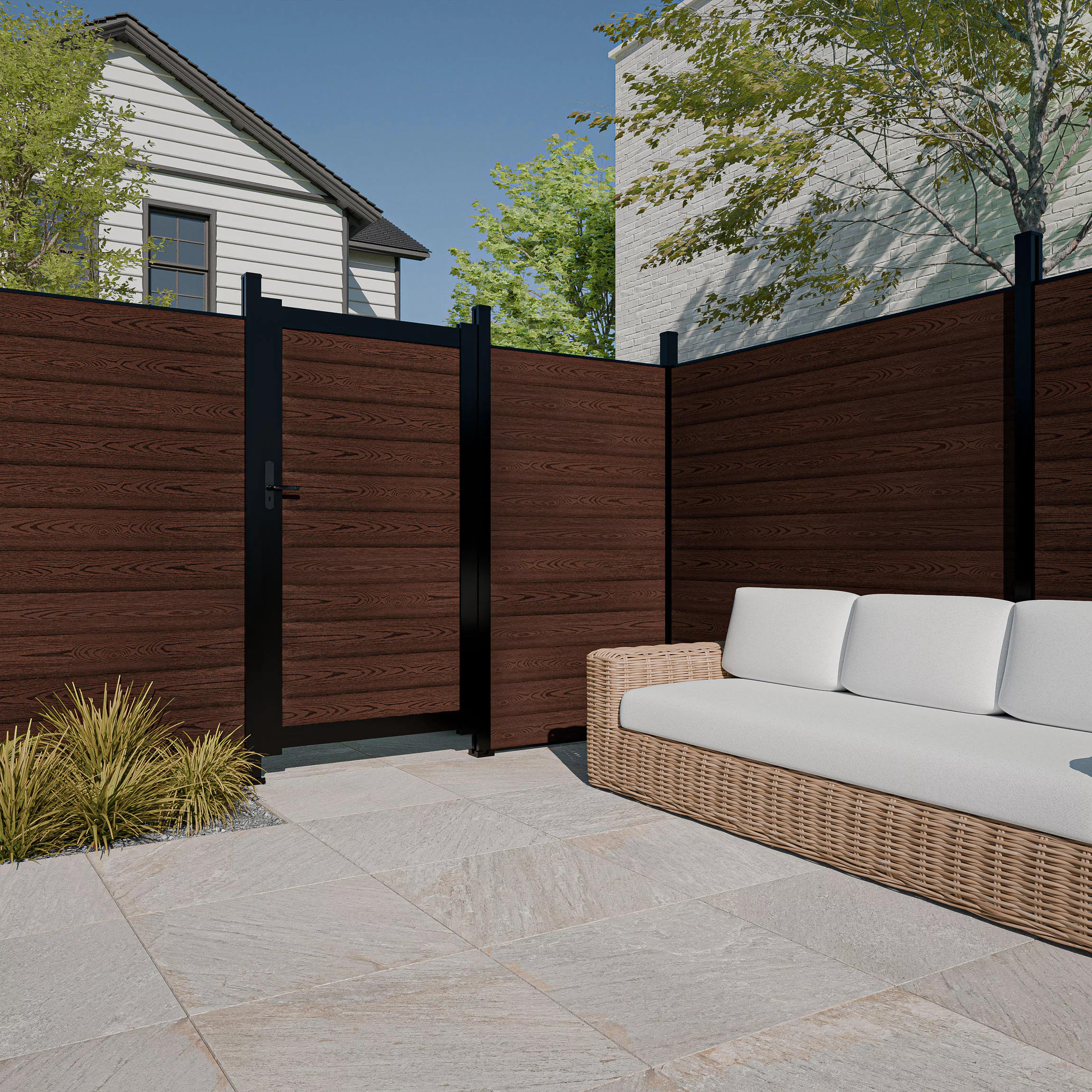
Comparison Table
The table below compares composite, timber, metal, and PVC gates across 6 key performance criteria:
| Criteria | Composite | Timber | Metal | PVC |
| Lifespan | 25–30 years | 10–15 years | 15–25 years | 20–25 years |
| Maintenance | Minimal | High | Moderate | Minimal |
| Weather Resistance | Excellent | Poor | Moderate | Good |
| Starting Cost | £800 | £200 | £500 | £400 |
| Appearance | Wood grain | Natural wood | Industrial | Plastic |
| Sustainability | High | Low | Moderate | Low |
How Much Do Composite Gates Cost in the UK?
Composite gates cost between £200 and £6,500 in the UK, depending on gate type, size, design, and automation requirements.
Cost by Gate Type
- Single Swing Gates: £200–£1,800 for standard residential widths of 900mm–1,800mm.
- Double Swing Gates: £1,500–£3,500 for driveway widths of 2,400mm–4,000mm.
- Sliding Gates: £1,800–£4,500 including ground track and motor system.
- Bi-Fold Gates: £2,000–£5,000 for openings of 2,400mm–5,000mm.
- Pedestrian Gates: £200–£900 for standard widths of 700mm–1,200mm.
Cost by Size
- Small Gates (up to 1,800mm wide): £200–£1,500.
- Medium Gates (1,800mm–3,000mm wide): £1,500–£3,000.
- Large Gates (3,000mm–5,000mm wide): £3,000–£6,500.
Installation Costs
- Basic Manual Installation: £300–£600 for single gate fitting including post setting.
- Double Gate Installation: £500–£900 including dual post setting and concrete foundations.
- Automated Gate Installation: £800–£2,000 including motor fitting, wiring, and control panel setup.
- Concrete Foundation Setting: £150–£300 per post at 600mm minimum depth.
Automation Costs
- Single-Arm Motor Kit: £300–£600 per motor unit.
- Underground Motor Kit: £600–£1,200 per motor unit.
- Sliding Gate Motor Kit: £400–£900 including rack-and-pinion drive system.
- Intercom and Keypad Entry: £200–£800 depending on video or audio configuration.
Additional Cost Factors
- Bespoke Sizing: Custom panel dimensions above standard sizes add £200–£600 to base gate costs.
- Dual-Tone Colour Finish: Contrasting frame and infill colours add £150–£400 to standard colour pricing.
- Decorative Hardware Upgrades: Stainless steel or black finish hinges, latches, and locks add £50–£200.
- Removal of Existing Gates: £100–£250 for removal and disposal of existing gate structures.
How Are Composite Gates Installed? (Step-by-Step Guide)
Composite gate installation follows a sequential process starting from site survey and measurement, through post setting and panel hanging, to final hardware fitting and automation commissioning.
Step 1: Survey the Site
A site survey identifies access restrictions, ground conditions, and utility locations before installation begins.
- Check for underground cables, pipes, and drainage runs along the post hole positions using a cable avoidance tool.
- Identify surface type — concrete, block paving, tarmac, or soil — to determine excavation method.
- Check driveway gradient to determine whether a raked, stepped, or level gate configuration is required.
- Confirm overhead clearance for sliding gate track or bi-fold gate arc where applicable.
Step 2: Measure the Opening
Accurate measurement determines the correct gate size and post placement.
- Measure the full opening width at ground level, mid-height, and top rail height.
- Record the smallest measurement as the governing opening width.
- Allow 10–20mm clearance per side between gate panel and post face for hinge fitting.
- Measure ground-level gradients on sloped driveways to determine raked or stepped gate configuration.
Step 3: Check Gate Delivery and Components
Checking all components before installation begins prevents delays mid-installation.
- Confirm gate panel dimensions match the measured opening width and height.
- Check all hardware components are present including hinges, latch, lock, and fixings.
- Inspect gate panels for surface damage, colour consistency, and dimensional accuracy before post holes are dug.
- Confirm automation kit components are complete if motorised operation is required.
Step 4: Prepare the Foundation
Foundation preparation ensures posts remain plumb and structurally stable throughout the gate lifespan.
- Mark post hole positions at each side of the opening using a spirit level and string line.
- Dig post holes to a minimum depth of 600mm for standard residential gates.
- Increase hole depth to 750mm–900mm for gates taller than 1,800mm or heavier than 50kg per panel.
- Post hole diameter requires a minimum of 3 times the post width for adequate concrete coverage.
- Clear all loose soil and debris from the base of each hole before post placement.
Step 5: Set the Gate Posts
Gate posts carry the full structural load of the gate panels and automation systems.
- Place posts into prepared holes and pack with temporary timber bracing to hold plumb position.
- Check vertical alignment on all 4 faces of each post using a spirit level before pouring concrete.
- Pour concrete mix to within 50mm of ground level, sloping the top surface away from the post base to deflect rainwater.
- Confirm post spacing matches gate panel width plus hinge and latch clearance allowances before concrete sets.
Step 6: Allow Concrete to Cure
Concrete curing time determines when gate hanging can safely begin.
- Standard concrete mix requires 24–48 hours before gate panels are hung.
- Fast-setting post mix achieves structural strength in 4–6 hours under dry conditions.
- Do not apply lateral load to posts before full curing is complete to prevent post misalignment.
Step 7: Fit the Hinges
Hinge positioning determines gate swing clearance and long-term operational alignment.
- Mark hinge positions on the post face at 150mm from the top and bottom of the gate panel height.
- Add a third central hinge on gate panels exceeding 1,800mm in height or 40kg in weight.
- Use stainless steel or galvanised hinges rated to a minimum of 1.5 times the gate panel weight.
- Pre-drill fixing holes to prevent composite post or timber post splitting during bolt fitting.
Step 8: Hang the Gate Panels
Gate panel hanging requires two people for panels exceeding 20kg in weight.
- Lift the gate panel into position against the hinge plates with temporary timber packers holding ground clearance.
- Maintain a minimum ground clearance of 75mm–100mm on standard driveways.
- Increase ground clearance to 150mm on driveways with significant surface debris or leaf accumulation.
- Secure hinge bolts finger-tight before final alignment check to allow minor positional adjustment.
Step 9: Adjust Gate Alignment
Alignment adjustment ensures smooth operation and consistent gap tolerances across the gate panel.
- Check top, bottom, and leading edge gaps are consistent across the full gate height.
- Adjust hinge plate positions horizontally and vertically using slotted hinge adjustment bolts.
- Confirm the gate swings freely through the full opening arc without ground contact or post contact.
- Tighten all hinge bolts to manufacturer-specified torque values after final alignment confirmation.
Step 10: Fit the Gate Stop
A gate stop prevents the gate panel from swinging beyond its intended opening arc.
- Fix a rubber-faced gate stop to the post face at the fully open gate position.
- Position the gate stop at mid-height on the gate panel to distribute impact load evenly.
- Confirm the gate stop engages before the hinge reaches its maximum rotation limit.
Step 11: Fit the Latch and Lock
Latch and lock fitting secures the gate in the closed position.
- Position the latch at a comfortable hand height of 900mm–1,050mm from ground level.
- Align the lock body and keep plate across the gate closing face for consistent engagement.
- Test latch and lock engagement across 10 full open and close cycles before proceeding.
Step 12: Fit Post Caps
Post caps protect the top of each gate post from rainwater ingress and surface weathering.
- Select flat, pyramid, or ball-top post caps matching the gate hardware finish.
- Apply a small bead of waterproof sealant to the post top face before cap fitting.
- Press caps firmly onto post tops and confirm secure seating before completing installation.
Step 13: Fit Automation Motor and Wiring
Automation fitting applies to motorised gate installations only.
- Mount the motor arm to the post and gate panel bracket at manufacturer-specified angles for correct torque application.
- Run all motor and control panel wiring through conduit buried at a minimum depth of 450mm below ground level.
- Connect motor, intercom, keypad, and safety sensor wiring to the control panel following manufacturer wiring diagrams.
- Set motor torque limits, open and close speed, and auto-close delay on the control panel before testing.
Step 14: Test Safety Sensors
Safety sensor testing confirms the gate stops and reverses on detecting an obstruction.
- Position photocell sensors at 150mm and 500mm above ground level on both gate posts.
- Test each photocell across 5 full open and close cycles by breaking the sensor beam mid-movement.
- Confirm the gate stops and reverses within 0.5 seconds of sensor activation on each test cycle.
- Test safety edges on gate leading faces by applying gentle pressure mid-close to confirm reversal response.
Step 15: Final Inspection and Commissioning
Final inspection confirms the installation meets operational and safety standards before handover.
- Check all fixings, bolts, and hinge fasteners are tightened to manufacturer-specified torque values.
- Confirm gate panels open and close smoothly without binding, scraping, or misalignment.
- Test all remote controls, keypads, and intercom functions across multiple cycles.
- Apply a thin coat of silicone lubricant to all hinge pivot points and latch mechanisms.
- Provide the property owner with manufacturer documentation, warranty information, and automation control panel instructions.
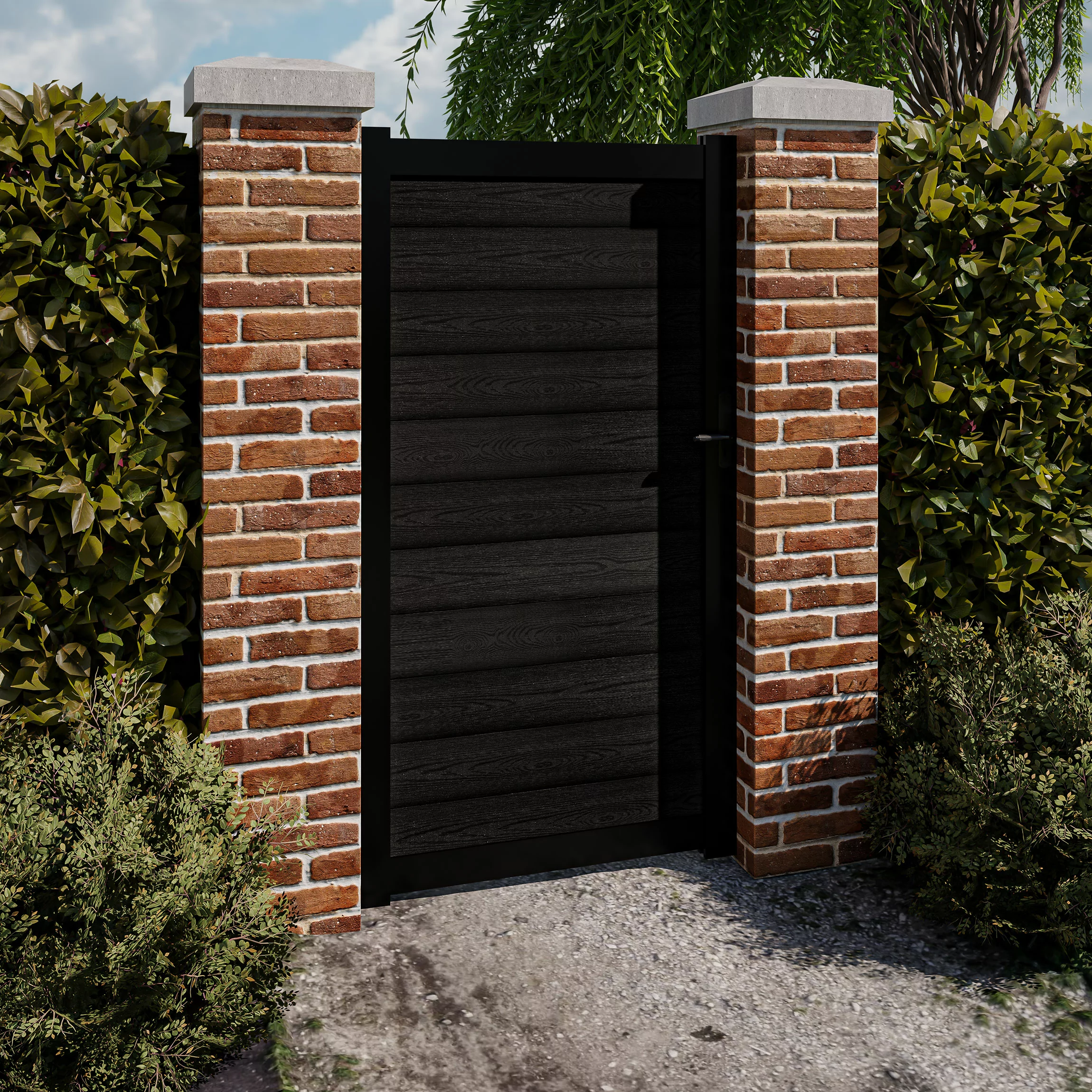
How Do You Maintain Composite Gates?
Composite gates are maintained through regular cleaning every 3–6 months, hardware lubrication every 6 months, drainage and expansion gap checks every 3 months, annual post and foundation inspections, seasonal maintenance, and professional automation servicing every 2–3 years.
Regular Cleaning
Regular cleaning prevents surface dirt, algae, and mould from building up on composite gate panels.
- Clean composite gate panels every 3–6 months using warm soapy water and a soft-bristle brush.
- Rinse panels thoroughly with clean water after washing to remove all soap residue.
- Remove algae and mould growth using a composite-safe cleaner diluted to manufacturer-specified concentrations.
- Avoid pressure washing at settings above 1,500 PSI to prevent surface texture damage on embossed panels.
- Never use solvent-based cleaners, bleach, or abrasive pads on composite gate surfaces.
Hardware Lubrication
Regular lubrication keeps hinges, latches, and locks operating smoothly throughout the gate lifespan.
- Apply silicone-based lubricant to all hinge pivot points every 6 months.
- Lubricate latch mechanisms and lock barrels with a dry PTFE spray every 6 months.
- Avoid oil-based lubricants on composite gate hardware as they attract dirt and accelerate wear.
- Check hinge bolts for loosening every 6 months and retighten to manufacturer-specified torque values.
Drainage and Gap Checks
Keeping drainage channels and expansion gaps clear prevents panel damage during wet and warm conditions.
- Clear debris, leaves, and soil from the base of gate panels and post bases every 3 months.
- Check expansion gaps between gate panels and posts are clear of debris to allow thermal movement.
- Confirm ground clearance of 75mm–100mm is maintained below gate panels after ground settlement.
- Clear sliding gate ground tracks of stones, debris, and compacted soil every 3 months.
Post and Foundation Checks
Post and foundation integrity determines the long-term structural stability of the entire gate installation.
- Inspect gate posts for vertical alignment using a spirit level every 12 months.
- Check concrete post bases for cracking or surface erosion annually, particularly after severe winter frost.
- Re-pack loose post bases with fresh concrete mix, allowing 24–48 hours curing before gate operation resumes.
- Inspect post cap seals annually and reseal with waterproof sealant where cracking or lifting is observed.
Automation System Maintenance
Automated composite gates require additional maintenance to keep motor and control systems operating reliably.
- Test automation motor open and close cycles monthly to identify speed or torque irregularities early.
- Clean photocell sensor lenses monthly with a dry lint-free cloth to maintain accurate obstruction detection.
- Test safety edge sensors across 3 full open and close cycles every 3 months.
- Check all buried cable conduit entry points annually for water ingress and reseal where necessary.
- Service automation motors professionally every 2–3 years to inspect internal components and motor brushes.
- Update automation control panel firmware annually where manufacturer updates are available.
Annual Structural Inspection
A full annual structural inspection identifies early signs of wear, damage, or misalignment before problems develop.
- Check all panel faces for surface cracking, delamination, or colour fading across the full panel area.
- Inspect all hinge plates and fixing bolts for corrosion, particularly in coastal UK locations.
- Confirm gate panels open and close without binding, scraping, or misalignment across the full swing arc.
- Check leading edge and closing face gaps are consistent from top to bottom of the gate panel height.
- Inspect all latch, lock, and automation bracket fixings for movement or loosening.
- Document inspection findings and schedule remedial work within 30 days of inspection completion.
Seasonal Maintenance
UK seasonal conditions require specific maintenance actions at different points throughout the year.
- Spring: Deep clean panels after winter, clear post bases of frost-heaved soil, and lubricate all hardware.
- Summer: Check expansion gaps are clear ahead of peak temperature periods to allow thermal movement.
- Autumn: Clear fallen leaves from gate tracks, post bases, and drainage channels before wet season begins.
- Winter: Remove snow and ice from gate panels using a plastic scraper, avoiding metal tools on composite surfaces.
What Hardware and Accessories Do You Need for Composite Gates?
Composite gates require hinges, latches, locks, gate stops, post caps, drop bolts, automation motors, safety sensors, access control systems, and decorative accessories for a complete and fully functional installation.
Hinges
- Select adjustable stainless steel or galvanised steel hinges rated to a minimum of 1.5 times the gate panel weight.
- Use 2 hinges per gate panel for panels up to 1,800mm in height and 40kg in weight.
- Add a third central hinge for panels exceeding 1,800mm in height or 40kg in weight.
- Available finishes include black, anthracite grey, silver, and stainless steel.
- Adjustable hinges allow 3-dimensional positional correction after installation without removing gate panels.
Latches
- Magnetic Latches: Self-closing magnetic engagement for lightweight pedestrian and garden gates.
- Gravity Latches: Drop-bolt style latch engaging automatically on gate closure for single and double swing gates.
- Spring-Loaded Latches: Spring-return mechanism for consistent self-closing engagement on residential driveway gates.
- Double-Sided Latches: Allowing manual release from both inside and outside the gate for pedestrian access.
Locks
- Key Lock: Cylinder key lock for standard residential gate security on single and double swing gates.
- Padlock Loop: Welded steel loop accepting a padlock for additional gate security.
- Multipoint Lock: Locking at 3 or more points simultaneously across the gate height for high-security applications.
- Electromagnetic Lock: 12V or 24V electric lock releasing on authorised entry signal for automated gate systems.
- Digital Keypad Lock: Code-entry lock for keyless access control on residential and commercial gates.
Gate Stops
- Fix rubber-faced gate stops to the post face at the fully open gate position.
- Position gate stops at mid-height on the gate panel to distribute impact load evenly across the post.
- Ground-mounted gate stops are available for installations where post-mounted stops are not suitable.
Post Caps
- Flat Caps: Clean, minimal profile for contemporary gate installations.
- Pyramid Caps: Traditional angled cap deflecting rainwater away from post top surface.
- Ball-Top Caps: Decorative rounded cap for traditional and heritage gate styles.
- Finial Caps: Ornamental pointed cap for period property and decorative gate installations.
Drop Bolts
- Surface-mounted drop bolts engage into a ground socket to hold one gate panel stationary.
- Flush-fit drop bolts sit within the gate panel face for a cleaner aesthetic on premium installations.
- Use drop bolts rated to a minimum ground socket depth of 150mm for structural stability.
Automation Motors
- Single-Arm Motors: Surface-mounted arm actuators for single and double swing gates up to 4,000mm wide.
- Underground Motors: Concealed below-ground actuators for a clean, unobtrusive appearance on swing gates.
- Sliding Gate Motors: Rack-and-pinion or belt-drive motors for horizontal sliding gate operation.
- Bi-Fold Motors: Specialist folding actuators for bi-fold composite gate configurations.
- Select motors rated to a minimum of 1.5 times the gate panel weight for reliable long-term operation.
Safety Sensors
- Photocell Sensors: Infrared beam sensors mounted on gate posts at 150mm and 500mm above ground level.
- Safety Edges: Pressure-sensitive rubber strips fitted to gate leading edges reversing movement on contact.
- Loop Detectors: Ground-buried induction loops detecting vehicle presence for automatic gate opening.
- Safety sensors are a legal requirement under BS EN 12453 for all automated gate installations in the UK.
Access Control Systems
- Keypads: Code-entry panels for keyless pedestrian and vehicle access control.
- Proximity Card Readers: RFID card or fob readers for multi-user access control on commercial gates.
- Video Intercoms: Camera and screen systems allowing remote visual verification before gate release.
- Audio Intercoms: Voice communication systems for residential pedestrian and driveway gate entry.
- GSM Intercoms: Mobile-connected intercom systems allowing gate release from any location via smartphone.
Decorative Accessories
- Hinge Covers: Decorative plates concealing hinge bolts and fixing heads on gate panel faces.
- Gate Numbers: Stainless steel or powder-coated aluminium house numbers mounted directly to gate panels.
- Letterbox Inserts: Composite-compatible letterbox frames fitted into gate panel cut-outs for front driveway gates.
- Solar Post Lights: LED lighting units mounted to gate post tops for illuminated nighttime gate operation.
- Gate Bells: Wired or wireless bell push units mounted to gate posts for visitor announcement.
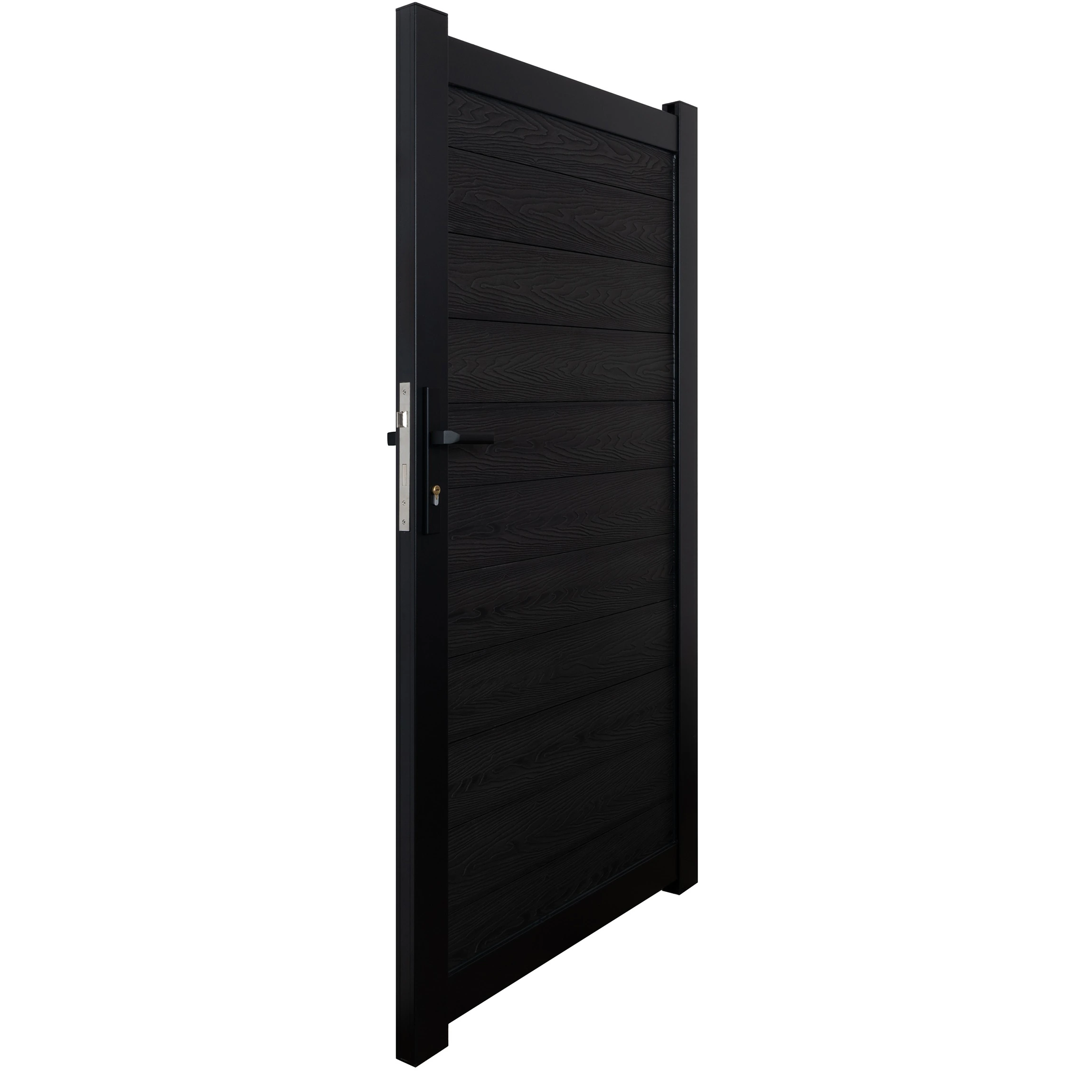
Do You Need Planning Permission for a Composite Gate in the UK?
Planning permission for a composite gate is not required in most residential cases, but height limits, property type, and boundary position determine when permission becomes necessary.
When Planning Permission Is Not Required
- Gates up to 1,000mm fronting a vehicle highway do not require planning permission.
- Gates up to 2,000mm on boundaries not fronting a highway do not require planning permission.
- Replacing an existing gate at the same height and position does not require planning permission.
When Planning Permission Is Required
- Gates exceeding 1,000mm fronting a road or footpath used by vehicles require planning permission.
- Gates exceeding 2,000mm on any boundary position require planning permission.
- Gates on listed buildings or within listed building curtilages require listed building consent.
- Gates within a Conservation Area fronting a highway require planning permission regardless of height.
Properties Without Permitted Development Rights
- Properties with an Article 4 Direction require planning permission for all gate installations.
- Flats and maisonettes do not benefit from permitted development rights for gate installations.
- New-build properties sometimes have permitted development rights removed as a planning condition.
Highway Visibility Requirements
- Gates must not open outward over the public highway without prior highway authority approval.
- Driveway gates within 5,000mm of the highway boundary require a visibility splay check before installation.
How to Confirm Planning Permission Requirements
- Submit a Lawful Development Certificate to the local planning authority for written confirmation.
- Use the Planning Portal at planningportal.co.uk to check permitted development rules for the specific property.
- Contact the local council planning department directly for listed buildings, Conservation Areas, and Article 4 locations.
- Retrospective planning applications for unpermitted gate installations currently cost £206 in England as of 2024.
How Long Do Composite Gates Last?
Composite gates last 25–30 years under standard UK outdoor conditions, compared to 10–15 years for untreated softwood timber gates and 15–25 years for galvanised steel gates.
The bonded wood fibre and thermoplastic polymer matrix resists rot, warping, corrosion, and UV degradation throughout the full lifespan without painting, staining, or sealing. Composite gates installed in coastal UK locations with high salt air exposure maintain structural integrity for 20–25 years with standard 6-monthly cleaning and annual hardware maintenance.
Are Composite Gates Environmentally Sustainable?
Yes, composite gates are environmentally sustainable, incorporating 50–70% recycled wood fibre and thermoplastic polymer content that reduces virgin timber consumption by 60–70% compared to solid timber gate production. Composite gate manufacturing generates 30–40% fewer carbon emissions than equivalent virgin timber gate production.
Composite gates require no chemical painting, staining, or preservative treatment, eliminating solvent and VOC emissions across the full 25–30 year service lifespan. Composite gate panels are recyclable at end of service life, with wood fibre and polymer components re-entering the wood plastic composite manufacturing supply chain as secondary raw material. Leading UK composite gate manufacturers hold FSC, PEFC, and ISO 14001 certification confirming responsible sourcing and production-stage environmental controls.
How Do You Choose the Right Composite Gate?
Choose the right composite gate by measuring the opening accurately, selecting the correct gate type, height, style, colour, security level, and automation requirements for the specific property and boundary.
- Measure the Opening First: Measure the opening width at ground level, middle height, and top. Use the smallest measurement as the final width when picking a gate size.
- Check the Driveway Slope: Check if the driveway is flat or slopes up or down, as this decides whether a flat, raked, or stepped gate style is needed.
- Pick the Right Gate Type: Single swing gates fit openings from 900mm to 1,800mm. Double swing gates fit 2,400mm to 4,000mm. Sliding gates work best where there is no room for a gate to swing open. Bi-fold gates fold in half, making them perfect for tight driveways needing wide access.
- Choose the Right Height: 1,800mm gives full privacy for most homes. 2,100mm works better for business properties. 2,400mm suits high-security boundaries.
- Check Planning Permission First: Gates taller than 1,000mm facing a road need planning permission in the UK before buying or fitting.
- Pick the Right Panel Style: Solid panels block all outside views on front driveways. Slatted panels let wind through and suit coastal or exposed gardens. Framed and boarded panels add extra strength for wide openings over 2,000mm.
- Choose a Colour That Fits the Home: Match the gate colour to the front door, fencing, or window frames. Anthracite grey, black, and charcoal suit modern homes. Oak and walnut tones suit older or traditional properties.
- Decide How Secure the Gate Needs to Be: Solid panels with multipoint locks work best for high-security homes. Electric locks holding 280–500kg suit automated gates. Video intercoms and key fob readers suit business premises with multiple users.
- Choose Manual or Automated: Manual gates suit side entries and garden access points used occasionally. Automated gates suit driveways used several times a day. Always pick a motor rated to at least 1.5 times the gate panel weight.
- Check Post and Foundation Depth: Gates taller than 1,800mm or heavier than 50kg per panel need concrete foundations at 750mm–900mm deep to stay straight and stable.
- Check the Motor Fits the Gate: Confirm the gate weight, width, and type fall within the motor’s rated capacity before buying an automation system.
- Think About Long-Term Costs: Composite gates cost £0–£20 per year to maintain. Factor this saving against the higher purchase price when planning a budget.
- Set a Budget Before Choosing: Composite gates start from £200 for small pedestrian gates and reach £6,500 for large automated driveway gates. Fix a budget before choosing size, style, and automation.
- Get Written Planning Confirmation: Apply for a Lawful Development Certificate from the local council if there is any doubt about height or boundary position before installation starts.


