
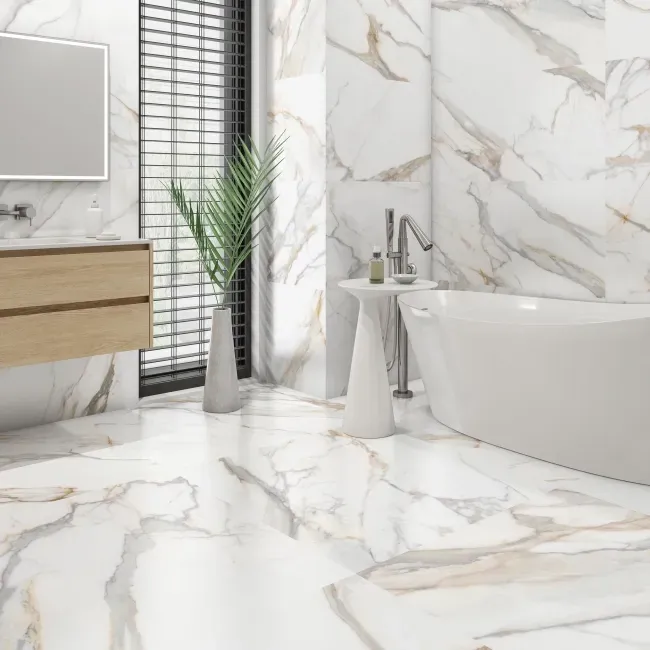
Three different slip resistance systems are used on tile specifications, and the R rating most people look for is not the one designed for barefoot bathroom use. R ratings come from a test carried out wearing shoes on an oil-covered ramp; a bathroom is a barefoot, water-covered environment, which has its own separate classification.
Choosing a non-slip bathroom floor tile properly means knowing which rating applies to your situation, what the tile’s finish and format do to its grip, and how slip resistance changes once the floor has been in use for a few years. This guide covers all three rating systems, how to match a rating to a specific bathroom, and the practical decisions beyond the tile itself.
Table of Contents
Why Bathroom Floor Slip Resistance Matters
A bathroom combines water, soap residue and bare feet, which is the specific set of conditions that makes a floor slippery. The highest-risk moments in a bathroom are predictable: stepping out of a bath or shower onto a wet floor, moving barefoot across the room immediately after bathing, and water pooling around a basin or at the shower threshold. Households with young children or older adults face higher risk again, since unpredictable movement and reduced balance both increase the chance of a fall.
The important point is that slip resistance is a specification, not a marketing description. A tile described as “anti-slip” without a stated, tested rating tells you very little; a tile with a published rating against a named standard tells you what conditions it was actually tested in.
The Three Slip Rating Systems Explained
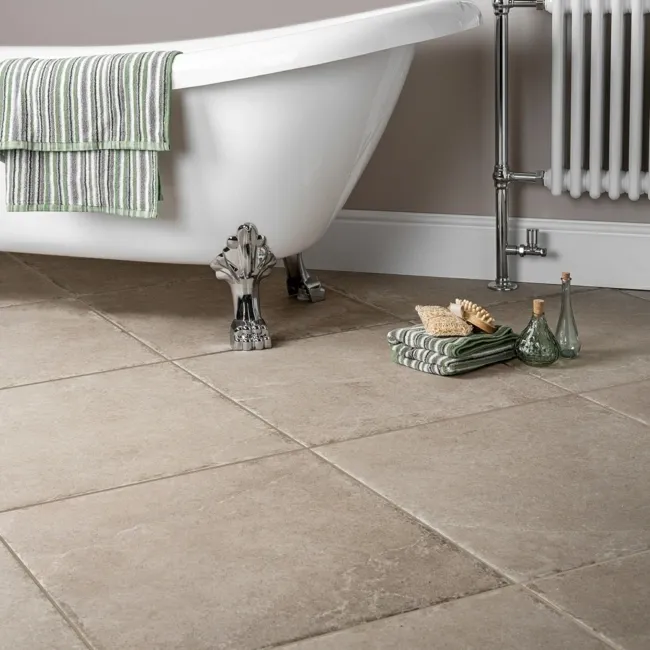
Three separate systems appear on UK tile specifications, and each measures something different under different conditions. The table below sets them out.
| System | Standard | Test Conditions | Scale |
| R rating | DIN 51130 | Shod foot, oil-covered ramp | R9 (lowest) to R13 (highest) |
| Barefoot class | DIN 51097 | Bare foot, wet ramp | Class A, B, C (C highest) |
| PTV | BS 7976 (pendulum test) | Rubber slider on a wet surface | Numeric value |
R Ratings (DIN 51130)
The R rating is the most commonly quoted figure on tile listings, and it comes from a German ramp test carried out wearing shoes. An operator walks across a tiled ramp coated in oil, and the angle at which they begin to slip determines the rating. A higher number means the ramp reached a steeper angle before slipping began. The scale runs from R9 at the lowest to R13 at the highest, and it was developed for workplace environments such as commercial kitchens and industrial areas rather than domestic barefoot spaces.
Barefoot Classes (DIN 51097)
DIN 51097 uses the same ramp principle, but the operator walks barefoot on a surface wetted with water rather than shod on oil. Results fall into three classes: Class A, slip resistant at ramp angles of roughly 12 to 18 degrees; Class B, at roughly 18 to 24 degrees; and Class C, at angles greater than around 24 degrees. This standard was developed for barefoot wet environments such as swimming pool surrounds, changing rooms and shower areas, which makes its test conditions far closer to how a domestic bathroom is actually used.
Pendulum Test Values (BS 7976)
In the UK, the pendulum test is the method most widely relied on by safety professionals, and it produces a numeric Pendulum Test Value rather than a class or an R number. A weighted pendulum with a rubber slider swings across the tile surface, usually tested wet, and the resistance it meets produces the score. The Health and Safety Executive’s guidance identifies a PTV of 36 or above, measured in wet or “final conditions of use” rather than dry, as the benchmark for low slip potential on pedestrian surfaces — a useful reference point where a manufacturer publishes PTV data.
These three systems are not interchangeable. An R rating cannot be reliably converted into a PTV score or a barefoot class, and a supplier quoting only one figure is not giving you the others by implication. Where slip resistance genuinely matters for a project, ask the manufacturer which standards a specific tile has been tested against rather than inferring one figure from another.
Why Barefoot Ratings Matter Most in a Bathroom
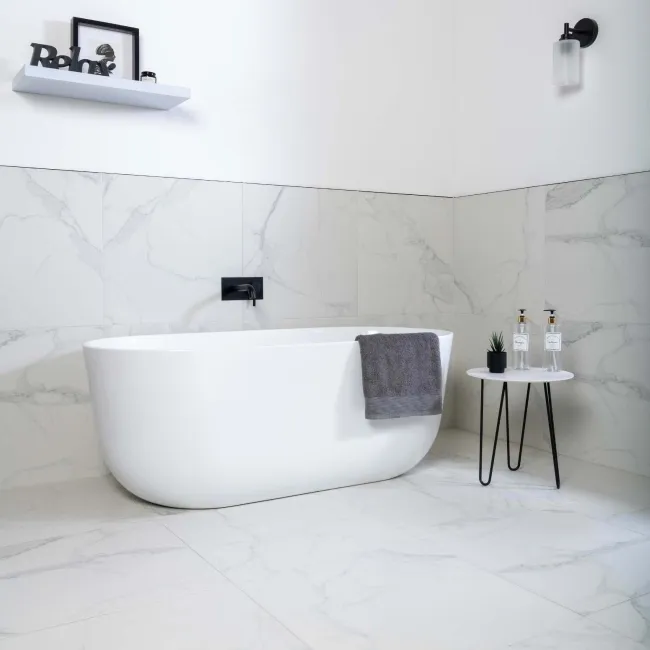
Most people use a bathroom barefoot on a floor wetted with water, which is exactly the scenario DIN 51097 tests and exactly the scenario DIN 51130 does not. The R rating test uses footwear and oil; both change the friction behaviour of a surface compared with skin and water. A tile can carry a reassuring-looking R rating and still have been tested in conditions with limited relevance to a domestic bathroom.
This does not make R ratings useless. They remain a reasonable comparative indicator between tiles, they are far more widely published than barefoot classes, and for a bathroom where slippers or shoes are typically worn they are more directly relevant. The practical approach: treat a published barefoot class as the more meaningful figure for a bathroom when one is available, use the R rating as a comparative guide when it is not, and check PTV data where a manufacturer provides it and the application is high risk.
Which Rating Do You Actually Need?
There is no legal minimum slip rating for a domestic bathroom floor in the UK, so the decision comes down to how the room is used rather than compliance with a fixed standard. The figures below reflect common trade practice — the working conventions installers and specifiers use day to day — rather than a regulatory requirement, and the manufacturer’s stated suitability for a specific product should be the final check.
| Bathroom Type | Common R Rating Guidance | Barefoot Class |
| Cloakroom or dry-use WC | R9 upward | Class A upward |
| Standard bathroom with bath or enclosed shower | R10 upward | Class B upward |
| Walk-in shower or wet room | R11 upward | Class C |
| Bathroom used by children or older adults | R10 upward, R11 in wet zones | Class B upward, Class C in wet zones |
Three questions narrow the decision quickly:
Does water sit on the floor, or only splash it? An enclosed shower or a bath contains most water; a wet room or open walk-in shower drains across the floor itself, which is the single biggest factor pushing toward a higher rating.
Who uses the room, and how? A rarely used guest cloakroom and a family bathroom with young children have genuinely different requirements.
Is the whole floor equally wet? Many bathrooms have a wet zone around the shower and a comparatively dry zone elsewhere, and specifying a higher-rated tile for the wet zone is a legitimate approach.
How Tile Finish Affects Grip
Surface finish is the strongest single indicator of how a tile will behave underfoot, and it is visible before any rating is checked.
Polished and high gloss finishes generally offer the least grip when wet, and are usually better suited to walls than bathroom floors.
Lappato or semi-polished finishes sit between polished and matt. They can be appropriate for lower-risk bathroom floors such as a lightly used ensuite, but check the rating rather than assuming.
Matt and semi-matt finishes typically perform better underfoot than polished ones and are the common default for domestic bathroom floors.
Structured and textured finishes offer the most grip and are the usual choice for wet rooms and shower floors, at the cost of a rougher feel underfoot and more effort to keep clean.
A textured floor takes more cleaning than a smooth one, and this is a genuine trade-off rather than a detail. A surface with more texture traps more soap residue and limescale, and that build-up itself reduces grip if it is not cleaned off — covered in more detail below.
Tile Size, Grout and Slip Resistance
Grout lines contribute grip, so a large-format tile with fewer grout lines per square metre relies more heavily on its own surface texture. A floor laid in 300×300mm tiles has considerably more grout line per square metre than the same floor laid in 900×900mm tiles, and grout is typically more textured than the tile face. This does not make large-format tiles unsafe, but it does mean a large-format floor tile needs an appropriate surface finish to compensate rather than relying on the layout to provide traction.
Two related points are worth factoring into a specification: a narrower grout joint reduces this effect further, since rectified tiles allow very narrow joints which look seamless but contribute less texture across the floor; and mosaic and small-format tiles have the opposite characteristic, with a high proportion of grout line per square metre, which is one reason small-format tiles are a common choice for shower floors.
Installation Factors That Affect Safety
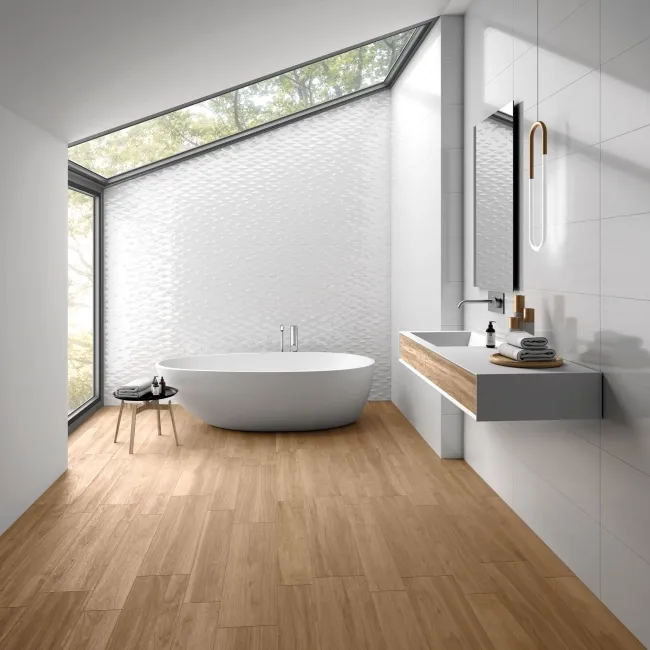
A correctly rated tile can still produce an unsafe floor if it is badly installed. Three installation issues affect safety directly.
Lippage is the term for adjacent tiles sitting at slightly different heights, and it creates a genuine trip hazard as well as an uneven finish. It is most noticeable on large-format tiles, and it is prevented by a properly levelled substrate and, where appropriate, a tile levelling system during installation.
Drainage and fall matter in any area where water reaches the floor directly. A shower or wet room floor needs a fall toward the drain so water runs away rather than pooling, since standing water defeats even a well-rated tile. The correct gradient depends on the drainage system and tile format, so follow the manufacturer’s and the drainage system’s specification rather than a general figure.
Substrate preparation underpins both. A floor that is not flat produces lippage; a floor that is not correctly fallen produces standing water. Our guide to how to tile: preparing, installing and maintaining tiles covers substrate preparation in more detail.
How Slip Resistance Changes Over Time
A tile’s published slip rating describes the tile when new and clean, not the floor after two years of use. This is the part of bathroom floor safety most often overlooked, and it matters because the changes are gradual enough to go unnoticed.
Soap and shampoo residue builds a thin film on a bathroom floor that reduces grip, particularly in the area immediately outside a shower. Limescale accumulates in hard water areas and both dulls and smooths the surface over time. Polishes and wax-based cleaners can leave a slippery residue on a tile that was specified precisely for its grip, so check that any cleaning product is suitable for the tile before using it. Worn grout loses texture as it ages too, which reduces the contribution grout lines make to overall floor traction.
Regular cleaning with a product suited to the tile, rinsing thoroughly so no film is left behind, and refilling grout that has started to wear all help a floor retain the characteristics it was chosen for.
Bathroom Safety Beyond the Tile
The tile is one component of a safe bathroom floor rather than the whole solution. Several other elements contribute, and some are considerably cheaper than changing a floor.
Bath and shower mats add grip at the specific point where most slips happen: the step out of a bath or shower. Grab rails give a secure handhold at the bath, shower and WC, and matter most for users with reduced mobility. A shower seat removes the need to stand on a wet floor for the whole duration of a shower. Effective extraction clears steam faster, which reduces condensation settling on the floor as well as helping with damp generally. Good lighting makes wet patches visible — a dim bathroom hides exactly the hazards a person needs to see. Underfloor heating dries a floor faster after use, which shortens the period the floor spends wet.
Improving an Existing Bathroom Floor
Where retiling is not practical, several options improve an existing floor without replacing it. Anti-slip treatments are available that alter the surface of an existing tile to increase grip; these vary considerably in how they work and how long they last, so check the product’s suitability for the specific tile material and follow its instructions closely. Anti-slip adhesive strips applied at the highest-risk points, such as the step out of a bath, are a simpler and more targeted option.
Beyond treatments, the measures in the section above apply equally to an existing bathroom: adding a good bath mat, fitting a grab rail, improving lighting and reviewing cleaning products all reduce risk without touching the floor itself. Where a floor is genuinely unsuitable, such as a polished tile in a wet room, replacement remains the more reliable answer.
Buying Checklist
Confirm each of the following before ordering a bathroom floor tile.
- The tile is specified by the manufacturer for floor use, not wall-only.
- A slip rating is published against a named standard, rather than a vague “anti-slip” description.
- The rating suits how wet the floor will actually get, with a higher rating specified for a wet room or open walk-in shower.
- A barefoot class is checked where available.
- The finish matches the intention: matt or textured for a floor, with polished finishes kept to walls or low-risk areas.
- For a large-format tile, the surface finish is doing the work rather than the grout lines.
- The substrate can be levelled adequately for the tile format chosen.
- Cleaning requirements are understood, particularly for a textured finish.
- A sample has been viewed and, where possible, felt underfoot before committing.
Getting Bathroom Floor Safety Right
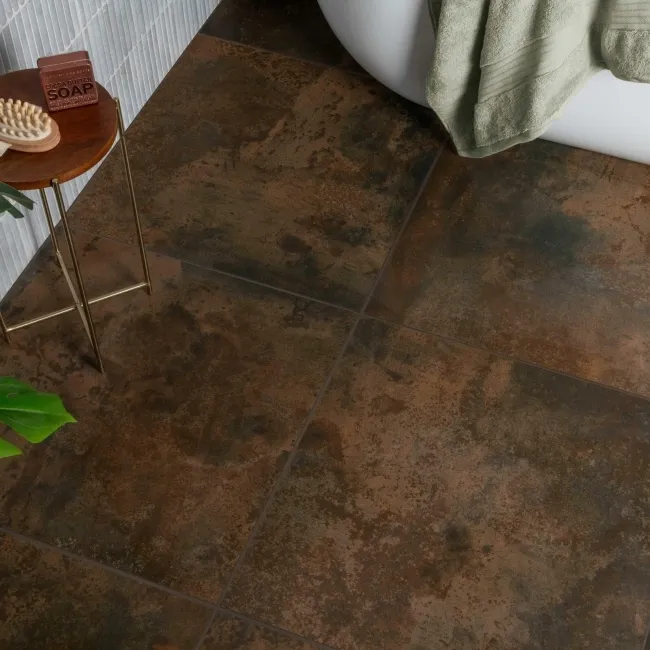
Match the rating system to the way the bathroom is actually used, then check the finish, format and installation support that choice. Beyond the specification, a well-falled floor, a flat substrate, sensible cleaning and a few low-cost additions such as a grab rail or bath mat all contribute more than a single number on a product page.
Full detail on how gradings are assessed is covered in our slip ratings explained guide, and our anti-slip tiles and bathroom floor tiles ranges are worth browsing alongside it. Where a bathroom is being adapted for someone with reduced mobility, an occupational therapist or specialist installer can advise on requirements specific to that person.
Frequently Asked Questions
What slip rating do I need for a bathroom floor?
There is no legal minimum for a domestic bathroom in the UK, but R10 or above is the rating most commonly specified for a standard bathroom floor, with R11 or above for a wet room or open walk-in shower. Where a barefoot class is published, Class B suits a standard bathroom and Class C suits a wet room — this figure reflects bathroom conditions more closely than an R rating does, since it’s tested barefoot on a wet surface rather than shod on oil.
What is the difference between R ratings and barefoot A, B and C classes?
R ratings come from a ramp test carried out wearing shoes on an oil-covered surface, while A, B and C classes come from a ramp test carried out barefoot on a water-wetted surface. Since a bathroom is a barefoot, water environment, the A/B/C classification matches real bathroom use more closely, though R ratings are more widely published on tile listings.
Can I convert an R rating into a PTV score?
No, the two are measured by entirely different test methods and do not convert reliably from one to the other. If a supplier provides only one figure, that figure does not tell you what the tile would score under the other system; ask the manufacturer which standards the tile has been tested against.
Are large format tiles more slippery?
Large format tiles have fewer grout lines per square metre, and since grout contributes grip, the tile’s own surface finish has to do more of the work. A large format tile with an appropriate matt or textured finish can still be a sound floor choice — the point is not to rely on grout lines for traction when there are few of them.
Do anti-slip tiles stay slip resistant forever?
No, slip resistance can reduce over time as soap residue, limescale and unsuitable cleaning products build up on the surface. Regular cleaning with a product suited to the tile, thorough rinsing and maintaining the grout all help a floor retain the properties it was specified for.
Can I make my existing bathroom floor less slippery?
Anti-slip treatments and adhesive strips can improve an existing tiled floor without replacing it, though their suitability depends on the tile material. Adding a bath mat, fitting a grab rail, improving lighting and reviewing cleaning products all reduce risk as well, and are simpler than treating the floor itself.
