
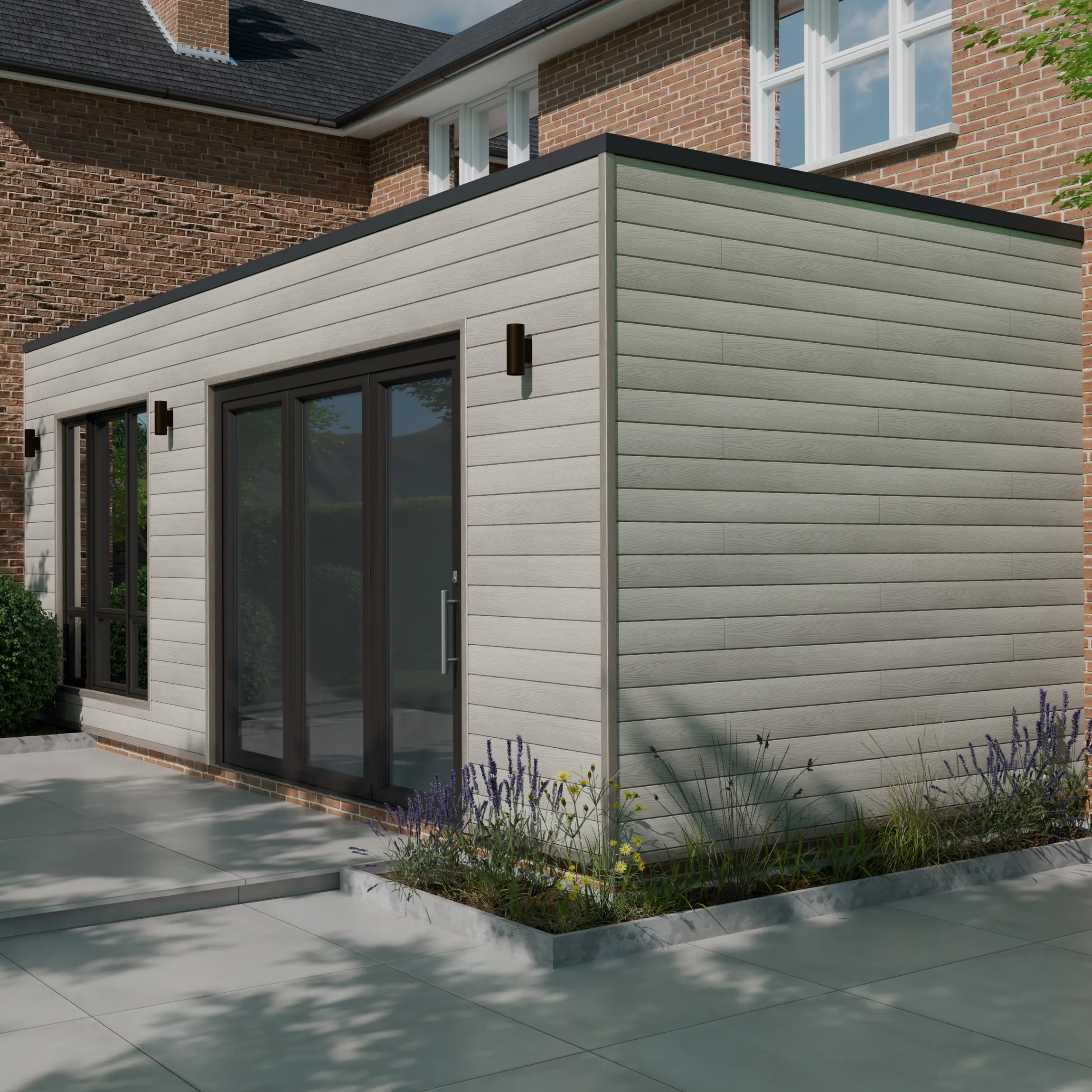
Composite cladding is a recycled wood–polymer exterior wall system that delivers 20–30 years of weather resistance, limits water absorption below 2%, reduces maintenance by more than 50% compared with untreated timber, and performs reliably in high-rainfall British climate conditions.
Composite cladding combines recycled wood fibres with thermoplastic polymers to create durable façade boards used on residential walls, garden rooms, commercial elevations, dormers, balconies, and renovation projects. Board formats include shiplap wall cladding, external shiplap cladding, composite cladding panels, composite panelling, hollow-core boards, solid-core boards, and fire-rated systems.
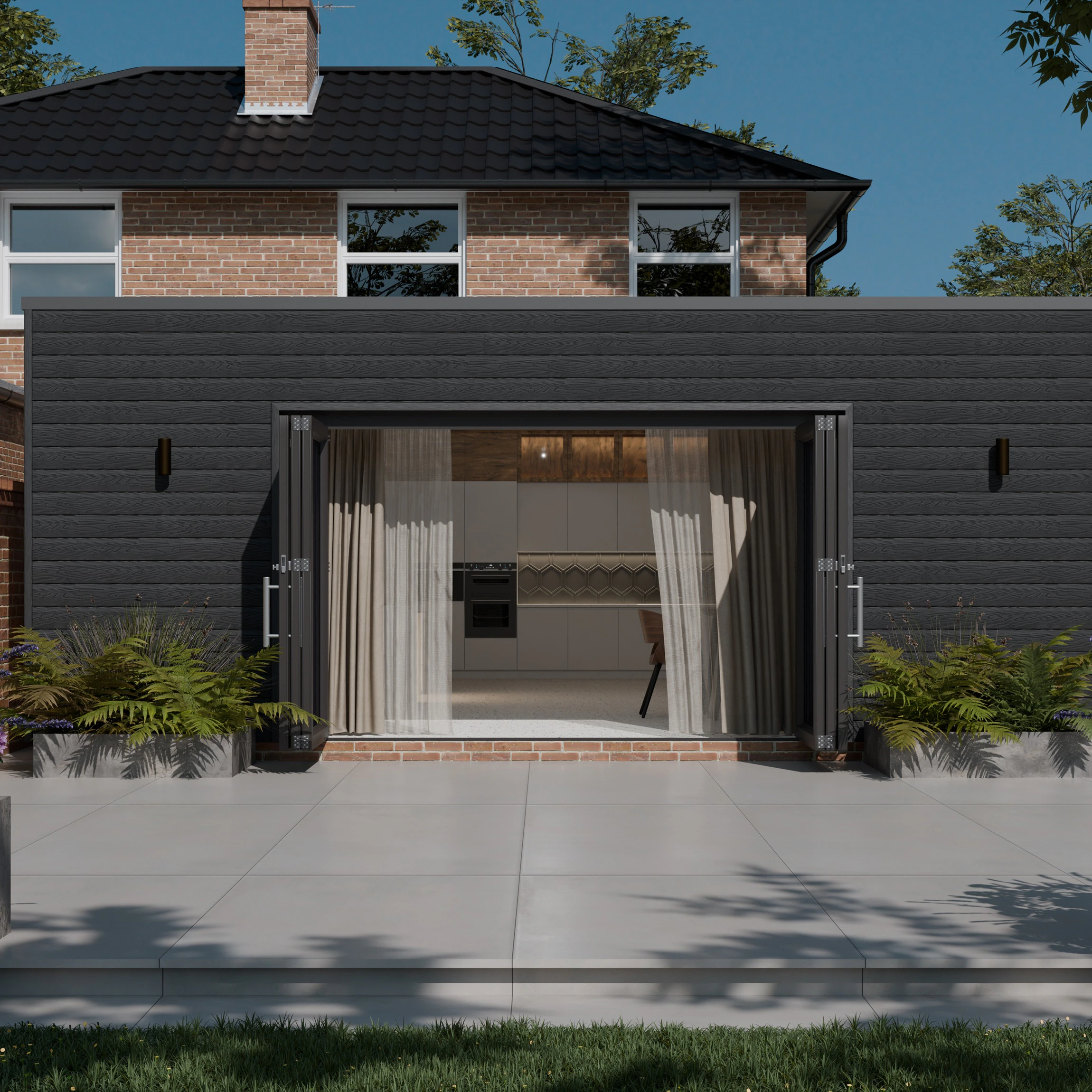
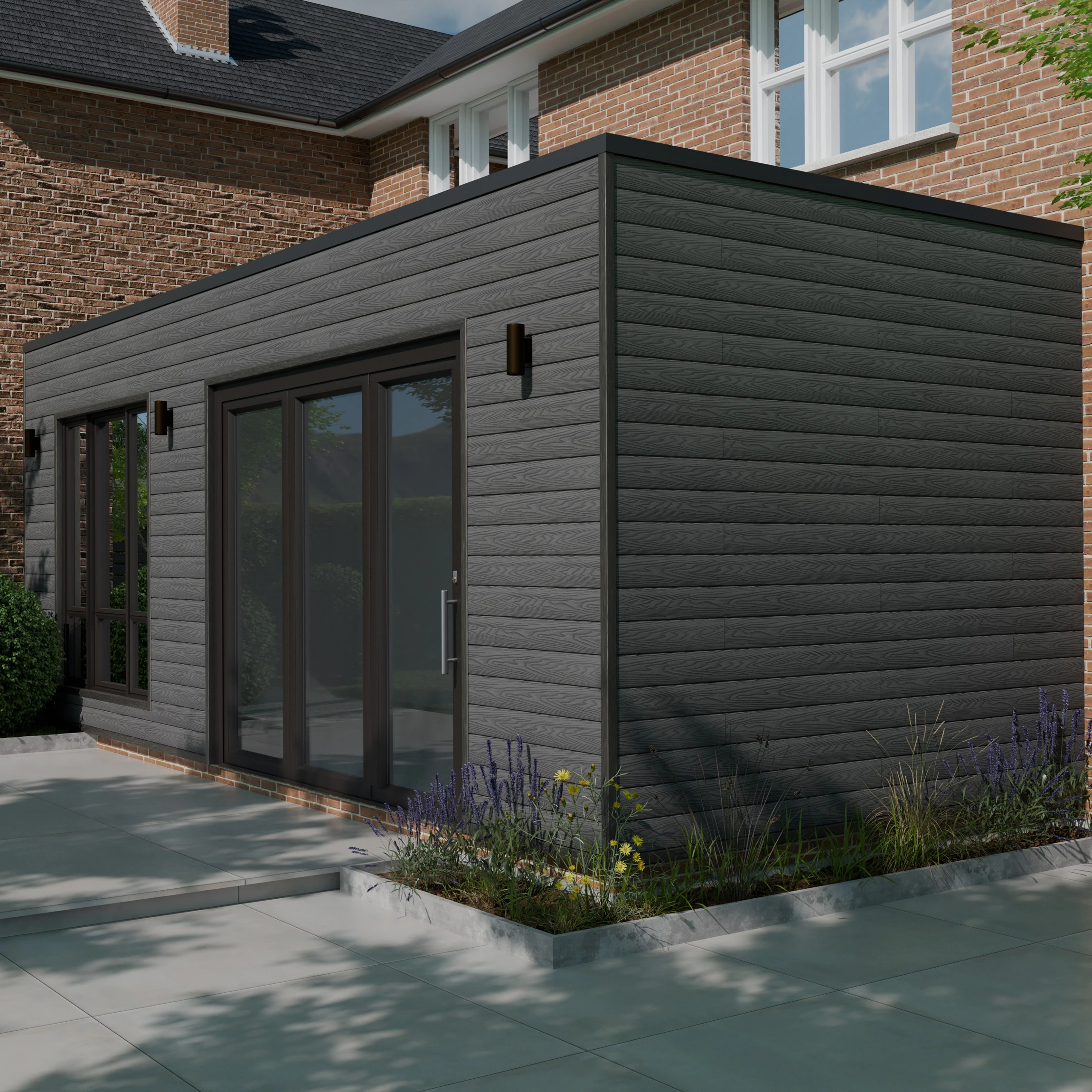
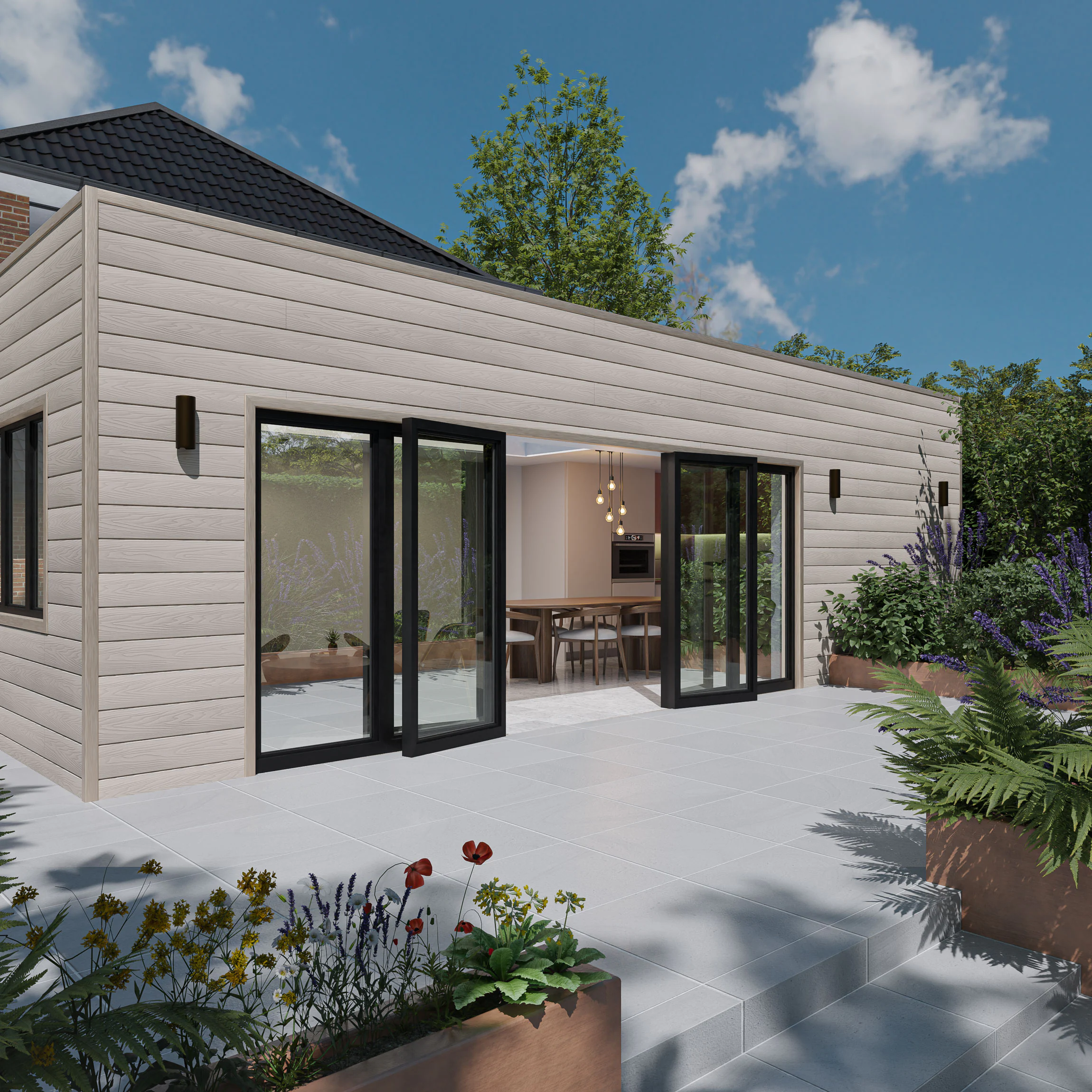
Colour options range from natural wood tones such as oak and walnut to contemporary grey, charcoal, and anthracite finishes. Surface textures include embossed woodgrain and smooth matt profiles. Co-extruded outer layers improve stain resistance and colour stability within ΔE 3 tolerance thresholds under moderate UK sunlight exposure.
Performance characteristics include resistance to rainfall between 800–1,400 mm annually, dimensional stability during -5°C to 25°C seasonal variation, corrosion resistance in coastal environments, and compatibility with ventilated cavity systems aligned with BS 5250 moisture management principles. Fire-rated grades achieve Euroclass classifications under BS EN 13501-1 when specified correctly.
Installation requires structural wall preparation, breathable membrane integration, batten subframes at 400–600 mm centres, 25–38 mm ventilation gaps, 3–6 mm per metre expansion allowances, and corrosion-resistant fixings. Ongoing maintenance consists of biannual cleaning and inspection without painting or sealing.
Cost in Britain typically ranges from £45–£120 per square metre for materials and £150–£300 per square metre installed, depending on board profile, fire rating, and installation complexity.
This guide explains composition, types, benefits, disadvantages, lifespan, fire compliance, installation process, maintenance requirements, environmental impact, colour options, cost considerations, and comparison with timber, uPVC, metal, fibre cement, brick, and render systems to support informed specification decisions for British construction projects.
Table of Contents
What Is Composite Cladding?
Composite cladding is an exterior wall covering made from recycled wood fibres and plastic polymers, designed to protect buildings from rain, sunlight, and temperature change while reducing maintenance by more than 50% compared with untreated timber cladding.
Composite cladding belongs to the material category “wood-plastic composite” (WPC). Wood-plastic composite combines small wood particles with melted plastic under heat and pressure to form dense, stable boards used on building façades.
According to University of Sheffield Department of Materials Science and Engineering research published in 2025, advanced wood-plastic composite façade boards demonstrate 30–40% lower water absorption and 18–22% higher flexural strength compared with standard softwood cladding under laboratory moisture cycling tests. Lower absorption reduces swelling and surface cracking in high-rainfall regions across England and Wales.
Composite cladding performs three measurable protection functions:
- Resist water penetration – water absorption remains below 2% mass gain after 24-hour immersion testing
- Reduce ultraviolet degradation – colour variation remains below ΔE 3 after 3,000-hour accelerated UV exposure
- Control thermal movement – dimensional change remains significantly lower than untreated timber during seasonal temperature variation
Composite cladding systems include interlocking façade boards, ventilated cavity battens, corrosion-resistant fixings, and breathable membranes aligned with BS 5250 moisture management guidance.
What Is Composite Cladding Made From?
Composite cladding is made from recycled wood fibres, thermoplastic polymers such as high-density polyethylene, coupling agents, pigments, and ultraviolet stabilisers blended to form a dense, moisture-resistant exterior façade board engineered for structural durability and weather stability.
Recycled Wood Fibres
Recycled wood fibres form approximately 40–60% of composite cladding composition and provide rigidity, surface texture, and compressive strength. Fibre reinforcement increases board density and improves load distribution across external wall elevations in residential and commercial construction.
Thermoplastic Polymers
Thermoplastic polymers such as high-density polyethylene typically represent 30–50% of composite cladding composition and provide moisture resistance, dimensional stability, and impact resilience. Polymer matrices reduce water absorption and limit expansion during seasonal temperature variation.
Coupling Agents
Coupling agents generally account for 1–3% of composite cladding composition and improve adhesion between wood fibres and polymer matrices. Enhanced bonding increases flexural strength and reduces internal separation under mechanical stress.
Pigments and Ultraviolet Stabilisers
Pigments and ultraviolet stabilisers usually represent 1–5% of composite cladding composition and protect against colour fading and photodegradation. Stabilised surfaces maintain consistent appearance during prolonged ultraviolet exposure in temperate British climates.
What Are the Types of Composite Cladding?
Composite cladding types include shiplap wall cladding, composite wall cladding, composite cladding panels, composite panelling, shiplap panels, external shiplap cladding, capped composite cladding, hollow-core boards, solid-core boards, and fire-rated systems, each defined by board profile, structural density, and performance classification.
Composite cladding types vary by installation profile, core structure, outer protective layer, and regulatory performance rating used in residential and commercial façade construction across Britain.
Shiplap Wall Cladding
Shiplap wall cladding features overlapping horizontal boards with a rebated edge profile that improves rainwater runoff and façade ventilation. Shiplap geometry enhances weather resistance and creates defined shadow lines used in garden rooms and exterior elevations.
External Shiplap Cladding
External shiplap cladding applies the same interlocking rebated profile in outdoor wall systems exposed to rainfall and wind-driven moisture. Overlapping board design reduces direct water ingress and improves drainage performance in high-rainfall regions.
Shiplap Panels
Shiplap panels consist of pre-formed interlocking boards manufactured in fixed-width formats for simplified installation. Panel uniformity improves alignment accuracy and reduces fitting time in domestic and light commercial projects.
Composite Wall Cladding
Composite wall cladding refers to vertically or horizontally fixed façade boards manufactured from wood-polymer composite material. Composite wall cladding enhances moisture resistance and dimensional stability compared with untreated timber wall boards.
Composite Cladding Panels
Composite cladding panels are precision-cut façade boards designed for concealed fixing systems. Panel configuration improves structural load distribution and supports ventilated cavity wall construction aligned with moisture management principles.
Composite Panelling
Composite panelling describes decorative or protective wall coverings manufactured from composite material in modular board formats. Composite panelling improves impact resistance and reduces maintenance frequency in exterior wall applications.
Hollow-Core Composite Cladding
Hollow-core composite cladding contains engineered internal cavities that reduce board weight while maintaining structural performance. Reduced density lowers installation load on subframes and improves handling efficiency.
Solid-Core Composite Cladding
Solid-core composite cladding features a fully dense internal structure without void channels. Increased mass enhances impact resistance and compressive strength in exposed façade areas.
Fire-Rated Composite Cladding
Fire-rated composite cladding incorporates fire-retardant additives to improve reaction-to-fire classification under Euroclass standards. Fire performance compliance supports regulated building requirements within specific development categories.
What are the Pros and Cons of Composite Cladding?
Pros of Composite Wall Cladding?
Composite cladding provides moisture resistance, low maintenance, dimensional stability, colour durability, impact strength, and extended service life, making composite cladding a high-performance external wall system suited to temperate, high-rainfall conditions across Britain.
Moisture Resistance
Composite cladding restricts water absorption to below 2% mass gain during 24-hour immersion testing. Reduced moisture penetration decreases rot formation, fungal growth, and surface swelling compared with untreated timber cladding used on exterior façades.
Low Maintenance
Composite cladding removes the requirement for annual staining, sealing, or repainting. Integrated polymer protection reduces surface cracking and biological degradation. Maintenance frequency decreases by more than 50% across a 20-year service period.
Dimensional Stability
Composite cladding controls expansion and contraction during seasonal temperature variation. Stabilised fibre-polymer structure reduces board warping and edge distortion during freeze–thaw cycles common in northern and inland regions.
Colour Durability
Composite cladding incorporates UV stabilisers and dispersed pigments that maintain consistent surface tone. Accelerated ultraviolet exposure testing records colour variation remaining within ΔE 3 tolerance thresholds under prolonged solar radiation.
Impact Strength
Composite cladding increases flexural strength and surface hardness compared with softwood boards. Reinforced composite structure improves resistance to dents and mechanical stress in exposed wall elevations.
Extended Service Life
Composite cladding maintains structural integrity for 20–25 years under standard environmental exposure. Longer lifespan reduces material replacement frequency and lowers lifecycle cost in residential and commercial construction.
Cons of Composite Wall Cladding
Composite cladding disadvantages include higher initial cost, thermal expansion movement, potential surface scratching, limited structural load-bearing capacity, and colour variation between production batches, which affect installation precision and long-term aesthetic uniformity in external façade applications.
Higher Initial Cost
Composite cladding typically costs 20–40% more per square metre than pressure-treated softwood boards. Higher upfront material pricing increases initial project expenditure despite reduced long-term maintenance costs.
Thermal Expansion
Composite cladding expands and contracts with temperature variation. Linear expansion rates average 3–6 mm per metre under significant seasonal temperature change. Incorrect spacing during installation increases risk of buckling or joint stress.
Surface Scratching
Composite cladding surfaces demonstrate improved durability compared with timber, yet heavy impact or abrasive contact may cause visible scratching. Surface repairs require board replacement rather than sanding.
Limited Load-Bearing Capacity
Composite cladding functions as a non-structural façade covering. Composite boards do not provide primary load-bearing support. Structural framing systems remain necessary behind composite cladding panels.
Batch Colour Variation
Composite cladding production batches may display minor pigment variation. Colour consistency improves when boards from identical batch numbers install on the same elevation.
How Does Composite Cladding Perform in the UK Climate?
Composite cladding performs effectively in the UK climate by limiting water absorption below 2%, controlling thermal expansion during freeze–thaw cycles, resisting salt-air corrosion in coastal regions, and maintaining colour stability under moderate ultraviolet exposure typical across Britain.
Performance in High Rainfall Regions
United Kingdom annual rainfall ranges between 800 mm and 1,400 mm, with western Scotland exceeding 3,000 mm in upland zones according to Met Office climate data. Composite cladding reduces moisture penetration and restricts fungal decay compared with untreated timber boards. Lower absorption limits swelling and surface distortion in persistently damp environments.
Performance During Freeze–Thaw Cycles
Winter temperatures in inland and northern regions regularly fluctuate between -5°C and 10°C. Composite cladding controls expansion and contraction through stabilised fibre–polymer composition. Reduced dimensional movement decreases joint stress and edge warping during repeated freeze–thaw exposure.
Performance in Coastal Conditions
Coastal façades experience wind-driven rain and salt-laden air. Polymer matrices resist corrosion and surface degradation. Composite cladding maintains structural integrity without oxidation, unlike exposed steel or untreated timber components.
Performance Under Moderate UV Exposure
Southern Britain records approximately 1,400–1,600 annual sunlight hours based on Met Office solar radiation averages. Integrated ultraviolet stabilisers reduce photodegradation and limit colour shift within ΔE 3 tolerance thresholds during extended sunlight exposure.
Is Composite Cladding Fire Resistant and Building Regulation Compliant?
Composite cladding is available in fire-retardant grades that achieve Euroclass reaction-to-fire classifications such as B-s1,d0 or C-s3,d2 under BS EN 13501-1, enabling composite cladding systems to comply with relevant sections of UK Building Regulations when correctly specified and installed.
Reaction-to-Fire Classification
Euroclass ratings measure combustibility, smoke production, and flaming droplets.
- Class B-s1,d0 indicates limited combustibility with low smoke emission and no flaming droplets.
- Class C-s3,d2 indicates combustible performance with higher smoke output.
Composite cladding fire performance depends on polymer formulation and fire-retardant additive content. Standard-grade boards typically achieve lower classifications than fire-enhanced systems.
Compliance with UK Building Regulations
Approved Document B of the Building Regulations sets fire safety requirements for external wall systems in England, with parallel guidance in Scotland and Wales. Buildings above 18 metres in height require materials achieving minimum A2-s1,d0 classification in many residential categories.
Composite cladding products used on low-rise dwellings, garden rooms, and outbuildings may comply when installed within permitted development parameters and supported by tested certification.
Installation and System Compliance
Fire performance depends on full system specification, including insulation type, cavity barriers, fixings, and subframe materials. Cavity barriers and fire stops reduce flame spread within ventilated façade systems. Compliance requires documented test certification from accredited laboratories.
How Long Does Composite Cladding Last?
Composite cladding lasts 20–30 years in typical UK climate conditions, maintaining structural stability, surface durability, and moisture resistance throughout repeated rainfall exposure, seasonal temperature variation, and moderate ultraviolet radiation levels.
Expected Service Life
Composite cladding lifespan exceeds untreated softwood cladding by approximately 10–15 years. Untreated timber averages 10–15 years without intensive maintenance, whereas composite boards retain functional integrity for two to three decades under standard residential use.
Resistance to Moisture and Decay
Composite cladding restricts water absorption to below 2% mass gain during 24-hour immersion testing. Reduced absorption decreases rot formation and fungal decay in high-rainfall regions where annual precipitation ranges between 800 mm and 1,400 mm.
Stability During Temperature Variation
Seasonal temperature fluctuation between -5°C and 25°C causes expansion and contraction in exterior materials. Composite cladding controls dimensional movement through stabilised fibre–polymer composition, reducing warping and joint stress during freeze–thaw cycles.
Surface Durability and Colour Retention
Integrated pigments and ultraviolet stabilisers maintain surface tone within ΔE 3 tolerance thresholds during prolonged sunlight exposure. Minor initial colour stabilisation occurs within the first 3–6 months, followed by long-term tonal consistency.
How Is Composite Cladding Installed?
Composite cladding installs onto a structurally sound external wall using a ventilated batten subframe, breathable membrane, corrosion-resistant fixings, calibrated expansion gaps, and perimeter trims to ensure moisture control, dimensional stability, drainage performance, and regulatory compliance in UK façade systems.
Inspect and Prepare the Substrate
Substrate preparation includes structural assessment, moisture evaluation, and surface levelling. Masonry, timber frame, or blockwork walls require dry, stable, and load-bearing surfaces before installation. Uneven substrates affect board alignment and ventilation consistency.
Install a Breather Membrane
Breather membrane installation creates a secondary moisture barrier behind composite cladding. Membrane placement aligns with BS 5250 condensation management guidance. Overlapped joints and sealed penetrations prevent water ingress while allowing vapour permeability.
Fix Vertical or Horizontal Battens
Batten installation forms the ventilated cavity system. Treated timber battens or aluminium rails typically install at 400–600 mm centres depending on board thickness and wind load exposure. Ventilated cavities generally maintain a 25–38 mm airflow gap to promote drainage and evaporation.
Install Cavity Barriers Where Required
Cavity barrier installation supports fire compartmentation within ventilated façades. Horizontal and vertical barriers install at floor levels and around openings in accordance with Approved Document B requirements for specific building categories.
Allow for Thermal Expansion
Composite cladding expands approximately 3–6 mm per linear metre under temperature fluctuation. Installation spacing includes perimeter clearance and end-to-end expansion gaps. Fixings remain slightly offset within slot holes to accommodate movement.
Install Starter Profiles
Starter profile installation ensures level alignment for the first composite cladding board. Base clearance from ground level typically maintains 150 mm minimum separation to reduce splashback moisture exposure.
Secure Composite Cladding Boards
Composite cladding boards attach using stainless steel screws or concealed clip systems. Concealed clips maintain uniform board spacing and enable airflow behind panels. Face-fixing applies where structural reinforcement is required.
Fit Edge Trims and Finishing Profiles
Corner trims, edge trims, window reveals, and end caps seal exposed board edges. Trim integration improves weather resistance and maintains visual uniformity across façade elevations.
Maintain Drainage and Ventilation Paths
Drainage gaps remain unobstructed at base and head of the façade. Continuous airflow supports moisture evaporation and reduces condensation accumulation within cavity zones.
How Much Does Composite Cladding Cost in the UK?
Composite cladding costs in the UK typically range from £45 to £120 per square metre for material supply, with full installed façade systems commonly priced between £150 and £300 per square metre depending on board type, fixings, subframe complexity, and regional labour rates.
Material Supply Costs
Composite cladding panel prices vary by profile, core density, surface finish, and protective layers. Standard profiles such as shiplap and square-edge composite panelling generally cost from £45 to £80 per square metre. Higher-performance or fire-rated composite cladding panels typically cost between £80 and £120 per square metre.
Subframe and Fixings
Support battens, corrosion-resistant fixings, breathable membranes, and trims contribute additional material costs. Subframe systems generally add £15 to £40 per square metre. Quality breathable membranes and trims can increase total material outlay by £10–£25 per square metre.
Installation Labour Costs
Labour rates depend on installer experience, project complexity, and regional wage variation. Labour costs for composite cladding installation typically range from £80 to £140 per square metre. Complex façades with multiple corners, reveals, and openings increase labour hours and total installation cost.
Additional Cost Factors
Additional cost influences include access equipment hire, waste removal, scaffolding provision, and specialised fire-rated systems. Scaffolding for two-storey façades can add £8–£15 per square metre. Fire-retardant composite systems and cavity barriers increase material pricing by 10–25%.
Typical Total Installed Cost
Total installed composite cladding systems in the UK commonly range from:
- £150–£200 per square metre for standard composite cladding
- £200–£300 per square metre for premium or fire-rated systems
What Colours and Finishes Are Available in Composite Cladding?
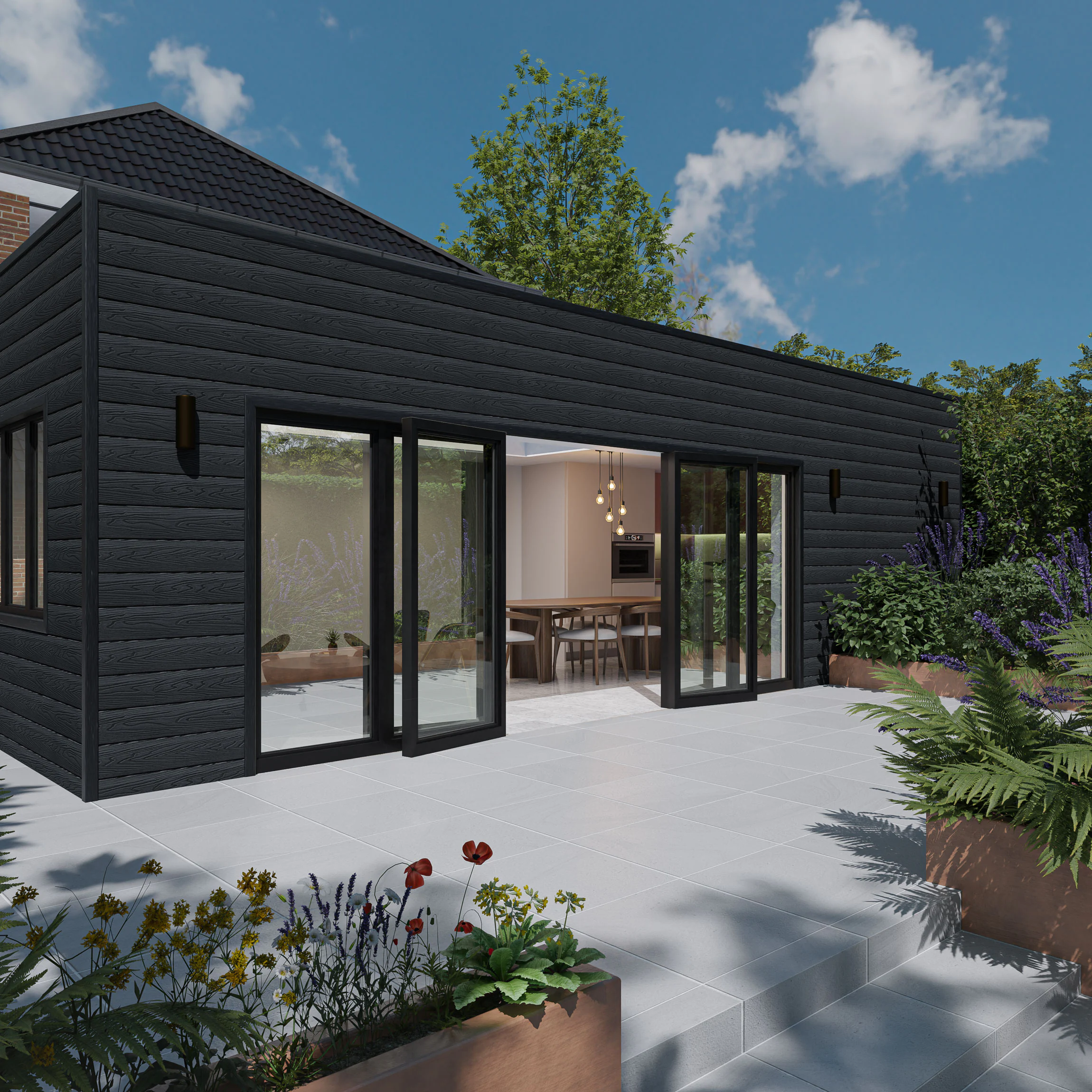
Composite cladding is available in natural wood tones, contemporary grey shades, black and anthracite finishes, textured woodgrain surfaces, smooth matt finishes, and multi-tone composite cladding panels designed for exterior wall applications in British residential and commercial architecture.
Natural Wood Tone Colours
Natural wood tone composite cladding includes oak, teak, walnut, cedar, and redwood shades. Wood-effect pigmentation replicates timber grain appearance while maintaining polymer-based moisture resistance. Wood-tone composite cladding supports traditional and rural façade aesthetics without staining requirements.
Grey, Black, and Anthracite Shades
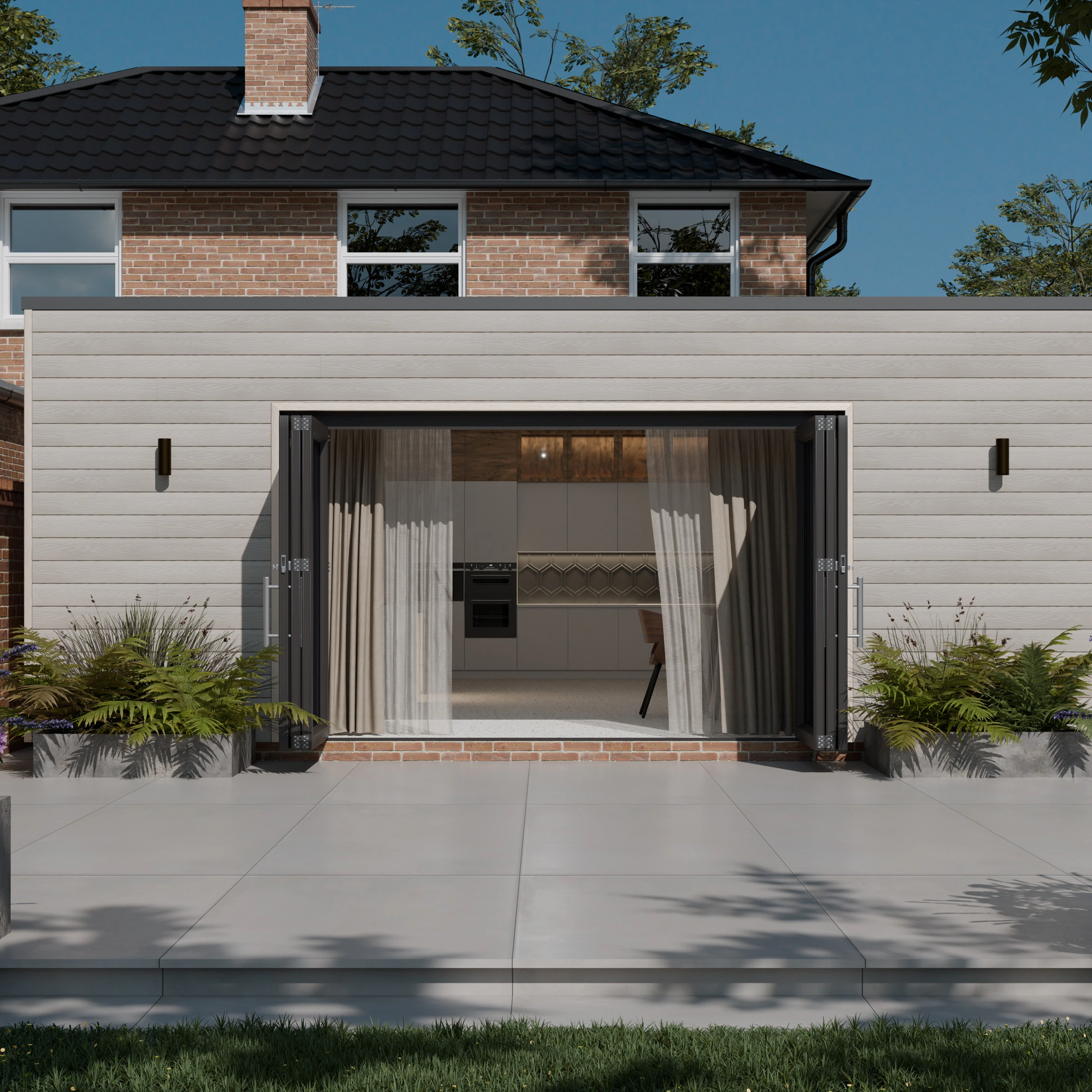
Grey and anthracite composite cladding colours include light grey, slate grey, charcoal, and deep black finishes. Neutral monochrome palettes align with modern architectural elevations and complement brick, render, and stone façades common across England, Scotland, and Wales.
Textured Woodgrain Finishes
Textured woodgrain composite cladding features embossed surface patterns that simulate natural timber grain depth. Surface texture increases tactile definition and reduces visible surface marks compared with flat boards.
Smooth Matt Finishes
Smooth matt composite cladding provides uniform colour distribution with low surface reflectivity. Matt finish surfaces reduce glare under direct sunlight and maintain consistent tone across horizontal and vertical elevations.
Multi-Tone and Co-Extruded Finishes
Multi-tone composite cladding panels integrate layered colour pigmentation within the board surface. Co-extruded outer layers enhance stain resistance and improve surface durability. Colour variation between boards remains controlled within industry manufacturing tolerances.
Is Composite Cladding Environmentally Friendly?
Composite cladding is environmentally friendly when manufactured using recycled wood fibres and recycled polymers, reducing landfill waste, lowering virgin timber demand, and extending service life to 20–30 years, which decreases replacement frequency and lifecycle material consumption.
Use of Recycled Materials
Composite cladding commonly contains 40–60% recycled wood fibres and 30–50% recycled thermoplastic polymers. Recycled content reduces pressure on forestry resources and diverts plastic waste from landfill streams within UK waste management systems.
Reduced Timber Harvesting
Composite cladding decreases reliance on slow-growing hardwood species used in exterior façades. Lower virgin timber demand supports sustainable forestry management practices regulated under UK and European timber standards.
Extended Service Life
Composite cladding lifespan averages 20–30 years under typical British climate exposure. Longer durability reduces material replacement cycles compared with untreated softwood cladding lasting 10–15 years without intensive maintenance.
Lower Maintenance Impact
Composite cladding eliminates annual painting, staining, and chemical treatment. Reduced maintenance lowers solvent emissions and decreases use of protective coatings that contribute to volatile organic compound release.
End-of-Life Considerations
Composite cladding recycling remains limited compared with single-material timber or metal systems. Some manufacturers operate closed-loop recycling schemes that reprocess offcuts and returned boards into new composite products.
Where Can Composite Cladding Be Used?
Composite cladding can be used on residential façades, garden rooms, commercial buildings, outbuildings, balconies, dormers, feature walls, and renovation projects where moisture resistance, dimensional stability, and low maintenance exterior performance are required in British climate conditions.
Residential External Walls
Composite cladding installs on house extensions, new-build façades, and retrofit wall upgrades. Weather-resistant board composition supports performance in regions with 800–1,400 mm average annual rainfall.
Garden Rooms and Outbuildings
Composite cladding covers garden offices, sheds, and leisure structures. Moisture-resistant properties reduce rot risk in timber-framed garden constructions exposed to direct rainfall and ground-level splashback.
Commercial and Retail Units
Composite cladding applies to shopfront elevations, office exteriors, and hospitality premises. Durable surfaces resist impact and reduce maintenance disruption in high-footfall environments.
Balconies and Dormer Conversions
Composite cladding panels install on balcony surrounds and dormer walls. Lightweight hollow-core boards reduce structural load on roof extensions while maintaining façade durability.
Feature Walls and Architectural Accents
Composite cladding creates external feature panels and contrasting façade sections. Shiplap wall cladding and composite panelling enhance visual depth in contemporary architectural design.
Renovation and Over-Cladding Projects
Composite cladding installs over existing masonry or timber substrates using ventilated batten systems. Over-cladding improves thermal envelope protection and modernises outdated exterior finishes.
How Does Composite Cladding Compare to Other Cladding Materials?
Composite cladding provides lower maintenance than timber, higher moisture resistance than untreated softwood, corrosion resistance compared with steel, and improved dimensional stability compared with uPVC, offering a balanced external façade solution for wet and temperature-variable British conditions.
Compared with Timber Cladding
Timber cladding absorbs high levels of moisture during prolonged rainfall. Increased moisture absorption accelerates rot formation and fungal decay. Untreated timber typically lasts 10–15 years without intensive maintenance. Composite cladding restricts water absorption below 2% mass gain and achieves 20–30 years of service life under standard UK exposure.
Compared with uPVC Cladding
uPVC cladding demonstrates higher thermal expansion during seasonal temperature fluctuation. Excessive expansion increases joint movement. Composite cladding maintains greater structural rigidity and improved impact resistance due to fibre reinforcement. Textured woodgrain finishes provide enhanced surface realism compared with smooth plastic panels.
Compared with Metal Cladding
Metal cladding systems such as galvanised steel and aluminium achieve high structural strength and non-combustibility ratings. Coastal exposure increases corrosion risk without protective coatings. Composite cladding resists rust formation and maintains colour stability without galvanisation requirements.
Compared with Fibre Cement Cladding
Fibre cement panels offer strong fire performance classifications and high compressive strength. Panel weight increases subframe loading and installation complexity. Composite cladding weighs less, simplifies cutting and fixing processes, and reduces installation time.
Compared with Brick and Render
Brick and render façades provide high compressive durability and long structural lifespan. Construction requires extended curing periods and greater foundation support. Composite cladding installs using ventilated cavity systems, enabling faster retrofit application and improved moisture drainage behind the elevation.
What Maintenance Does Composite Cladding Require?
Composite cladding requires periodic cleaning, inspection of fixings and expansion gaps, removal of organic debris, and avoidance of abrasive tools, with no requirement for painting, staining, or sealing throughout a typical 20–30 year service life.
Routine Cleaning
Composite cladding benefits from washing two times per year using warm water and mild detergent. Soft-bristle brushes remove surface dirt, algae, and airborne pollutants. Pressure washing above 1,500 psi risks surface damage and remains unsuitable for close-range application.
Removal of Organic Debris
Leaves, moss, and soil accumulation retain surface moisture. Debris removal reduces staining risk and limits biological growth in shaded or north-facing elevations. Ground clearance of at least 150 mm reduces splashback contamination.
Inspection of Fixings and Expansion Gaps
Composite cladding expands 3–6 mm per linear metre during temperature variation. Annual inspection confirms adequate spacing at board ends and perimeter edges. Corrosion-resistant fixings require visual inspection to ensure structural stability.
Surface Stain Management
Oil, grease, and organic stains require prompt cleaning with non-solvent household detergents. Abrasive pads and metal brushes scratch protective surfaces and remain unsuitable for use on composite boards.
No Coating or Sealing Requirements
Composite cladding does not require painting, varnishing, or annual sealing. Integrated pigments and ultraviolet stabilisers maintain surface tone within industry tolerance thresholds under moderate British sunlight exposure.
What Problems Can Occur with Composite Cladding?
Composite cladding problems include thermal expansion movement, surface scratching, colour variation between batches, mould growth in persistently damp areas, improper ventilation issues, and fire classification limitations in certain building categories.
Thermal Expansion Movement
Composite boards expand approximately 3–6 mm per linear metre during seasonal temperature fluctuation. Inadequate expansion gaps at board ends increase risk of buckling, joint stress, and visible distortion.
Surface Scratching and Impact Marks
Surface hardness exceeds untreated timber; however, heavy impact or abrasive contact causes visible scratches. Surface repair typically requires board replacement rather than sanding or refinishing.
Colour Variation Between Production Batches
Minor pigment variation occurs between manufacturing batches. Mixed-batch installation on a single elevation increases tonal inconsistency. Batch number alignment reduces visible variation.
Mould and Algae Growth
High humidity and shaded elevations encourage organic surface growth. Moisture retention from debris accumulation increases staining risk. Routine cleaning reduces biological surface contamination.
Ventilation and Moisture Trapping
Improper batten spacing or blocked cavity airflow reduces drainage efficiency. Insufficient ventilation increases condensation accumulation behind façade systems.
Fire Classification Limitations
Standard-grade composite boards may not achieve A2-s1,d0 classification required for certain high-rise residential categories. Fire-rated variants remain necessary for regulated building types.
What Should Be Considered Before Buying Composite Cladding?
Before buying composite cladding, consider material composition and recycled content, board profile and finish, fire performance classification, thermal expansion allowance, installation system requirements, total installed cost, and long-term maintenance expectations within United Kingdom building environments.
Material Composition and Recycled Content
Assess the proportion of recycled wood fibres and thermoplastic polymers. Higher wood-fibre percentages increase surface texture realism, while greater polymer content enhances moisture resistance. Recycled-content levels influence environmental performance and lifecycle impact.
Board Profile and Finish
Choose board profiles such as shiplap panels, square-edged cladding, or composite panelling based on aesthetic objectives. Natural wood tones, greys, anthracite finishes, textured grain, and smooth matt surfaces determine visual integration with surrounding architecture.
Fire Performance Classification
Verify reaction-to-fire classification under BS EN 13501-1. Buildings above 18 metres in height often require boards achieving A2-s1,d0 or equivalent specification. Fire-rated systems and cavity barriers may be necessary for compliance.
Thermal Movement Allowance
Thermal expansion rates typically range between 3–6 mm per linear metre during seasonal fluctuation. Confirm expansion gap requirements and fixing system compatibility to prevent buckling or joint stress.
Installation System Requirements
Determine subframe batten spacing, breathable membrane compatibility, and corrosion-resistant fixings. Ventilated cavity systems support moisture drainage and condensation control aligned with BS 5250 guidance.
Total Installed Cost
Evaluate material supply costs, subframe and fixings, labour rates, and access equipment hire. Budget allowances for specialised trims, site waste disposal, and any fire-rated components influence overall expenditure.
Maintenance Expectations
Understand minimal routine maintenance obligations such as biannual cleaning, debris removal, and inspection of fixings and expansion gaps. No annual painting, staining, or sealing remains necessary.
Final Thoughts
Composite cladding provides a durable, low-maintenance exterior solution suited to British climate conditions, offering 20–30 years of service life with strong resistance to moisture, temperature fluctuation, and ultraviolet exposure. When correctly specified for fire classification, ventilation, and thermal expansion, it delivers reliable long-term façade performance for residential and commercial projects. Although initial costs exceed untreated timber, reduced maintenance, extended lifespan, and consistent appearance make composite cladding a practical, lifecycle-efficient investment.
