
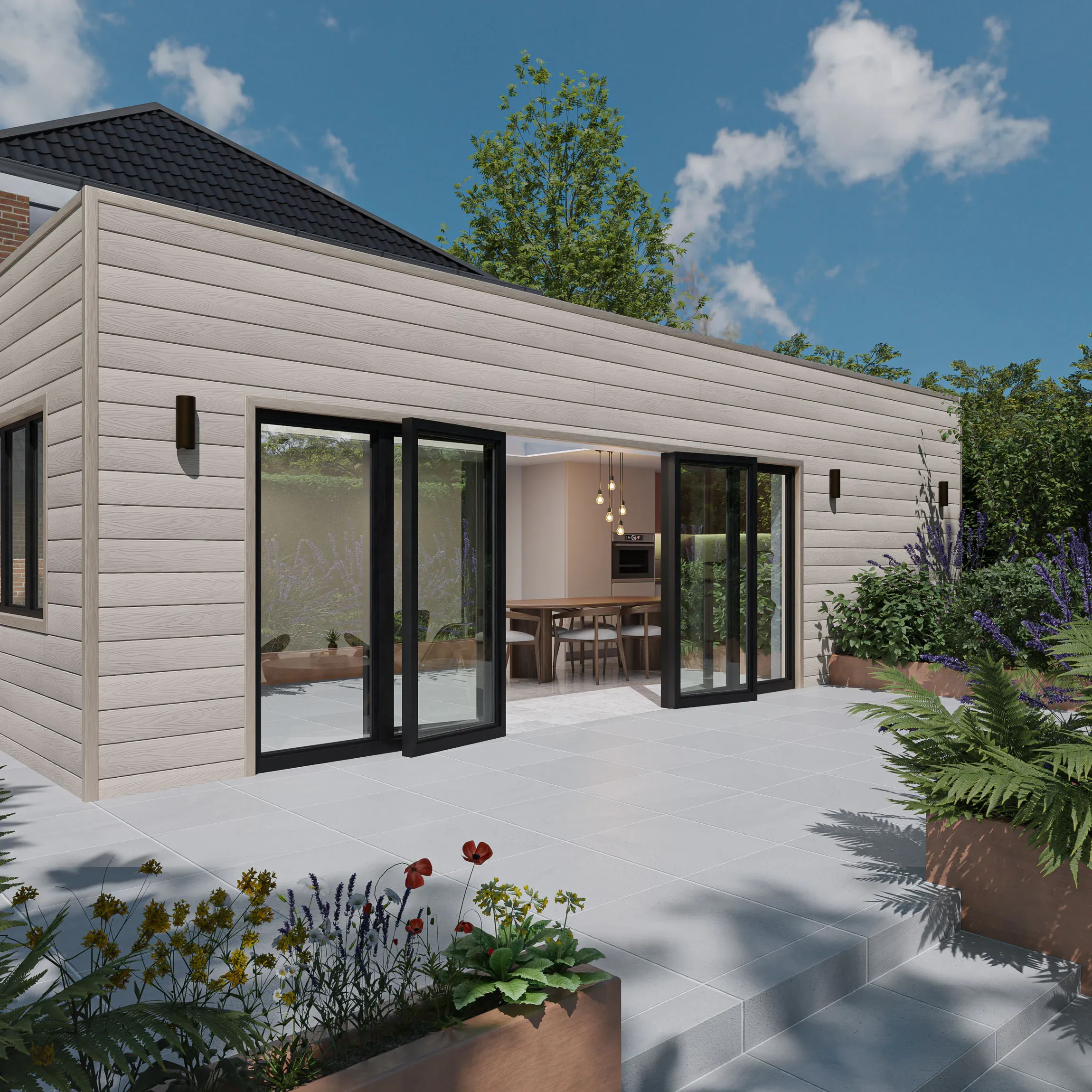
If you’re a UK homeowner or builder looking to upgrade your exterior with something that’s both durable and stylish, composite cladding could be the ideal solution. Made from a blend of recycled wood fibres and plastics, it delivers long-lasting, weather-resistant performance with very little maintenance, making it perfect for the unpredictable British climate. In this guide from Walls and Floors, we’ll cover the essentials, share practical installation advice, and explain why composite cladding is a smart investment for modern homes.
Table of Contents
What is Composite Cladding?
Composite wall cladding is an engineered external wall covering made from recycled wood fibres and thermoplastic polymers designed to provide enhanced durability, reduced maintenance, and improved moisture resistance compared with natural timber.
Manufacturing involves extrusion under high pressure to create consistent board profiles. Many systems use co-extruded protective caps to increase ultraviolet resistance and stain resistance.
Composite cladding differs from timber in three measurable areas:
- Moisture absorption below 1–2% compared with untreated timber at 8–12%
- Reduced annual maintenance frequency
- Increased dimensional stability under humidity variation
Composite cladding is available in multiple surface finishes including wood-grain textures and smooth contemporary profiles.
What Types of Composite Cladding Are Available in the UK?
The main types of composite cladding in the UK include shiplap, slatted, panel, capped vs. uncapped, and hollow-core vs. solid-core, each offering unique aesthetics, installation ease, and performance features.
When it comes to choosing composite cladding, variety is key. Here’s a breakdown of the main types you’ll find in the UK market, each suited to different aesthetics and applications:
- Shiplap Cladding: Overlapping boards that create a seamless, weather-tight seal. Ideal for traditional or coastal homes, as they handle wind and rain well. Popular in colours like teak or light grey.
- Slatted Cladding: Features gaps between boards for a contemporary, airy look. Great for modern extensions or garden features, offering ventilation while maintaining privacy.
- Panel Cladding: Larger, flat sheets for quick coverage on bigger surfaces. Often used in commercial settings but increasingly popular for residential projects needing a minimalist vibe.
- Capped vs. Uncapped: Capped versions have an extra protective layer for better fade and stain resistance, while uncapped are more budget-friendly but may require slightly more upkeep.
- Hollow-Core vs. Solid-Core: Hollow-core is lighter and easier to handle during installation, whereas solid-core offers superior insulation and strength for high-traffic areas.
At Walls and Floors, we stock a range of these options, including fire-rated varieties that comply with UK standards, ensuring you can find the perfect fit for your project.
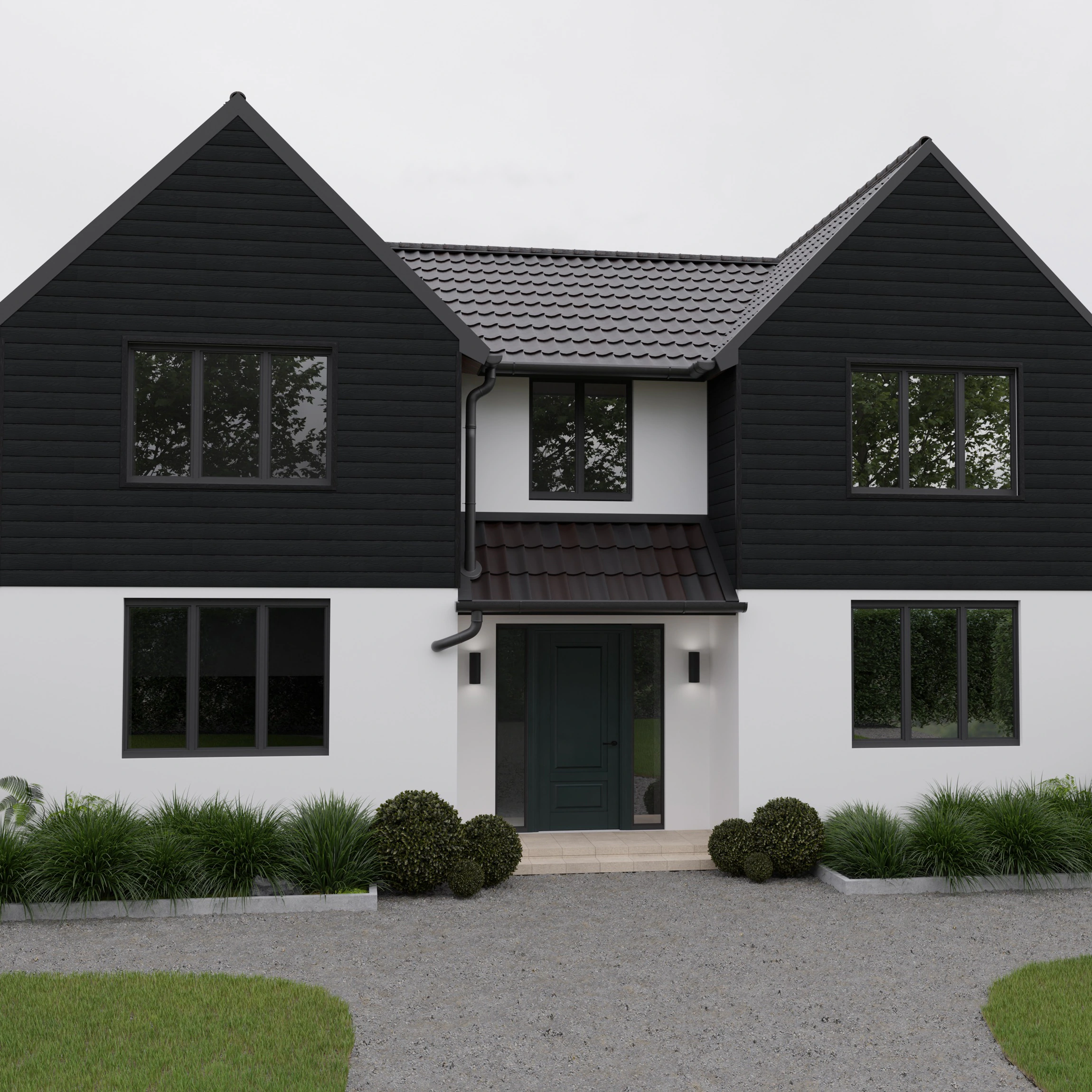
Why Choose Composite Cladding? Key Benefits and Potential Drawbacks
Composite cladding provides increased durability, reduced maintenance, and enhanced weather resistance compared with untreated timber, though higher initial material cost and thermal expansion require correct installation planning.
Benefits:
- Durability and Weather Resistance: It stands up to the UK’s harsh elements without cracking, splintering, or rotting. Many products come with 25-year warranties, outlasting traditional wood by miles.
- Low Maintenance: Forget annual painting or sealing. A quick wash twice a year keeps it looking new, saving you time and money.
- Eco-Friendly: Made from recycled materials, it’s a sustainable choice that reduces waste. Plus, its insulation properties can lower energy bills, aligning with UK green building trends.
- Aesthetic Versatility: From rustic wood effects to bold colours like charcoal or olive green, it enhances curb appeal without the authenticity trade-off.
- Fire Safety: Modern composites often achieve Class B or higher ratings, crucial for UK compliance.
- Cost-Effective Long-Term: While upfront costs are higher, the reduced maintenance and longevity make it cheaper over time compared to wood, which might need replacing every 10-15 years.
Potential Drawbacks:
- Higher upfront cost than basic timber boards
- Thermal expansion of approximately 0.03 mm per metre per °C
- Surface temperature increase in darker finishes during peak sunlight
What Components Are Required for Composite Cladding Installation?
The essential components for composite cladding installation include cladding boards, battens for the subframe, fixings like screws or clips, starter strips, trims, a breathable membrane, and optional insulation or sealants for enhanced performance.
To successfully install composite cladding, you’ll need a selection of key components that ensure a secure, ventilated, and long-lasting finish. These materials work together to create a system that’s not only aesthetically pleasing but also compliant with UK standards. Here’s a detailed list of what’s typically required, based on common practices for UK projects:
- Cladding Boards or Panels: The main stars of the show—these are the composite sheets or planks you choose (e.g., shiplap or slatted). Calculate quantities based on your wall area, adding 10-15% for cuts and waste. Opt for fire-rated ones if needed.
- Battens (Subframe): Vertical supports made from treated timber or recycled plastic, spaced 400-600mm apart. They create a ventilation cavity (at least 38mm) to prevent moisture issues. You’ll need enough to cover the entire area, plus fixings to attach them to the wall.
- Fixings (Screws, Clips, or Nails): Stainless steel or coated screws/clips designed for composites to avoid corrosion. Hidden clips are popular for a seamless look, while screws provide extra security in windy areas.
- Starter Strips or Clips: These go at the base to level and secure the first row of boards, ensuring proper alignment and ground clearance (about 15mm for airflow).
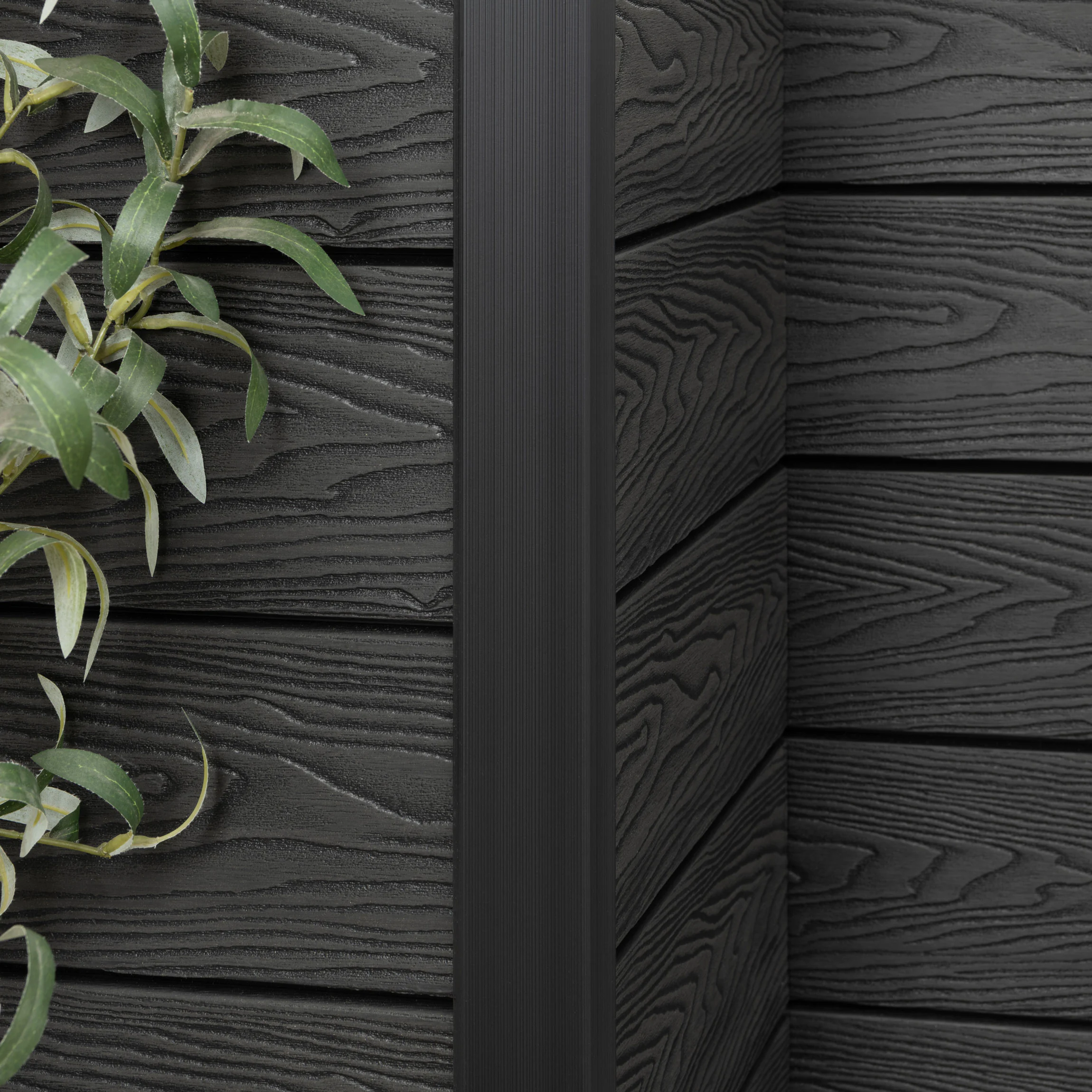
- Trims and Accessories: Corner trims, end caps, L-profiles, and J-channels for neat edges around windows, doors, and corners. They hide gaps and protect against water ingress.
- Breathable Membrane: A vapour-permeable sheet installed behind the battens to allow moisture escape while blocking wind-driven rain.
- Optional Add-Ons: Insulation boards for better energy efficiency, sealants for joints, or flashing for extra weatherproofing in exposed areas. Also, consider expansion strips if your boards are prone to thermal movement.
At Walls and Floors, our composite cladding kits often include many of these components bundled together, making it easier to get everything you need in one go. Always check manufacturer specifications, as some systems require proprietary fixings for warranty validity.
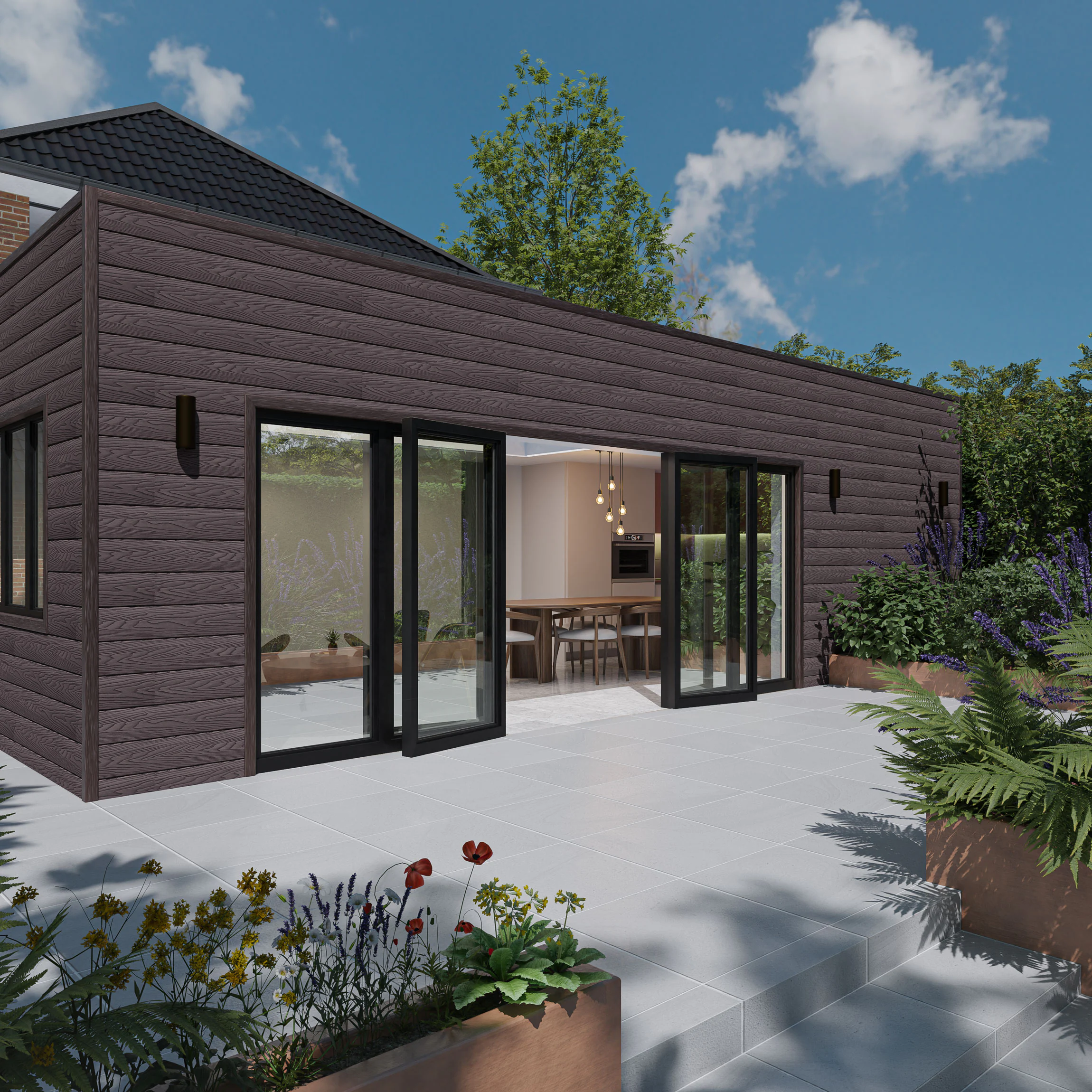
Step-by-Step Guide to Composite Cladding Installation
Composite cladding installation involves preparing the surface, installing a ventilated subframe, fitting boards from the bottom up with expansion gaps, and adding trims for a finished look.
Installing composite cladding can be a rewarding DIY project if you’re handy, but for larger jobs, we recommend professionals to ensure compliance and longevity. Here’s a detailed walkthrough based on standard UK practices.
Preparation Phase
- Assess and Plan: Measure your wall area accurately. Check for any structural issues and ensure the surface is clean, flat, and dry. Acclimatise boards on-site for 24-48 hours (or up to 3 days) to match local humidity.
- Gather Tools and Materials: You’ll need a drill, circular saw, spirit level, tape measure, screws/clips, battens (timber or recycled plastic), starter strips, trims, and safety gear like gloves and goggles.
- Check Regulations: Verify local building regs (more on this below). For UK homes, ensure at least 1m from boundaries if under 11m tall.
Installation Steps
Install Subframe
Fix vertical battens for horizontal board layouts. Maintain 400–600 mm spacing. Secure each batten using minimum three fixings. Ensure 20–25 mm cavity depth.
Install Starter Profiles
Fix base trim horizontally. Maintain 15 mm clearance above ground level.
Install Boards
Fix boards from bottom upward. Maintain:
- 5–8 mm perimeter expansion gaps
- 2–3 mm joint spacing
- Minimum 30 mm screw penetration
United Kingdom seasonal temperature variation from –5°C to 30°C produces linear expansion across 3.6 m boards of approximately 3–4 mm.
Install Trims
Cut trims precisely. Fix at 300–400 mm intervals. Confirm corner alignment before tightening.
Average installation duration ranges between 2–4 days for 100 m² façade.
How to Install Corner and Edge Trims?
Corner and edge trims are fixed after board alignment using stainless steel fixings at 300–400 mm centres while maintaining expansion clearance at junctions.
Measure trim length precisely. Pre-drill pilot holes to prevent splitting. Maintain consistent expansion allowance at internal corners. Ensure flush alignment against the board face.
Trims protect exposed board ends from water ingress and mechanical damage.
What Are the UK Building Regulations You Need to Follow?
Composite cladding installation in the United Kingdom must comply with Approved Document B for fire safety, Approved Document C for moisture resistance, and Approved Document L for energy performance where thermal elements are affected.
Approved Document B governs external wall fire performance. Reaction-to-fire classification follows BS EN 13501-1 Euroclass standards. Buildings above 11 metres in height fall under enhanced façade scrutiny under the Building Safety Act 2022. Materials used in relevant buildings must meet defined combustibility classifications depending on building use and height category.
Approved Document C regulates resistance to moisture penetration. Composite cladding installation must incorporate:
- Minimum 20–25 mm continuous ventilation cavity
- Vapour-permeable breather membrane
- 150 mm minimum clearance above finished ground level
These measures reduce interstitial condensation risk and limit water ingress.
Approved Document L applies where cladding installation alters thermal elements of the external wall. U-value performance of the wall assembly must not worsen following installation. Insulated backing systems may be required to maintain compliance.
Planning permission requirements depend on property type and location. Composite cladding installation generally falls within Permitted Development rights for dwelling houses, provided:
- External appearance change does not materially alter principal elevation facing highway
- Property is not located within conservation area, national park, or listed building designation
- More than 25% of the external façade is not replaced without meeting thermal upgrade obligations
Boundary proximity also influences fire performance requirements. External walls located within 1 metre of a boundary may require higher fire resistance classification.
Composite cladding installation therefore requires assessment of building height, boundary distance, façade percentage alteration, and fire classification before commencement. Regulatory compliance ensures structural safety, moisture control, and lawful installation within the United Kingdom.
Can Composite Cladding Be Installed Vertically and Horizontally?
Composite cladding can be installed vertically and horizontally when the subframe battens are fixed perpendicular to the board direction and a continuous ventilation cavity of minimum 20–25 mm is maintained.
Orientation does not change the structural principle of composite cladding installation. Structural support must always run perpendicular to board alignment to distribute load correctly.
Horizontal composite cladding installation requires vertical battens spaced 400–600 mm centres. This layout promotes efficient water runoff along board length and reduces direct water exposure at board joints.
Vertical composite cladding installation requires horizontal battens or counter-battens. This configuration produces a contemporary linear façade appearance and supports rapid surface drainage during wind-driven rain.
Expansion management remains identical in both orientations. Installation must include:
- 5–8 mm perimeter expansion gaps
- 2–3 mm spacing between board joints
- Minimum 30 mm fixing penetration into battens
Composite boards expand approximately 0.03 mm per linear metre per °C. Seasonal temperature fluctuation in the United Kingdom from –5°C to 30°C generates measurable dimensional movement across longer board lengths.
Ventilation continuity must remain uninterrupted at the base and top of the façade regardless of orientation. Airflow reduces moisture retention and supports compliance with Approved Document C moisture resistance standards.
Composite cladding orientation therefore depends on architectural design preference and drainage strategy rather than structural limitation.
How much does composite cladding cost in the UK?
Composite cladding installation in the United Kingdom costs £20–£80 per m² for materials and £40–£70 per m² for labour, resulting in a total installed cost of £60–£150 per m² depending on specification, façade complexity, and access requirements.
Material cost varies by board specification. Uncapped hollow-core boards typically range from £20–£35 per m². Solid-core or capped boards typically range from £45–£80 per m² due to increased density and surface protection.
Subframe materials add additional cost. Treated timber battens generally range from £5–£10 per linear metre. Aluminium rail systems increase structural precision but raise material expenditure.
Labour cost depends on façade height, scaffold requirement, and detailing complexity. Installation for a 100 m² façade typically requires 3–5 working days. Daily labour rates commonly range between £150–£250 per installer depending on region.
Additional cost factors include:
- Scaffold hire for elevations above single storey
- Window and door detailing complexity
- Fire-rated board specification where required
- Insulation upgrades to meet Approved Document L
For an average 100 m² residential façade, total project cost typically ranges from £6,000–£12,000 including materials, labour, trims, and fixings.
Composite cladding installation reduces long-term repainting expenditure compared with timber systems requiring maintenance cycles every 3–5 years, which influences lifecycle cost assessment rather than initial capital outlay.
Is Professional Installation Recommended?
Professional composite cladding installation reduces structural failure risk, moisture ingress probability, and regulatory non-compliance compared with unverified installation methods.
Composite cladding installation requires correct batten spacing of 400–600 mm centres, expansion gaps of 5–8 mm, and continuous 20–25 mm ventilation cavities. Incorrect spacing or restricted airflow increases board distortion and condensation accumulation. Approved Document B fire compliance and Approved Document C moisture management standards apply to external wall systems in the United Kingdom.
Professional installers follow manufacturer fixing specifications, stainless steel grade requirements, and wind load guidance defined in EN 1991-1-4. Installation aligned with technical guidance preserves material warranty validity and ensures long-term façade performance.
Is composite cladding DIY-friendly?
Composite cladding installation is suitable for competent DIY application on small-scale projects where accurate measurement, controlled batten spacing of 400–600 mm centres, 20–25 mm ventilation cavities, and 5–8 mm expansion gaps are maintained.
Composite cladding installation requires structural substrate inspection, breather membrane placement, perpendicular batten alignment, and stainless steel fixing penetration of minimum 30 mm into the subframe. Incorrect spacing or restricted airflow increases board distortion and condensation accumulation.
Single-storey garden rooms, sheds, and small extensions present lower access complexity compared with multi-storey façades requiring scaffold and regulatory assessment.
Regulatory compliance with Approved Document B and Approved Document C remains mandatory regardless of project scale. Composite cladding installation therefore suits experienced DIY installers with structural awareness and precise spacing control rather than unverified first-time installation attempts.
How Do You Maintain It for the Long Run?
Composite cladding requires biannual cleaning and annual inspection of fixings, joints, and ventilation gaps to achieve a typical service life of 20–30 years under United Kingdom climatic conditions.
Routine maintenance preserves structural stability and surface appearance. Wash composite cladding twice per year using warm water and mild detergent applied with a soft-bristle brush. Rinse with a low-pressure hose. Avoid abrasive pads, solvent-based cleaners, and high-pressure washing above 1,500 psi to prevent surface damage.
Inspect the façade annually for:
- Blocked ventilation gaps at base and top
- Loose stainless steel fixings
- Accumulated debris behind trim junctions
- Sealant deterioration around penetrations
Remove organic debris such as leaves or moss to maintain airflow within the 20–25 mm cavity. Continuous airflow reduces moisture retention and limits biological growth.
Composite cladding does not require painting, staining, or sealing. Co-extruded capped boards demonstrate improved ultraviolet resistance and colour stability compared with untreated timber, which typically requires repainting every 3–5 years.
Surface temperature variation may increase expansion movement during warmer months. Confirm expansion gaps of 5–8 mm at perimeters remain unobstructed during inspection.
Correct cleaning frequency and inspection practice preserve board integrity, maintain structural fixing performance, and support long-term façade durability within United Kingdom environmental exposure conditions.
What Mistakes Should You Avoid?
Common composite cladding installation failures result from insufficient ventilation, incorrect batten spacing, inadequate expansion gaps, incompatible fixings, and poor substrate preparation.
Installation errors reduce structural stability and shorten façade lifespan. The most frequent mistakes are defined below:
- Reduce ventilation cavity below 20 mm
Ventilation cavities measuring less than 20–25 mm restrict airflow and increase condensation risk behind boards. Moisture accumulation accelerates mould formation and timber subframe degradation. - Space battens beyond 600 mm centres
Batten spacing exceeding 600 mm reduces load distribution strength and increases board deflection under wind pressure defined in EN 1991-1-4. - Omit expansion gaps
Composite boards expand approximately 0.03 mm per metre per °C. Failure to maintain 5–8 mm perimeter gaps and 2–3 mm joint spacing leads to buckling during seasonal temperature fluctuation from –5°C to 30°C. - Fix boards directly to masonry
Direct fixing eliminates ventilation cavity depth and prevents moisture evaporation, increasing damp penetration risk. - Use non-stainless or incompatible fixings
Carbon steel screws corrode under UK rainfall exposure averaging 800–1,400 mm annually. Corrosion staining weakens structural grip and affects façade appearance. - Ignore ground clearance requirements
Ground clearance below 150 mm exposes boards to splashback moisture and debris accumulation. - Over-tighten screws
Over-tightening restricts natural thermal movement and causes surface stress around fixing points.
Correct composite cladding installation requires controlled spacing, ventilation continuity, expansion management, and corrosion-resistant mechanical fixing to maintain long-term structural and moisture performance.
How Long Does Composite Wall Cladding Last?
Composite wall cladding typically lasts 25 to 30 years or more, providing a durable, low-maintenance alternative to timber. Properly installed, capped composite boards resist rot, warping, pests, and fading. Warranties usually range from 10–15 years.
Factors affecting lifespan:
- Maintenance: Regular cleaning prevents dirt buildup and preserves appearance.
- Quality: Capped boards last longer than uncapped.
- Environmental Exposure: Extreme UV, high humidity, and coastal conditions may slightly reduce lifespan.
- Installation: Correct fixing, ventilation, and expansion allowance are critical.
Is it completely fireproof?
Composite cladding is not completely fireproof; fire performance depends on its tested Euroclass rating under BS EN 13501-1.
Many composite boards achieve Euroclass B or C classification, which limits flame spread compared with untreated timber. Approved Document B defines required fire performance based on building height, use, and boundary proximity within the United Kingdom.
How does it compare to real wood?
Composite cladding offers lower maintenance, reduced moisture absorption, and greater dimensional stability compared with natural timber cladding, while natural wood provides a traditional appearance and organic surface variation.
Composite boards absorb approximately 1–2% moisture, whereas untreated softwood can absorb 8–12% under prolonged exposure. Reduced moisture uptake limits warping, cracking, and rot formation.
Natural timber requires repainting or sealing every 3–5 years in typical United Kingdom weather conditions. Composite cladding does not require staining or sealing.
Timber develops natural ageing and patina over time. Composite maintains consistent colour and surface finish due to polymer stabilisation and optional capped protection layers.
Structural installation principles, including 400–600 mm batten spacing and 20–25 mm ventilation cavities, apply to both systems.
Wrapping Up
Composite cladding installation is a regulated ventilated façade system that delivers long-term durability, controlled moisture management, reduced maintenance requirements, and structural stability for external walls in the United Kingdom.
Composite cladding installation integrates defined batten spacing of 400–600 mm centres, ventilation cavities of 20–25 mm, perimeter expansion gaps of 5–8 mm, and stainless steel mechanical fixings to manage thermal movement and environmental exposure.
Compliance with Approved Document B fire safety guidance and Approved Document C moisture resistance standards ensures lawful and structurally sound application.
Accurate preparation, correct spacing, expansion control, and routine inspection determine service life expectancy of 20–30 years under UK climatic conditions.
Composite cladding installation therefore represents a technically structured external wall solution based on ventilation continuity, mechanical fixing precision, and regulatory alignment within the United Kingdom built environment.
