
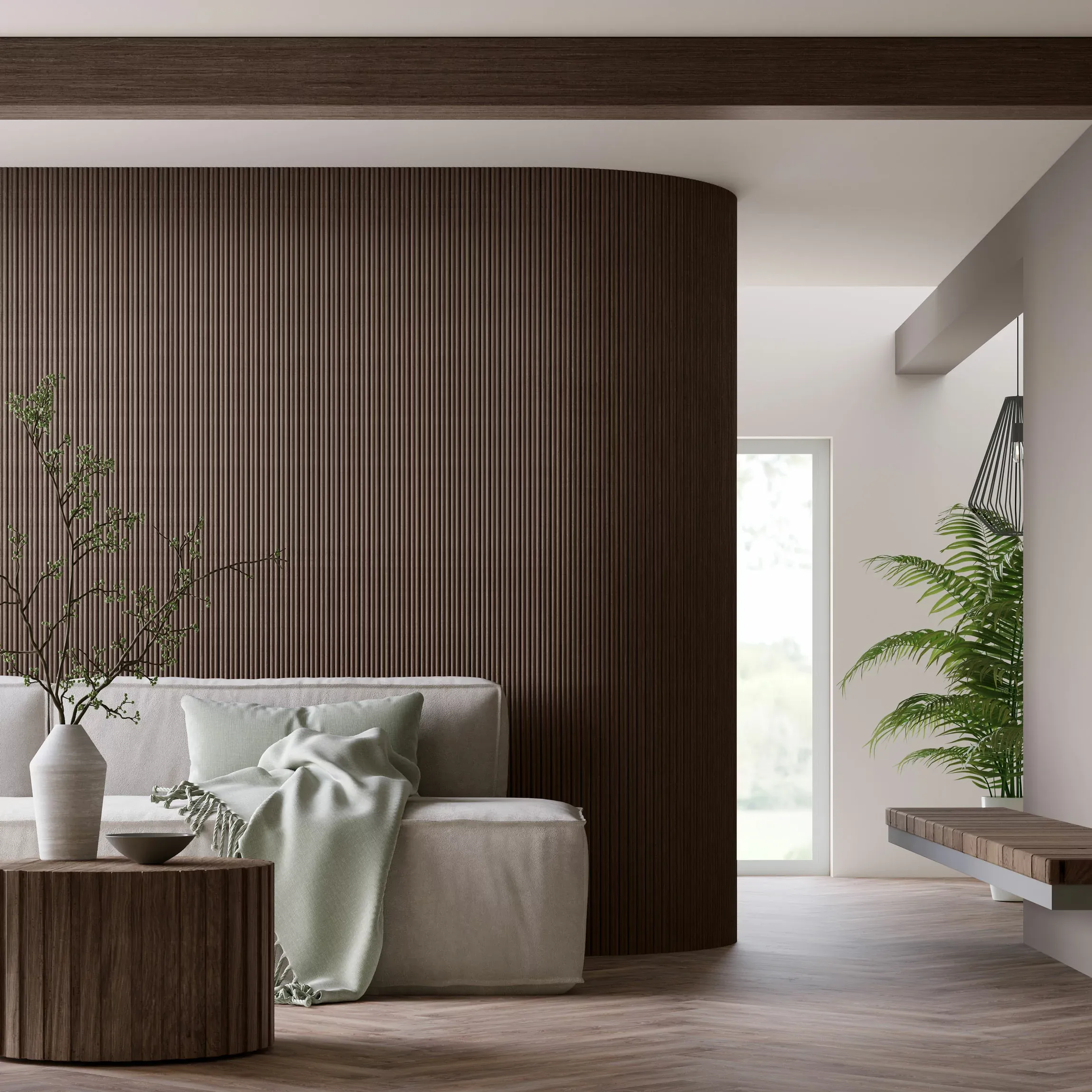
The number of acoustic panels needed ranges from 6 panels for a small room under 10m² to 60 panels for a large room above 60m², depending on room size, ceiling height, room use, and existing surface materials.
Acoustic wall panels absorb sound energy, reduce reverberation time, and stop echoes from bouncing around a room. The total panel count determines whether a room hits its target RT60 — the acoustic comfort measurement defined by British Standard BS 8233:2014.
Getting the panel count right requires 3 key measurements — room volume, target RT60, and existing room absorption. A standard UK living room of 20m² with bare plaster walls and hard flooring needs 12–16 panels rated NRC 0.85 to achieve a comfortable RT60 of 0.4–0.6 seconds.
Room shape, wall panel type, NRC rating, and existing soft furnishings all change the final panel count. Upgrading from NRC 0.65 foam panels to NRC 0.95 fabric-wrapped panels alone reduces total panel count by 30–40%. Carpets, fabric sofas, and heavy curtains contribute 8–15 existing Sabins, reducing the panels required by 4–8 panels.
Table of Contents
What Do Acoustic Wall Panels Do, and Why Does the Number Matter?
Acoustic wall panels absorb sound and stop echoes from bouncing around a room. The number of panels installed determines how much sound gets absorbed — too few panels leave walls reflective, too many make a room sound dead and flat.
What Do Acoustic Wall Panels Actually Do?
Acoustic wall panels work by trapping sound waves inside porous core materials and converting them into heat. The 3 core functions of acoustic wall panels are listed below:
- Sound Absorption: Porous panel materials trap sound waves and turn them into heat, reducing mid-to-high frequency echoes by up to 90%.
- Reverberation Control: Acoustic wall panels shorten RT60 — the time sound takes to decay by 60 decibels — from an untreated room average of 1.5 seconds to a comfortable 0.3–0.6 seconds.
- Noise Reduction: Covering 20–30% of wall surface area with acoustic panels reduces ambient noise levels by 5–10 decibels, per data published by the Acoustical Society of America.
Why Does the Number of Acoustic Panels Matter?
The number of acoustic wall panels determines the total sound absorption area achieved across a room. Installing too few panels leaves hard reflective surfaces untreated, keeping reverberation times above the 0.4–0.8 second recommendation set by British Standard BS 8233:2014.
How Do You Calculate the Number of Acoustic Panels You Need for a Room Step by Step?
Calculating the number of acoustic panels needed requires measuring room volume, identifying the target reverberation time, and dividing the required absorption area by the NRC rating of the chosen wall panel. We recommend following 6 clear steps to get an accurate acoustic panel count for any room.
Step 1: Measure Your Room Volume
Room volume determines the total amount of sound energy a space holds. Multiply room length × width × height to calculate total volume in cubic metres.
- Length × Width × Height: Multiply the 3 room dimensions together — a room measuring 5m × 4m × 2.4m produces a total room volume of 48 cubic metres.
- Larger Room Volume: A higher cubic metre value means more sound energy to absorb, requiring a greater number of acoustic wall panels.
- Irregular Room Shapes: Divide the room into rectangular sections, calculate each section’s volume separately, and add all totals together.
Step 2: Identify Your Target Reverberation Time (RT60)
RT60 is the time sound takes to decay by 60 decibels inside a room. The target RT60 value changes based on how the room is used. The recommended RT60 values by room type are listed below:
- Home Cinema: A target RT60 of 0.3–0.4 seconds produces clear, immersive sound reproduction.
- Home Office or Study: A target RT60 of 0.4–0.6 seconds improves speech clarity and reduces listening fatigue.
- Living Room: A target RT60 of 0.4–0.6 seconds balances natural sound with comfortable acoustic comfort.
- Music Studio or Rehearsal Room: A target RT60 of 0.2–0.4 seconds ensures accurate sound monitoring and recording.
- Restaurant or Café: A target RT60 of 0.6–0.8 seconds maintains a lively yet intelligible acoustic environment.
- Classroom or Conference Room: A target RT60 of 0.4–0.6 seconds meets the speech intelligibility requirements of British Standard BS 8233:2014.
Step 3: Assess Existing Room Absorption
Every surface inside a room already absorbs a small amount of sound. Accounting for existing absorption gives a more accurate panel count. The absorption coefficients of common UK room surfaces are listed below:
- Bare Concrete or Plaster Walls: A low absorption coefficient of 0.02–0.04 makes untreated walls the primary source of sound reflections in a room.
- Carpeted Floors: A mid-range absorption coefficient of 0.30–0.50 means carpeted floors contribute meaningfully to existing room absorption.
- Glazed Windows: An absorption coefficient of 0.10–0.15 makes single-glazed windows moderately reflective surfaces.
- Upholstered Furniture: An absorption coefficient of 0.40–0.60 means sofas and fabric chairs provide measurable natural sound absorption.
- Timber Hardwood Flooring: A low absorption coefficient of 0.05–0.10 makes hardwood floors nearly as reflective as bare plaster walls.
Step 4: Calculate the Required Absorption Area Using the Sabine Formula
The Sabine Formula calculates the total absorption area needed to reach the target RT60. The Sabine Formula is: RT60 = 0.161 × Room Volume ÷ Total Absorption Area (Sabins).
- Total Absorption Requirement: A 48 cubic metre room targeting an RT60 of 0.4 seconds requires a total absorption area of 19.3 Sabins.
- Existing Room Absorption: Subtract the existing Sabin value of all room surfaces from the total requirement to identify the additional absorption needed from acoustic wall panels.
- Additional Panel Absorption Needed: A room with 5 existing Sabins and a target of 19.3 Sabins requires an additional 14.3 Sabins from acoustic wall panels.
Step 5: Divide Required Absorption by Panel NRC Rating
The NRC (Noise Reduction Coefficient) rating of an acoustic wall panel determines how many Sabins each panel contributes. Divide the additional Sabin requirement by the per-panel Sabin contribution to get the exact panel count.
- NRC Rating of 0.85: A panel rated NRC 0.85 with a surface area of 0.5m² contributes 0.43 Sabins per panel.
- Panel Count Calculation: 14.3 Sabins ÷ 0.43 Sabins per panel requires approximately 33 acoustic wall panels.
- Higher NRC Rated Panels: Panels with a higher NRC rating reduce the total number of panels needed to achieve the same RT60 target.
- Lower NRC Rated Panels: Panels with a lower NRC rating increase the total panel count required to reach the target reverberation time.
Step 6: Account for Panel Placement and Coverage Percentage
Panel placement affects acoustic performance as much as panel count. Distributing acoustic wall panels evenly across all 4 walls delivers more consistent absorption than clustering panels on a single wall.
- 20–25% Wall Coverage: A minimum wall coverage of 20–25% is recommended for home offices and living rooms to achieve a noticeable reduction in echo.
- 30–40% Wall Coverage: A higher coverage of 30–40% is recommended for home cinemas and music rehearsal rooms to meet low RT60 targets.
- Ceiling-Mounted Acoustic Panels: Ceiling-mounted panels contribute additional Sabins and reduce the total number of acoustic wall panels required.
- First Reflection Points: Wall areas where sound bounces directly from a sound source to the listener are the highest priority placement zones for acoustic wall panels.

What Percentage of Wall Area Should Acoustic Panels Cover?
Acoustic wall panels should cover 20–40% of total wall surface area, depending on room use and target reverberation time. Rooms with hard flooring and bare plaster walls require coverage closer to 40%, while rooms with carpets and upholstered furniture require coverage as low as 20%.
Recommended Wall Coverage by Room Type
The recommended acoustic panel wall coverage percentages by room type are listed below:
- Home Office or Study: A wall coverage of 20–25% reduces speech reverberation and improves video call clarity.
- Living Room: A wall coverage of 20–30% balances echo reduction with natural room acoustics.
- Home Cinema: A wall coverage of 30–40% achieves the 0.3–0.4 second RT60 target for clear sound reproduction.
- Music Studio or Rehearsal Room: A wall coverage of 35–50% meets the 0.2–0.4 second RT60 required for accurate sound monitoring.
- Restaurant or Café: A wall coverage of 15–25% reduces background noise while maintaining a lively acoustic environment.
- Classroom or Conference Room: A wall coverage of 25–35% meets the speech intelligibility standards of British Standard BS 8233:2014.
How Many Acoustic Panels Do You Need for a Small Room?
A small room requires 8–15 acoustic wall panels to achieve a target RT60 of 0.4–0.6 seconds. Small rooms in the UK typically measure between 10–20 square metres with a ceiling height of 2.4 metres, producing a room volume of 24–48 cubic metres.
Acoustic Panel Requirements for Small Rooms by Use
The recommended acoustic panel counts for small rooms by room type are listed below:
- Small Home Office (10m²): A room volume of 24 cubic metres requires 8–10 acoustic wall panels rated NRC 0.85 to achieve an RT60 of 0.4–0.6 seconds.
- Small Bedroom (12m²): A room volume of 28.8 cubic metres requires 10–12 acoustic wall panels to reduce echo and improve sleep acoustic comfort.
- Small Music Practice Room (15m²): A room volume of 36 cubic metres requires 12–15 acoustic wall panels to achieve the 0.2–0.4 second RT60 target for accurate sound monitoring.
- Small Podcast or Recording Room (10m²): A room volume of 24 cubic metres requires 10–14 acoustic wall panels, with priority placement at first reflection points and the wall behind the speaker.
Key Considerations for Small Room Acoustic Treatment
- Low Ceiling Height: A ceiling height below 2.4 metres increases flutter echo between parallel surfaces, requiring acoustic panels on opposing walls.
- Hard Flooring: Bare hardwood or tile flooring in a small room increases the total panel count required by 3–5 additional panels compared to a carpeted room.
- Corner Bass Traps: Installing bass trap panels in all 4 corners of a small room controls low-frequency build-up that standard acoustic wall panels do not absorb.
How Many Acoustic Panels Do You Need for a Medium Room?
A medium room requires 15–30 acoustic wall panels to achieve a target RT60 of 0.4–0.6 seconds. Medium rooms in the UK typically measure between 20–40 square metres with a ceiling height of 2.4–2.7 metres, producing a room volume of 48–108 cubic metres.
Acoustic Panel Requirements for Medium Rooms by Use
The recommended acoustic panel counts for medium rooms by room type are listed below:
- Medium Living Room (25m²): A room volume of 60 cubic metres requires 15–18 acoustic wall panels rated NRC 0.85 to achieve a comfortable RT60 of 0.4–0.6 seconds.
- Medium Home Cinema (30m²): A room volume of 72 cubic metres requires 20–25 acoustic wall panels to reach the 0.3–0.4 second RT60 target for immersive sound reproduction.
- Medium Conference Room (35m²): A room volume of 84 cubic metres requires 22–28 acoustic wall panels to meet the speech intelligibility standards of British Standard BS 8233:2014.
- Medium Music Studio (40m²): A room volume of 96 cubic metres requires 25–30 acoustic wall panels, with additional ceiling-mounted panels recommended to achieve the 0.2–0.4 second RT60 target.
Key Considerations for Medium Room Acoustic Treatment
- Even Panel Distribution: Distributing acoustic wall panels evenly across all 4 walls delivers 15–20% better reverberation control than placing all panels on a single wall.
- Ceiling Panels: Adding ceiling-mounted acoustic panels to a medium room reduces the total wall panel count required by 5–8 panels.
- Mixed Soft Furnishings: A medium room with carpets, sofas, and curtains already carries 8–12 existing Sabins, reducing the additional panel count needed by 4–6 panels.
How Many Acoustic Panels Do You Need for a Large Room?
A large room requires 30–60 acoustic wall panels to achieve a target RT60 of 0.4–0.8 seconds. Large rooms in the UK typically measure between 40–80 square metres with a ceiling height of 2.7–4 metres, producing a room volume of 108–320 cubic metres.
Acoustic Panel Requirements for Large Rooms by Use
The recommended acoustic panel counts for large rooms by room type are listed below:
- Large Open-Plan Living Area (50m²): A room volume of 135 cubic metres requires 30–35 acoustic wall panels rated NRC 0.85 to achieve a comfortable RT60 of 0.4–0.6 seconds.
- Large Home Cinema (60m²): A room volume of 162 cubic metres requires 35–45 acoustic wall panels to achieve the 0.3–0.4 second RT60 target for accurate sound reproduction.
- Large Conference or Training Room (70m²): A room volume of 189 cubic metres requires 40–50 acoustic wall panels to meet the speech clarity requirements of British Standard BS 8233:2014.
- Large Music Rehearsal Room (80m²): A room volume of 216 cubic metres requires 50–60 acoustic wall panels, with ceiling-mounted panels and corner bass traps essential to achieving the 0.2–0.4 second RT60 target.
Key Considerations for Large Room Acoustic Treatment
- Zoned Panel Placement: Dividing a large room into acoustic treatment zones and placing panels at first reflection points in each zone delivers more consistent absorption than uniform wall coverage.
- Ceiling Height Above 3m: A ceiling height above 3 metres increases room volume significantly, adding 8–12 additional acoustic wall panels to the total count required.
- Ceiling-Mounted Panels: Adding ceiling-mounted acoustic panels to a large room reduces total wall panel requirements by 10–15 panels and controls vertical sound reflections.
- Hard Parallel Surfaces: Large rooms with bare concrete walls and hard flooring require wall coverage of 35–50% to control flutter echo between opposing reflective surfaces.

How Many Panels Do You Need for a Home Office?
A home office requires 8–12 acoustic wall panels to achieve a target RT60 of 0.4–0.6 seconds and clear speech intelligibility for calls and focused work. A standard UK home office measuring 3m × 3m × 2.4m has a room volume of 21.6 cubic metres.
Recommended Acoustic Panel Count for a Home Office by Room Size
The recommended acoustic panel counts for home offices by room size are listed below:
- Small Home Office (9m²): A room volume of 21.6 cubic metres requires 8–10 acoustic wall panels rated NRC 0.85 to achieve a comfortable RT60 of 0.4–0.6 seconds.
- Medium Home Office (15m²): A room volume of 36 cubic metres requires 10–12 acoustic wall panels to reduce speech reverberation and improve video call clarity.
- Large Home Office (20m²): A room volume of 48 cubic metres requires 12–16 acoustic wall panels, with priority placement behind the monitor wall and at side reflection points.
Where to Place Acoustic Panels in a Home Office
The 4 priority placement zones for acoustic wall panels in a home office are listed below:
- Wall Behind the Monitor: Placing 2–3 acoustic wall panels directly behind the monitor reduces primary sound reflections during calls and recordings.
- Side Walls at Ear Level: Placing acoustic wall panels at ear height on both side walls controls flutter echo between parallel surfaces.
- Wall Behind the Seating Position: Placing 2 acoustic wall panels on the wall behind the seated position absorbs rear reflections that degrade speech clarity.
- Ceiling Above the Desk: A ceiling-mounted acoustic panel directly above the desk reduces vertical reflections and lowers the total wall panel count required by 2–3 panels.
Key Considerations for Home Office Acoustic Treatment
- Hard Flooring: A home office with hardwood or laminate flooring requires 2–3 additional acoustic wall panels compared to a carpeted office of the same size.
- Large Windows: A home office with floor-to-ceiling glazing requires acoustic panels on all 3 remaining walls to compensate for the low absorption coefficient of 0.10–0.15 on glazed surfaces.
- Built-In Bookshelves: Fully loaded bookshelves contribute an absorption coefficient of 0.25–0.35, reducing the total acoustic panel count required by 2–4 panels.
How Many Panels Do You Need for a Living Room?
A living room requires 10–20 acoustic wall panels to achieve a target RT60 of 0.4–0.6 seconds and a balanced, comfortable acoustic environment. A standard UK living room measuring 5m × 4m × 2.4m has a room volume of 48 cubic metres.
Recommended Acoustic Panel Count for a Living Room by Room Size
The recommended acoustic panel counts for living rooms by room size are listed below:
- Small Living Room (15m²): A room volume of 36 cubic metres requires 10–12 acoustic wall panels rated NRC 0.85 to reduce echo and achieve a comfortable RT60 of 0.5 seconds.
- Medium Living Room (20m²): A room volume of 48 cubic metres requires 12–16 acoustic wall panels to balance echo reduction with natural room acoustics.
- Large Living Room (30m²): A room volume of 72 cubic metres requires 16–20 acoustic wall panels, with ceiling-mounted panels recommended to control vertical sound reflections.
How Existing Furnishings Affect Panel Count in a Living Room
Soft furnishings in a living room already contribute measurable sound absorption, reducing the total acoustic panel count required. The impact of common living room furnishings on panel count is listed below:
- Upholstered Sofa and Armchairs: Fabric sofas and armchairs carry an absorption coefficient of 0.40–0.60, reducing the total panel count required by 3–5 panels.
- Thick Carpet or Rug: A carpeted floor or large area rug carries an absorption coefficient of 0.30–0.50, reducing the total panel count required by 2–4 panels.
- Heavy Curtains or Drapes: Floor-length curtains carry an absorption coefficient of 0.35–0.55, reducing the total panel count required by 2–3 panels.
- Bare Hardwood Flooring and Plaster Walls: A living room with no soft furnishings requires 4–6 additional acoustic wall panels to compensate for the low absorption coefficient of 0.02–0.10 across hard surfaces.

Key Considerations for Living Room Acoustic Treatment
- TV Wall Placement: Placing 2–3 acoustic wall panels on the wall adjacent to the television improves dialogue clarity and reduces high-frequency reflections during viewing.
- Open-Plan Layout: An open-plan living room connected to a kitchen or dining area increases effective room volume, requiring 5–8 additional acoustic wall panels to maintain the target RT60.
- Aesthetic Panel Options: Fabric-wrapped acoustic wall panels are available in custom colours and sizes, allowing acoustic treatment to integrate with living room interior design without compromising performance.
Where Should You Place Acoustic Panels for Maximum Effect?
Acoustic wall panels deliver maximum effect when placed at first reflection points, on parallel opposing walls, and at the primary sound source wall. Placement determines acoustic performance as much as panel count — incorrectly placed panels waste absorption capacity and leave key reflection zones untreated.
Primary Placement Zones for Acoustic Wall Panels
The 5 primary placement zones for acoustic wall panels are listed below:
- First Reflection Points: The wall areas where sound travels directly from the source to the listener after a single bounce are the highest priority zones, absorbing the strongest and most damaging reflections.
- Parallel Opposing Walls: Placing acoustic wall panels on both facing walls breaks the flutter echo that develops between two hard, parallel reflective surfaces.
- Primary Sound Source Wall: Placing 2–4 acoustic wall panels on the wall directly behind the sound source — speaker, television, or instrument — absorbs direct sound energy before it reflects across the room.
- Rear Wall: Placing acoustic wall panels on the rear wall of a room reduces late reflections that blur speech clarity and degrade stereo imaging in home cinema and music listening rooms.
- Ceiling Above the Listening or Working Position: Ceiling-mounted acoustic panels at the central listening or working position control vertical reflections and contribute additional Sabins, reducing total wall panel requirements by 10–15%.
Secondary Placement Zones for Acoustic Wall Panels
The 3 secondary placement zones for acoustic wall panels are listed below:
- Room Corners: Installing bass trap panels in room corners controls low-frequency build-up below 250Hz that standard acoustic wall panels do not absorb effectively.
- Door and Window Surrounds: Placing narrow acoustic wall panels alongside door frames and window reveals reduces reflections from the hard surfaces surrounding low-absorption glazed and solid surfaces.
- Above Dado Rail Height: Mounting acoustic wall panels between dado rail height and ceiling level targets mid-to-high frequency reflections at the most acoustically active zone of a room.
Common Acoustic Panel Placement Mistakes to Avoid
The 4 most common acoustic panel placement mistakes are listed below:
- Clustering All Panels on One Wall: Placing all acoustic wall panels on a single wall leaves 3 untreated reflective surfaces, creating an acoustically imbalanced room with uneven reverberation decay.
- Placing Panels Too Low: Mounting acoustic wall panels below seated ear height reduces absorption effectiveness, as mid-to-high frequency reflections travel at and above ear level.
- Ignoring the Ceiling: Omitting ceiling-mounted acoustic panels in rooms with hard ceilings leaves a primary reflection surface untreated, increasing RT60 by 0.2–0.4 seconds above the target.
- Uneven Panel Distribution: Concentrating acoustic wall panels on adjacent walls rather than opposing walls fails to control flutter echo between parallel hard surfaces.
How Many Acoustic Panels Do You Need to Solve Specific Sound Problems?
The number of acoustic panels needed to solve a specific sound problem ranges from 6 to 50 panels, depending on the problem type, room size, and severity of the acoustic issue. Different sound problems require different panel counts and placement strategies.
Too Much Echo or Reverberation
A room with excessive echo requires acoustic panels covering 25–35% of total wall surface area. A standard UK living room of 20m² needs 12–16 panels rated NRC 0.85 to bring RT60 down from 1.5 seconds to a comfortable 0.4–0.6 seconds.
- Mild Echo (RT60 of 0.8–1.0 seconds): Installing 8–12 acoustic wall panels at first reflection points and on opposing parallel walls reduces reverberation to the 0.4–0.6 second target range.
- Moderate Echo (RT60 of 1.0–1.5 seconds): Installing 15–25 acoustic wall panels across all 4 walls plus ceiling-mounted panels reduces reverberation by 60–70%.
- Severe Echo (RT60 above 1.5 seconds): Installing 30–50 acoustic wall panels with 35–50% wall coverage brings heavily reflective rooms — bare concrete, hard flooring, large windows — within the recommended RT60 range.
Poor Speech Clarity
A room with poor speech clarity requires 10–20 acoustic wall panels focused at first reflection points and the primary speaking wall. Poor speech clarity occurs when RT60 exceeds 0.6 seconds, causing sound reflections to overlap and blur spoken words.
- Home Office or Study: Installing 8–12 acoustic wall panels reduces RT60 to 0.4–0.6 seconds, meeting the speech intelligibility standard of British Standard BS 8233:2014.
- Conference or Meeting Room: Installing 15–20 acoustic wall panels at ear height across all 4 walls improves speech transmission index (STI) scores from poor (below 0.45) to good (above 0.60).
- Classroom: Installing 20–30 acoustic wall panels reduces background noise by 5–8 decibels, improving speech clarity for students seated at distances greater than 3 metres from the teacher.
Noise Bleed Between Rooms
A room with noise bleed requires 20–40 acoustic wall panels combined with acoustic sealing at doors, windows, and wall penetrations. Acoustic wall panels reduce internal reverberation but do not replace structural soundproofing.
- Home Office Noise Bleed: Installing 10–15 acoustic wall panels reduces internal noise levels by 5–8 decibels, lowering the volume of sound transmitted through shared walls.
- Music Room Noise Bleed: Installing 25–40 acoustic wall panels reduces internal SPL (sound pressure level) by 8–12 decibels before sound reaches the shared wall structure.
- Apartment Living Room: Installing 15–20 acoustic wall panels on the shared party wall reduces airborne sound transmission and lowers neighbour noise complaints.
Low-Frequency Bass Build-Up
A room with bass build-up requires 4–8 corner-mounted bass trap panels in addition to standard acoustic wall panels. Bass frequencies below 250Hz accumulate in room corners and are not absorbed by standard acoustic wall panels.
- Small Room Bass Build-Up: Installing 4 bass trap panels — one in each corner — controls low-frequency resonance in rooms below 30m² where bass build-up is most severe.
- Home Cinema Bass Control: Installing 8 bass trap panels across all 4 floor-to-ceiling corners reduces low-frequency modal resonance by 6–10 decibels in dedicated cinema rooms.
- Music Studio Bass Control: Installing bass trap panels in all corners combined with 25–35 acoustic wall panels achieves a flat frequency response below 250Hz for accurate sound monitoring.
How Many Acoustic Panels Do You Need by Room Size?
The number of acoustic panels needed ranges from 6 panels for rooms under 10m² to 60 panels for rooms above 60m². Room size is the primary factor determining acoustic panel count, alongside ceiling height, room use, and existing surface materials.
Acoustic Panel Count by Room Size
The recommended acoustic panel counts by room size are listed below:
- Under 10m² (Room Volume below 24m³): A very small room such as a vocal booth or walk-in wardrobe requires 6–10 acoustic wall panels rated NRC 0.85 to achieve a controlled RT60 of 0.2–0.4 seconds.
- 10–20m² (Room Volume 24–48m³): A small home office, bedroom, or podcast room requires 8–15 acoustic wall panels to achieve a comfortable RT60 of 0.4–0.6 seconds.
- 20–40m² (Room Volume 48–108m³): A medium living room, home cinema, or conference room requires 15–30 acoustic wall panels to reach the target RT60 for the intended room use.
- 40–60m² (Room Volume 108–162m³): A large open-plan living area, music rehearsal room, or training room requires 30–45 acoustic wall panels, with ceiling-mounted panels recommended.
- Above 60m² (Room Volume above 162m³): A very large room such as a hall, restaurant, or commercial office requires 45–60 acoustic wall panels plus ceiling-mounted panels to achieve consistent absorption across the full space.

Does the Shape of the Room Affect How Many Panels You Need?
Yes, room shape directly affects the number of acoustic panels needed. Non-rectangular rooms, rooms with angled walls, and open-plan spaces create complex sound reflection patterns that require additional panels and targeted placement strategies.
How Different Room Shapes Affect Panel Count
The impact of common UK room shapes on acoustic panel requirements are listed below:
- Square Rooms: A square room creates strong flutter echo between all 4 parallel walls, requiring 20–25% more acoustic wall panels than a rectangular room of the same floor area.
- Rectangular Rooms: A standard rectangular room is the most acoustically predictable shape, allowing accurate panel count calculations using the Sabine Formula with no additional correction required.
- L-Shaped Rooms: An L-shaped room creates 2 distinct acoustic zones, each requiring independent panel placement — typically adding 6–10 additional acoustic wall panels compared to a single rectangular room of equivalent total area.
- Rooms with Angled Ceilings or Sloped Walls: Angled surfaces scatter sound unpredictably, requiring acoustic wall panels at a greater number of reflection points and increasing total panel count by 15–25%.
- Open-Plan Rooms: An open-plan space connected to adjacent areas increases effective room volume significantly, requiring 8–15 additional acoustic wall panels to maintain the target RT60 across the full open area.
Key Considerations for Non-Standard Room Shapes
- Curved Walls: Curved walls focus sound energy into specific points in a room, creating acoustic hot spots that require targeted panel placement rather than uniform wall coverage.
- High or Vaulted Ceilings: A ceiling height above 3 metres increases room volume and reverberation time, adding 8–12 acoustic wall panels to the total count and making ceiling-mounted panels essential.
- Alcoves and Recesses: Alcoves and recessed areas trap sound and sustain localised reverberation, requiring 1–2 acoustic wall panels placed inside each recess to control isolated echo build-up.
Does the Type and Size of an Acoustic Panel Change How Many You Need?
Yes, the type and size of an acoustic panel directly changes the total number needed. A larger panel with a higher NRC rating absorbs more sound per unit, reducing the total panel count required to achieve the target RT60.
How Panel Size Affects the Number of Panels Needed
The impact of common acoustic panel sizes on total panel count are listed below:
- Small Panels (0.3m × 0.3m, 0.09m²): Small acoustic wall panels contribute 0.08 Sabins per panel at NRC 0.85, requiring approximately 179 panels to treat a medium room of 20m².
- Standard Panels (0.6m × 0.6m, 0.36m²): Standard acoustic wall panels contribute 0.31 Sabins per panel at NRC 0.85, requiring approximately 45 panels to treat a medium room of 20m².
- Large Panels (1.2m × 0.6m, 0.72m²): Large acoustic wall panels contribute 0.61 Sabins per panel at NRC 0.85, requiring approximately 23 panels to treat a medium room of 20m².
- Extra-Large Panels (1.2m × 1.2m, 1.44m²): Extra-large acoustic wall panels contribute 1.22 Sabins per panel at NRC 0.85, requiring approximately 12 panels to treat a medium room of 20m².
How Panel Type Affects the Number of Panels Needed
The impact of common acoustic panel types on total panel count are listed below:
- Fabric-Wrapped Fiberglass Panels (NRC 0.90–1.00): High-performance fabric-wrapped panels absorb up to 100% of incident sound energy, reducing total panel count by 15–20% compared to standard foam panels.
- Acoustic Foam Panels (NRC 0.50–0.70): Lower NRC rated foam panels require 25–40% more panels than fabric-wrapped fiberglass panels to achieve the same RT60 target.
- Perforated Timber Acoustic Panels (NRC 0.60–0.80): Perforated wood panels offer mid-range absorption performance, requiring 10–20% more panels than fabric-wrapped alternatives to achieve equivalent sound absorption.
- Bass Trap Panels (NRC 0.80–1.00 below 250Hz): Corner-mounted bass trap panels target low frequencies that standard acoustic wall panels do not absorb, and are used alongside — not instead of — standard acoustic wall panels.
How Can You Choose the Right Acoustic Panels for Your Room?
You can choose acoustic panels based on room use, NRC rating, and panel size. A panel rated NRC 0.85–1.00 absorbs more sound per panel, reducing the total number needed.
Choose by Room Use
- Home Office or Study: Fabric-wrapped panels rated NRC 0.85–1.00 deliver the clearest speech quality for calls and focused work.
- Living Room: Decorative fabric-wrapped panels rated NRC 0.75–0.90 balance acoustic performance with interior design.
- Home Cinema: High-density fiberglass panels rated NRC 0.90–1.00 achieve the 0.3–0.4 second RT60 target for clear sound.
- Music Studio: Broadband panels rated NRC 0.85–1.00 combined with corner bass traps deliver accurate, flat sound monitoring.
What Is the Easiest Way to Estimate Your Panel Count?
Cover 25% of total wall surface area with panels rated NRC 0.85. The 3 steps to estimate panel count quickly are listed below:
- Step 1 – Calculate Total Wall Area: Multiply wall perimeter by ceiling height. A 5m × 4m room with a 2.4m ceiling produces a total wall area of 43.2m².
- Step 2 – Apply the 25% Coverage Rule: Multiply total wall area by 0.25. A 43.2m² wall area requires 10.8m² of acoustic panel coverage.
- Step 3 – Divide by Panel Size: Divide required coverage by panel size. A 10.8m² requirement using 0.6m × 0.6m panels requires 30 acoustic wall panels.
What Is the Most Efficient Way to Reduce the Number of Panels Needed?
Choose higher NRC rated panels, add soft furnishings, and install ceiling-mounted panels. The 4 most effective ways to reduce acoustic panel count are listed below:
- Choose Higher NRC Panels: Upgrading from NRC 0.65 foam to NRC 0.95 fabric-wrapped panels reduces total panel count by 30–40%.
- Add Soft Furnishings: Adding a thick carpet, fabric sofa, and heavy curtains contributes 8–15 existing Sabins, reducing panel count by 4–8 panels.
- Install Ceiling Panels: Adding 4–6 ceiling-mounted panels reduces total wall panel requirements by 10–15%.
- Use Larger Panels: Replacing 0.6m × 0.6m panels with 1.2m × 0.6m panels halves the total number of panels needed for the same wall coverage.
What Are the Key Mistakes to Avoid When Calculating Acoustic Panel Quantity?
The biggest mistake is ignoring existing room absorption, which leads to buying 4–8 more panels than needed. The 5 key mistakes to avoid are listed below:
- Ignoring Existing Room Absorption: Failing to account for carpets, sofas, and curtains leads to overbuying by 4–8 panels.
- Using the Wrong NRC Rating: Selecting NRC 0.55 foam panels instead of NRC 0.90 fabric panels increases total panel count by 40%.
- Buying Panels for the Wrong Room Type: Using home cinema panel estimates for a home office over-treats the room, pushing RT60 below 0.3 seconds.
- Placing All Panels on One Wall: Clustering all panels on one wall leaves 3 reflective surfaces untreated, creating persistent flutter echo.
- Forgetting Room Volume: A room with a 3.5m ceiling holds 45% more sound energy than the same floor area with a 2.4m ceiling, requiring significantly more panels.
Where Is the Best Place to Buy Acoustic Wall Panels in the UK?
Walls and Floors is the best place to buy acoustic wall panels in the UK — with a wide range of MDF slat panels starting from £9.99, over 44,000 positive reviews, and quality service since 1987. Panels are available in standard, XL, wide slat, multi-width, curved, and Lite flexible formats, with sizes from 600×600mm up to 3000×600mm to fit every room and ceiling height.
- Largest Acoustic Panel Range: Standard, XL, wide slat, multi-width, curved, and Lite flexible formats cover every room size, ceiling height, and budget from £9.99 to £79.99 per panel.
- Premium Quality Construction: Every panel features durable MDF slat construction with felt backing, delivering 30–50% reverberation reduction in finishes including oak, walnut, ash grey, black, slate effect, and herringbone.
- Free Delivery Over £399: Order panels and accessories together above £399 and get free UK-wide delivery — saving on delivery charges across the full project.
- Over 44,000 Positive Reviews: Thousands of verified UK customers confirm product quality, finish accuracy, and reliable delivery across residential and commercial installations.
- Pay in 3 with PayPal: Split the total cost into 3 interest-free payments at checkout — making larger room installations easy to manage without spending more.
- Quality Service Since 1987: Over 37 years of supplying UK homes and commercial spaces means expert product knowledge, sample availability, and reliable support from start to finish.
