
Tile adhesive is chosen from the tile, the substrate and the location; grout is chosen from the joint width, the environment and the finish you want. Those are two separate decisions, and most guidance covers only one of them. They matter because adhesive and grout are not accessories bought at the end of a tile order: they are part of an installation system alongside the substrate, the preparation and the tile itself, and the system fails at its weakest component.
This guide decodes the classification codes on the bag, walks both decisions in order, and covers the application mistakes that cause otherwise sound specifications to fail.
Table of Contents
Adhesive and Grout as a System
A tiled surface is only as good as the weakest part of the system holding it together. The tile, the substrate, the preparation products, the adhesive, the tile grouts and the movement joints all have to be compatible with each other and appropriate for the conditions.
This matters practically because the most common tiling failures are not caused by poor tiles. They are caused by an adhesive that could not cope with the substrate’s movement, a grout that was wrong for the joint width, or a rigid grout used where a flexible sealant was needed. Buying the adhesive and grout as an afterthought, on price alone, is how a good tile ends up on a floor that cracks within two years.
A useful rule: specify the adhesive and grout at the same time as the tile, not at the checkout. The tile supplier’s own recommendation for a specific product should be the first reference point, since some tiles, particularly natural stone and some large formats, have requirements the general rules do not cover.
Adhesive Classifications Decoded
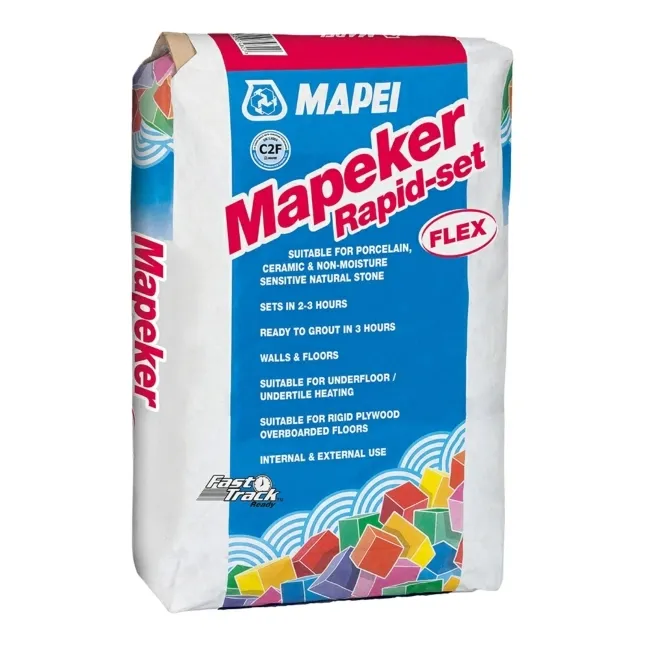
Tile adhesives sold in the UK are classified under EN 12004, and the code on the bag tells you the adhesive type, its performance level and its optional characteristics.
| Code | Meaning |
| C | Cementitious – powder mixed with water, the most common type |
| D | Dispersion – ready-mixed, water-based |
| R | Reaction resin – usually two-part epoxy |
| 1 | Normal performance |
| 2 | Improved performance (higher bond strength) |
| F | Fast setting |
| T | Reduced slip (holds tiles in place on a wall) |
| E | Extended open time (longer before it skins over) |
| S1 | Deformable |
| S2 | Highly deformable |
So a bag marked C2TE is an improved cementitious adhesive with reduced slip and extended open time. A bag marked C2FT S1 is an improved, fast-setting, reduced-slip cementitious adhesive that is also deformable.
S1 vs S2: What the Flexibility Rating Means
Under EN 12004, an S1 adhesive has a deformation of at least 2.5mm but less than 5mm; an S2 adhesive has a deformation of 5mm or more.
| S1 (deformable) | S2 (highly deformable) | |
| Deformation | ≥2.5mm and <5mm | ≥5mm |
| Typical use | Underfloor heating, large-format tiles, wet areas, most domestic floors | Substrates with significant movement: timber, metal, some boards; pools; heavily exposed exteriors |
| Cost | Moderate | Higher |
S1 covers the majority of domestic projects, including underfloor heating. S2 is for genuinely demanding substrates rather than a general upgrade. Flexibility is not a substitute for preparation: an S2 adhesive will not rescue a floor that moves excessively, a loose screed or an unsuitable board.
Choosing an Adhesive: Three Questions
1. What is the tile? Porcelain is dense with very low water absorption, so C2 is a sensible starting point for porcelain floors. Natural stone needs additional care, since pale marble, limestone and translucent stones can be discoloured by the wrong adhesive. Large-format tiles raise the stakes on everything.
2. What is the substrate? Concrete and screed need to be fully cured and level. Plaster must be dry. Timber floors usually move too much for a tiled finish applied directly, and a backer board or uncoupling system is commonly required.
3. Where is it going? Dry interior walls suit a ready-mixed adhesive; floors need a floor-rated cementitious adhesive; underfloor heating needs a flexible adhesive, generally S1 or above; exteriors need a flexible, freeze-thaw-rated adhesive.
Ready-Mixed or Powdered?
| Ready-mixed (dispersion) | Powdered (cementitious) | |
| Preparation | None; open and use | Mixed on site to a stated water ratio |
| Suits | Small to medium ceramic wall tiles in dry areas | Floors, porcelain, large formats, wet areas, exteriors |
| Not suitable for | Floors, heavy or large tiles, prolonged moisture | – |
| Working time | Longer open time typically | Limited by pot life once mixed |
White or Grey Adhesive?
Adhesive colour can show through the tile. Use white adhesive for light-coloured stone, glass and translucent tile. Grey is generally fine and more economical for darker porcelain and ceramic.
Applying Adhesive Properly
Trowel size should match the tile and substrate. Back-butter large-format tiles and natural stone for fuller contact. Never spot-fix floor tiles – dabs leave voids that become weak points under load. Treat coverage figures as a guide, since large-format floors typically need more than the headline figure suggests.
Grout Classifications Decoded
Grouts are classified under EN 13888.
| Code | Meaning |
| CG | Cementitious grout |
| RG | Reaction resin grout (epoxy) |
| CG1 | Normal cementitious grout |
| CG2 | Improved cementitious grout |
| W | Reduced water absorption |
| A | High abrasion resistance |
A grout marked CG2WA is an improved cementitious grout with both reduced water absorption and high abrasion resistance, worth looking for on a bathroom or kitchen floor.
Joint Width: The First Grout Decision
Grout is formulated to work within a stated joint width range, and using one outside its range is a common cause of cracking or slumping. Modern wide-range grouts often cover joints from around 1mm up to 15mm or more, allowing one colour across both walls and floors.
Cementitious vs Epoxy Grout
| Cementitious (CG) | Epoxy (RG) | |
| Water resistance | Good, better in CG2W grades | Excellent |
| Stain and chemical resistance | Moderate | High |
| Ease of use | Forgiving; longer working time | Sets faster; less forgiving; harder to clean off tile faces |
| Cost | Lower | Considerably higher |
| Typical use | Most domestic walls and floors | Wet rooms, commercial kitchens, areas needing chemical or hygiene performance |
For a first-time tiler in an ordinary bathroom, a good CG2WA cementitious grout is usually the better decision. Our comparison of anti-mould grout and epoxy grout (Article 8) covers this trade-off for showers specifically.
Choosing a Grout Colour
Matched grout makes the surface read as one continuous plane; contrasting grout makes the tile shape the feature; a mid-tone is the practical compromise. Our guide to grout colour matching (Article 9) covers this decision tile by tile.
Where Grout Should Not Be Used
Internal corners, the floor-to-wall junction, around baths and worktops, and larger floor perimeters are movement joints, not grout joints, and need a flexible sealant instead.
Estimating Quantities
Grout usage depends on joint width, joint depth, tile size and tile thickness. Use the manufacturer’s coverage calculator rather than a rule of thumb, and order a little more than the calculation suggests.
What Goes Wrong
- Using a ready-mixed wall adhesive on the floor.
- Relying on flexible adhesive to fix a moving substrate.
- Spot-fixing floor tiles.
- Grey adhesive under pale stone.
- Grouting before the adhesive has cured (see Article 7).
- Using grout in a movement joint.
- Grout outside its joint width range.
- Treating tile and grout as waterproofing.
Specifying With Confidence
C2 or above for porcelain, S1 for underfloor heating and most domestic floors, CG2WA for a bathroom or kitchen floor, epoxy where genuine chemical or water performance justifies the extra difficulty. Browse the range of tile adhesive, or see our guide to how to tile a bathroom for the full installation process.
Frequently Asked Questions
What does C2TE mean on a bag of tile adhesive?
C2TE is an improved cementitious adhesive with reduced slip and extended open time. C is cementitious, 2 indicates improved performance, T means reduced slip so tiles hold position on a wall, and E means a longer open time before the adhesive skins over.
What is the difference between S1 and S2 tile adhesive?
S1 adhesives have a deformation of at least 2.5mm but under 5mm; S2 adhesives deform 5mm or more. Neither replaces proper substrate preparation.
Do I need flexible adhesive for underfloor heating?
Yes, generally S1, to accommodate thermal expansion and contraction. Commission the heating before tiling, switch it off while the adhesive and grout cure, then bring it back up to temperature gradually.
What grout should I use in a shower?
A CG2W or CG2WA cementitious grout suits most domestic showers, with epoxy offering higher water and chemical resistance where justified. Internal corners and the floor-to-wall junction need flexible sealant, not grout.
Can I use the same grout on walls and floors?
Yes, provided the grout’s stated joint width range covers both.
Is epoxy grout worth it?
Worth the extra cost where water, stain or chemical resistance genuinely matters. For an ordinary domestic bathroom a good CG2WA cementitious grout is often more practical.
