
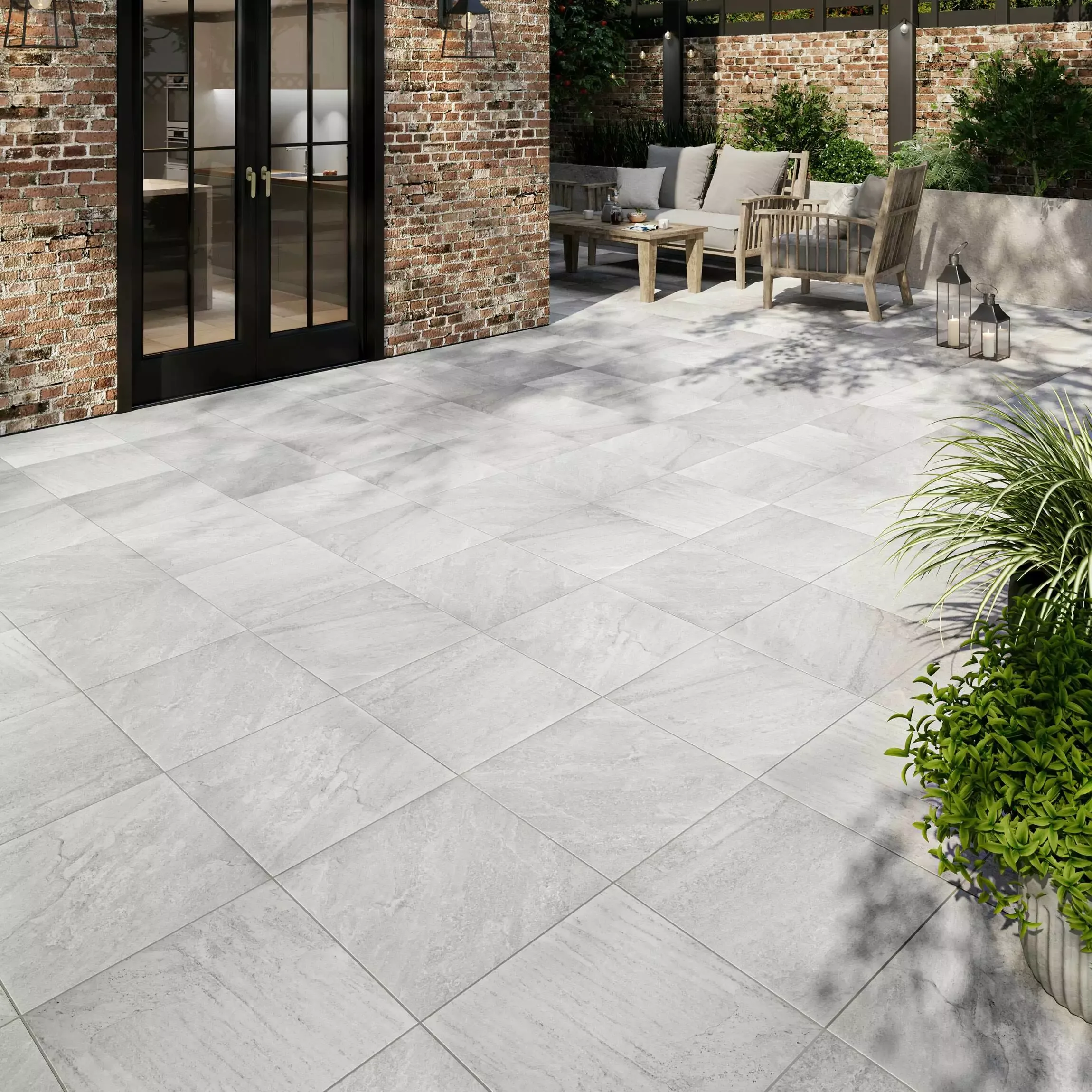
Paving slabs are flat, solid pieces of concrete, natural stone, porcelain, or clay laid on a prepared base to create a hard, long-lasting outdoor surface for patios, driveways, pathways, and gardens across the UK.
Picking the right paving slab saves you money, cuts down maintenance time, and makes your outdoor space last far longer. The 6 main types in the UK are concrete, natural stone, porcelain, clay, block paving, and resin-bound slabs, ranging from £10 per m² for concrete up to £100 per m² for premium granite.
The material you choose decides how long your slabs last and how much upkeep they need. Granite and clay last 75–100 years, porcelain lasts 40–50 years with no sealing ever needed, sandstone and limestone last 25–50 years with sealing every 1–2 years, and concrete lasts 20–30 years with sealing every 2–3 years. Porcelain soaks up less than 0.5% water, making it fully frost proof through UK winters without any treatment. Sandstone soaks up 10–20% water and cracks within 3–5 winters if left unsealed.
Getting the thickness and base right matters just as much as picking the right material. Patios and pathways need a 35mm thick slab, driveways need 50mm, and commercial areas need 63mm. Every paving slab installation needs a compacted MOT Type 1 sub-base at 100–150mm depth topped with a 30–50mm mortar bed. Slabs laid straight onto soil without a proper base fail within 3–7 years.
Paving slabs work across patios, driveways, pathways, pool surrounds, garden steps, courtyards, and public footpaths. Every outdoor paving slab needs a slip resistance rating of PTV 36 and above, which the UK Health and Safety Executive classifies as low slip risk. UK rules require planning permission for front garden paving over 5m² using solid, impermeable slabs, a drainage fall of 1:60, and a PTV of 36 and above for all accessible outdoor areas.
Table of Contents
What Are Paving Slabs?
Paving slabs are flat, solid pieces of concrete, stone, porcelain, or clay placed on the ground to create a firm, stable outdoor surface. They are the square or rectangular slabs you see on garden patios, driveways, and footpaths across the UK.
Paving slabs come in sizes ranging from 300mm × 300mm to 900mm × 600mm, with 450mm × 450mm being the most common size in the UK. A good-quality paving slab lasts 20–50 years with proper care.
What Are The Main Types Of Paving Slabs?
There are 6 main types of paving slabs available in the UK: concrete, natural stone, porcelain, clay, block paving, and resin-bound slabs. Each type differs in material, strength, appearance, and price.
The 6 main types of paving slabs are listed below:
- Concrete Paving Slabs: Made from cement, sand, and aggregate, priced from £10 per m².
- Natural Stone Paving Slabs: Cut from sandstone, limestone, slate, or granite, priced from £25 per m².
- Porcelain Paving Slabs: Baked at 1,200°C for a tough, water-resistant finish, priced from £30 per m².
- Clay Paving Slabs: Made from fired clay with natural colour variation, priced from £20 per m².
- Block Paving Slabs: Interlocking concrete or clay units laid in patterns, priced from £25 per m².
- Resin-Bound Slabs: Aggregate stones bound with clear resin for a permeable, smooth finish, priced from £40 per m².
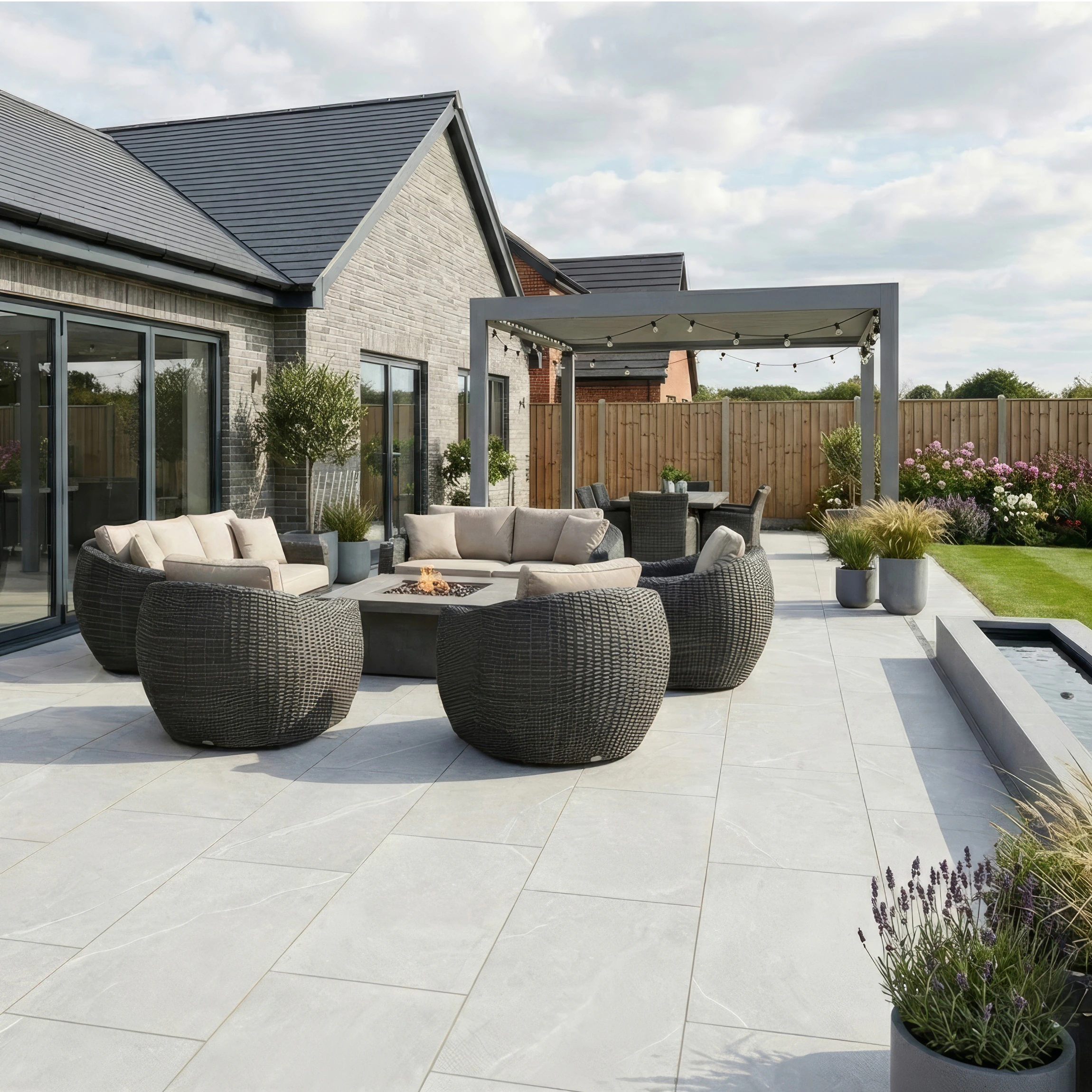
What Are Porcelain Paving Slabs?
Porcelain paving slabs are hard, smooth outdoor tiles baked at 1,200°C to create a tough, waterproof surface that lasts up to 50 years. Porcelain is the strongest paving slab type in the UK, with a compressive strength of over 50 N/mm².
Porcelain paving slabs soak up less than 0.5% water, keeping them frost-resistant through cold UK winters. No sealing is needed, and the colour stays bright for decades. Porcelain paving slabs are available in sizes ranging from 300mm × 300mm to 1200mm × 600mm, priced from £30 per m².
Porcelain paving slabs suit patios, garden terraces, pool surrounds, and low-traffic driveways across UK properties.
What Are Concrete Paving Slabs?
Concrete paving slabs are solid, pressed units made from cement, sand, and stone, and are the most affordable paving slab type in the UK, priced from £10 per m². Concrete paving slabs carry a compressive strength of 25–50 N/mm² and suit driveways, pathways, and patios.
Concrete paving slabs last 20–30 years with a solid sub-base underneath and sealing every 2–3 years. The most popular size across UK homes is 450mm × 450mm, with sizes ranging from 300mm × 300mm to 900mm × 600mm.
Concrete paving slabs are available in a wide range of colours and finishes, including smooth, exposed aggregate, and brushed textures, making them a versatile choice for most UK gardens.
What Are Natural Stone Paving Slabs?
Natural stone paving slabs are cut straight from quarried rock, including sandstone, limestone, slate, and granite, giving each slab a unique, natural look that no man-made material replicates. Natural stone paving slabs are priced from £25 per m² and last 30–50 years depending on stone type and care.
The 4 most common natural stone paving slabs in the UK are listed below:
- Sandstone Paving Slabs: Warm, earthy tones with a textured surface, priced from £25 per m².
- Limestone Paving Slabs: Light grey or cream tones with a smooth, dense finish, priced from £30 per m².
- Slate Paving Slabs: Dark grey tones with a naturally slip-resistant surface, priced from £35 per m².
- Granite Paving Slabs: The hardest natural stone with a compressive strength of 130–240 N/mm², priced from £40 per m².
Natural stone paving slabs need sealing every 1–2 years to stay protected against water, stains, and frost across the UK climate.
What Are Clay Paving Slabs?
Clay paving slabs are fired clay units that deliver a naturally textured, slip-resistant surface with rich, earthy tones that deepen with age. Clay paving slabs carry a compressive strength of 40–70 N/mm² and last up to 100 years, making them the longest-lasting paving slab type in the UK.
Clay paving slabs absorb 3–6% water and perform well in the wet UK climate without cracking or fading. Clay paving slabs are priced from £20 per m² and are available in sizes ranging from 200mm × 100mm to 450mm × 450mm.
Clay paving slabs suit traditional UK garden styles, courtyards, and period properties where a natural, aged appearance is preferred.
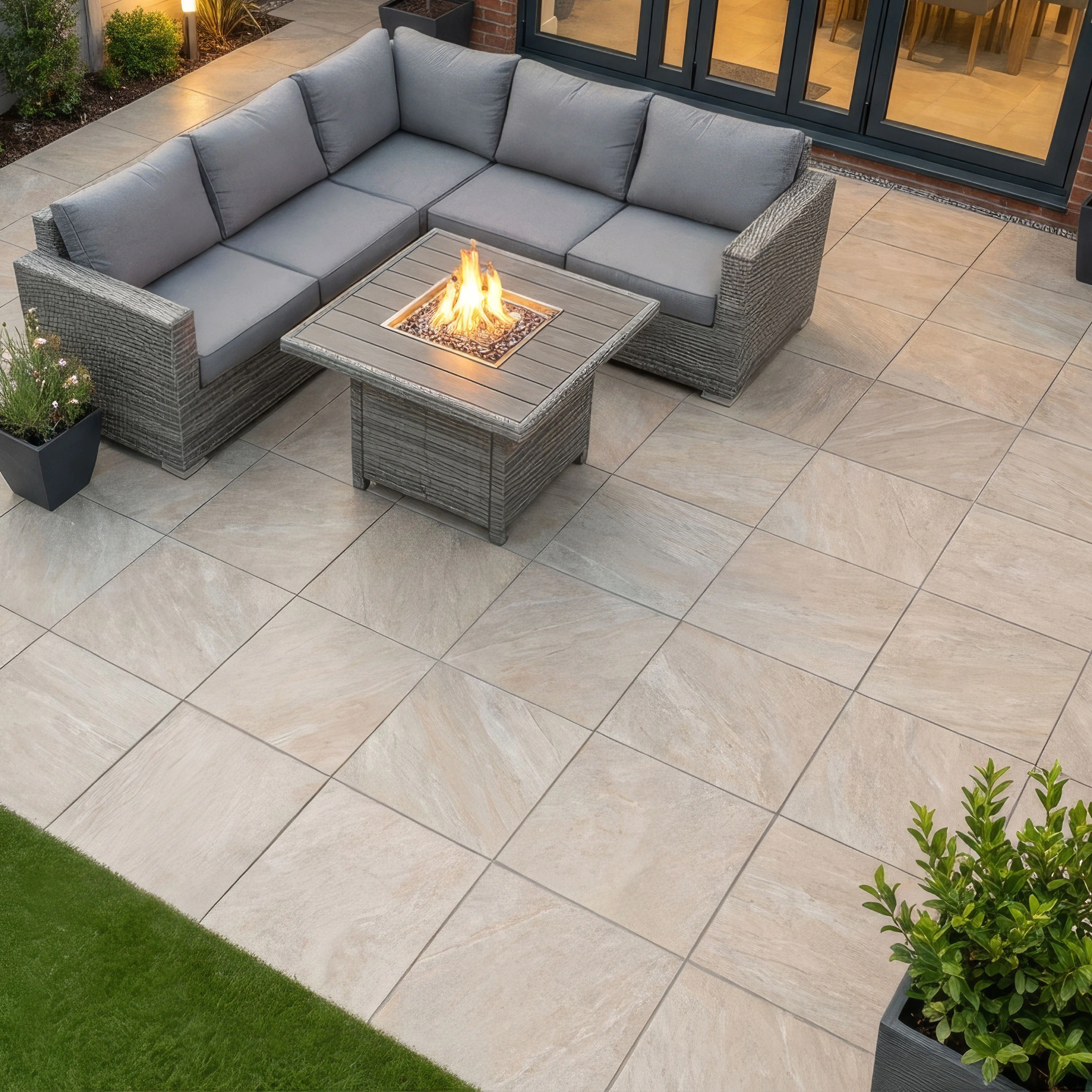
What Are Block Paving Slabs?
Block paving slabs are small, interlocking concrete or clay units laid in repeated patterns to form a strong, flexible surface suited to driveways and pathways. Block paving slabs carry a compressive strength of 35–60 N/mm² and are priced from £25 per m².
Block paving slabs are available in 3 main laying patterns used across UK driveways:
- Herringbone Pattern: The strongest block paving layout, recommended for driveways carrying vehicle loads.
- Stretcher Bond Pattern: A simple, brick-like layout suited to pathways and garden borders.
- Basketweave Pattern: A decorative layout suited to patios and low-traffic garden areas.
Block paving slabs last 20–40 years with proper jointing sand maintenance and re-sanding every 3–5 years. Individual blocks lift and replace without disturbing the surrounding surface, making repairs straightforward and cost-effective.
What Are Resin-Bound Paving Slabs?
Resin-bound paving slabs are natural aggregate stones mixed with clear UV-stable resin and trowelled onto a solid base to form a smooth, permeable, and decorative outdoor surface. Resin-bound paving meets SuDS (Sustainable Drainage Systems) requirements set by UK planning authorities, making it a compliant choice for front driveways.
Resin-bound paving slabs allow water to drain through the surface at a rate of 150–600 litres per m² per minute, preventing standing water and reducing flood risk. Resin-bound surfaces are priced from £40 per m² and carry a lifespan of 15–25 years depending on base quality and foot traffic levels.
Resin-bound paving slabs are available in over 20 aggregate colour blends, including golden gravel, slate grey, and russet brown, making them a popular decorative choice for modern UK driveways and pathways.
What Is The Difference Between Paving Slabs And Outdoor Tiles?
Paving slabs are thicker, load-bearing outdoor units measuring 30–50mm thick, while outdoor tiles are thinner decorative units measuring 10–20mm thick and designed primarily for covered or sheltered surfaces. The core difference lies in thickness, strength, and intended application.
The 3 main differences between paving slabs and outdoor tiles are listed below:
- Thickness: Paving slabs measure 30–50mm thick, outdoor tiles measure 10–20mm thick.
- Strength: Paving slabs carry a compressive strength of 25–50 N/mm², outdoor tiles carry 20–30 N/mm².
- Application: Paving slabs suit open driveways, patios, and pathways exposed to rain and frost, outdoor tiles suit covered terraces and sheltered areas.
Paving slabs withstand vehicle loads, heavy foot traffic, and freeze-thaw cycles across the UK climate. Outdoor tiles crack under vehicle loads and suffer frost damage when exposed to prolonged wet conditions without adequate protection.
Porcelain paving slabs bridge the gap between the two, as porcelain units of 20mm thickness perform reliably as both an outdoor tile and a paving slab on a solid, well-prepared base.
What Is The Difference Between Paving Slabs And Patio Slabs?
Paving slabs and patio slabs are the same product — “patio slabs” is simply the common UK term used when paving slabs are laid specifically on a garden patio area. The material, size, thickness, and installation method remain identical across both terms.
The term “paving slabs” applies broadly to driveways, pathways, public footpaths, and garden patios. The term “patio slabs” narrows the application to garden patio surfaces only. Both terms refer to the same flat, precast units of concrete, natural stone, porcelain, or clay.
Retailers across the UK use both terms interchangeably, so searching for paving slabs or patio slabs returns the same product range across most suppliers.
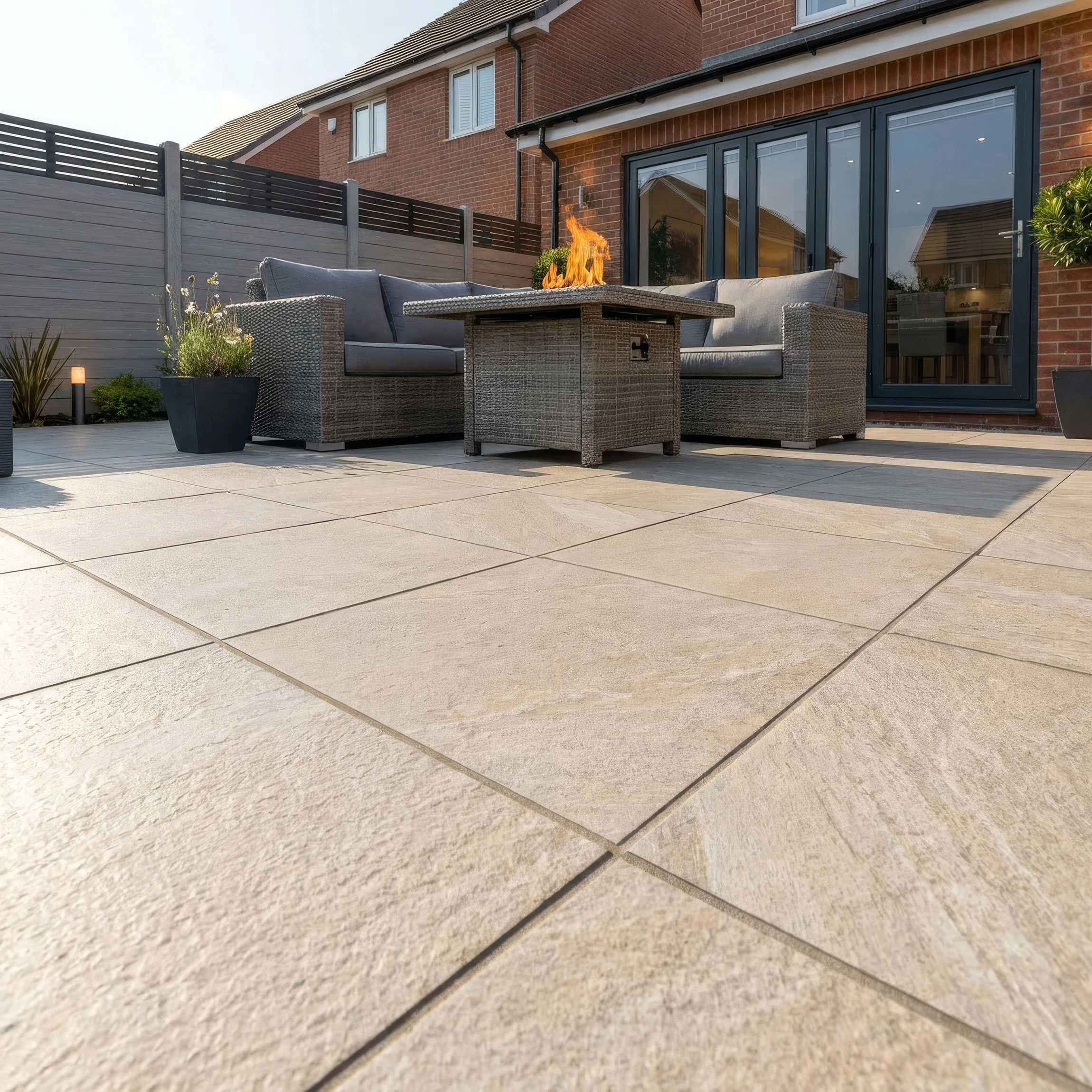
What Sizes Do Paving Slabs Come In?
Paving slabs in the UK come in sizes ranging from 300mm × 300mm to 900mm × 600mm for standard ranges, with large format porcelain slabs reaching up to 1200mm × 600mm. The most common paving slab size across UK residential properties is 450mm × 450mm.
The 6 most common paving slab sizes available in the UK are listed below:
- 300mm × 300mm Paving Slabs: Small-format slabs suited to narrow pathways and stepping stone layouts.
- 450mm × 450mm Paving Slabs: The most popular UK paving slab size, suited to patios, pathways, and garden areas.
- 600mm × 300mm Paving Slabs: A rectangular format suited to stretcher bond and modern linear layouts.
- 600mm × 600mm Paving Slabs: A large-format slab suited to wide patios and contemporary garden designs.
- 900mm × 600mm Paving Slabs: An extra-large format suited to spacious patios and commercial areas.
- 1200mm × 600mm Paving Slabs: A large-format porcelain slab suited to modern, minimalist garden designs.
Paving slab size affects the visual scale of the finished surface. Larger slabs make small garden spaces appear bigger, while smaller slabs suit traditional and cottage-style UK gardens.
What Thickness Should Paving Slabs Be?
Paving slabs for pedestrian use require a minimum thickness of 35mm, while paving slabs for driveways carrying vehicle loads require a minimum thickness of 50mm. Thickness determines the load-bearing capacity and long-term durability of the paved surface.
The 3 recommended paving slab thickness ranges for UK applications are listed below:
- 35mm Thick Paving Slabs: Suited to garden patios, pathways, and pedestrian foot traffic only.
- 50mm Thick Paving Slabs: Suited to residential driveways carrying standard passenger vehicles up to 3,500kg.
- 63mm Thick Paving Slabs: Suited to commercial driveways and areas carrying heavy vehicles over 3,500kg.
Porcelain paving slabs are an exception to standard thickness rules. A 20mm porcelain paving slab bonded onto a solid concrete base performs equivalently to a 35mm concrete slab for pedestrian applications due to porcelain’s higher compressive strength of 50+ N/mm².
Using a paving slab thinner than the recommended thickness for the intended load causes cracking, sinking, and surface failure within 2–5 years of installation.
What Colours Are Available In Paving Slabs?
Paving slabs in the UK are available in over 30 standard colours, ranging from natural stone tones of buff, grey, and slate to contemporary shades of charcoal, white, and sandstone. Colour availability varies by material type, with porcelain and concrete offering the widest colour ranges.
The most popular paving slab colours across UK gardens and driveways are listed below:
- Buff Paving Slabs: A warm, golden-yellow tone that suits traditional UK gardens and period properties.
- Grey Paving Slabs: A cool, neutral tone that suits contemporary and modern garden designs.
- Charcoal Paving Slabs: A dark, near-black tone that suits minimalist and urban garden styles.
- Sandstone Paving Slabs: A warm, mid-brown tone that replicates the appearance of natural sandstone.
- White Paving Slabs: A bright, clean tone suited to Mediterranean-style and coastal garden designs.
- Slate Grey Paving Slabs: A blue-grey tone that suits modern and industrial garden aesthetics.
Natural stone paving slabs deliver colour variation within each individual slab, as no two quarried stone slabs carry identical markings. Concrete and porcelain paving slabs deliver consistent, uniform colour across every slab in the batch, making them better suited to layouts requiring a uniform appearance.
Paving slab colour fades at different rates depending on material. Porcelain paving slabs retain colour for 40–50 years without fading. Concrete paving slabs show visible colour fade within 10–15 years without regular sealing. Natural stone paving slabs mellow and deepen in tone naturally over time, which many UK homeowners consider a desirable characteristic.
Are Paving Slabs Slip Resistant?
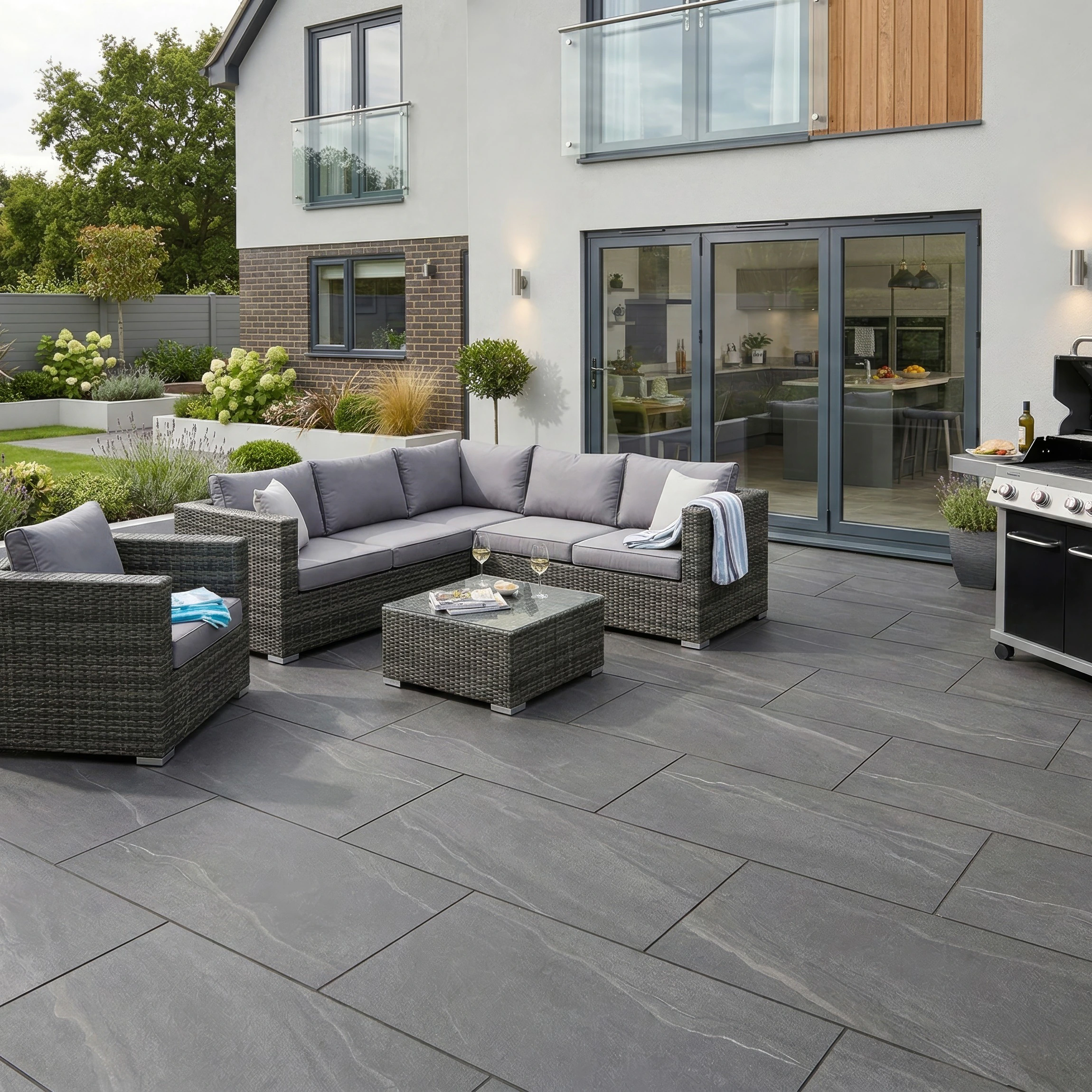
Most paving slabs sold in the UK are slip resistant, measured by a Pendulum Test Value (PTV) of 36 and above, which the UK Health and Safety Executive classifies as low slip risk. The higher the PTV number, the safer the surface underfoot.
The 3 slip resistance levels for paving slabs are listed below:
- PTV Below 25: High slip risk, not safe for outdoor use.
- PTV 25–35: Moderate slip risk, only suited to dry outdoor areas.
- PTV 36 and Above: Low slip risk, safe for all UK outdoor paving areas.
Textured slate and brushed concrete paving slabs deliver the highest slip resistance with a PTV of 45–60. Smooth porcelain paving slabs carry a PTV of 36–45 when a textured finish is chosen. Moss and algae growth drops the PTV of any paving slab, so cleaning every 6–12 months keeps the surface safe.
Are Paving Slabs Frost Resistant?
Porcelain and granite paving slabs are fully frost resistant without any sealing, while concrete and sandstone paving slabs need sealing every 1–3 years to survive UK winters without cracking. Frost resistance depends on how much water a slab soaks up — the less water absorbed, the better the frost resistance.
The frost resistance of the 4 main paving slab types is listed below:
- Porcelain Paving Slabs: Absorb less than 0.5% water, fully frost resistant with no sealing needed.
- Granite Paving Slabs: Absorb less than 1% water, frost resistant without sealing.
- Concrete Paving Slabs: Absorb 5–10% water, need sealing every 2–3 years.
- Sandstone Paving Slabs: Absorb 10–20% water, need sealing every 1–2 years.
Unsealed sandstone and limestone paving slabs crack and flake within 3–5 winters in exposed UK locations.
What Are The Pros And Cons Of Porcelain Paving Slabs?
Porcelain paving slabs are the most durable and lowest maintenance paving slab type in the UK, lasting up to 50 years, but cost more upfront and need a perfectly flat base to install correctly. Porcelain paving slabs are priced from £30 per m².
The 5 main pros of porcelain paving slabs are listed below:
- Durability: Compressive strength of over 50 N/mm², the strongest of all paving slab types.
- Frost Resistant: Absorbs less than 0.5% water, fully frost resistant without sealing.
- Low Maintenance: No sealing needed, just a brush and water clean every 6–12 months.
- Colour Retention: Colour stays bright for 40–50 years without fading.
- Slip Resistant: Textured finishes carry a PTV of 36–45, meeting UK safety standards.
The 4 main cons of porcelain paving slabs are listed below:
- Higher Cost: Priced from £30 per m², compared to concrete paving slabs from £10 per m².
- Needs A Solid Base: Requires a perfectly flat, solid concrete base and specialist adhesive mortar.
- Hard To Cut: Needs a diamond-tipped wet saw, adding to installation cost.
- Heavy: Large porcelain slabs weigh 40–80kg, needing 2 people to lift safely.
How Long Do Paving Slabs Last?
Paving slabs last between 20 and 100 years depending on the material, how well the base is prepared, and how often the slabs are maintained. Granite and clay paving slabs last the longest, while budget concrete slabs have the shortest lifespan.
The lifespan of each paving slab type is listed below:
- Granite Paving Slabs: 75–100 years with sealing every 3–5 years.
- Clay Paving Slabs: 75–100 years with minimal maintenance.
- Porcelain Paving Slabs: 40–50 years with no sealing required.
- Limestone Paving Slabs: 30–50 years with sealing every 1–2 years.
- Sandstone Paving Slabs: 25–40 years with sealing every 1–2 years.
- Concrete Paving Slabs: 20–30 years with sealing every 2–3 years.
A solid sub-base of 100–150mm depth adds 10–15 years to the lifespan of any paving slab. Paving slabs laid directly onto soil without a sub-base fail within 3–7 years.
Where Can You Use Paving Slabs?
Paving slabs are used across 8 main areas in UK homes and commercial properties: patios, driveways, pathways, pool surrounds, garden steps, courtyards, pub gardens, and public footpaths. The material type and thickness determine which paving slab suits each area.
The 8 main areas where paving slabs are used in the UK are listed below:
- Patios: Porcelain, natural stone, or concrete paving slabs at 35mm thickness.
- Driveways: Concrete or block paving slabs at 50mm thickness for vehicles up to 3,500kg.
- Pathways: Concrete or natural stone paving slabs at 35mm thickness.
- Pool Surrounds: Porcelain or granite slabs with anti-slip finishes.
- Garden Steps: Granite or porcelain slabs at 50mm thickness.
- Courtyards: Natural stone or clay paving slabs for a traditional UK look.
- Pub Gardens: Concrete or porcelain slabs at 50mm thickness for heavy foot traffic.
- Public Footpaths: Concrete paving slabs at 63mm thickness meeting UK highways standards.
Which Paving Slabs Are Lowest Maintenance?
Porcelain paving slabs are the lowest maintenance option in the UK, needing only a brush and water clean every 6–12 months with no sealing, painting, or chemical treatment required. Porcelain absorbs less than 0.5% water, stopping moss, algae, and stains from soaking in.
The maintenance requirements of the 4 main paving slab types are listed below:
- Porcelain Paving Slabs: Brush and water clean every 6–12 months, no sealing needed.
- Granite Paving Slabs: Brush and water clean every 6–12 months, sealing every 3–5 years.
- Concrete Paving Slabs: Pressure wash every 6–12 months, sealing every 2–3 years.
- Sandstone Paving Slabs: Pressure wash every 6–12 months, sealing every 1–2 years.
Clay paving slabs rank second after porcelain for low maintenance, needing only an annual brush clean and sealing every 3–5 years. Sandstone paving slabs need the most upkeep of all natural stone types due to their high water absorption rate of 10–20%.

How Much Do Paving Slabs Cost?
Paving slabs in the UK cost between £10 per m² and £100 per m² for materials, with professional installation adding £30–£70 per m² on top. A fully installed 20m² patio costs between £1,400 and £4,000 depending on the slab type chosen.
The material and installed costs of the main paving slab types are listed below:
- Concrete Paving Slabs: £10–£25 per m² materials, £40–£70 per m² installed.
- Clay Paving Slabs: £20–£40 per m² materials, £50–£90 per m² installed.
- Sandstone Paving Slabs: £25–£50 per m² materials, £55–£100 per m² installed.
- Limestone Paving Slabs: £30–£60 per m² materials, £60–£110 per m² installed.
- Porcelain Paving Slabs: £30–£80 per m² materials, £70–£130 per m² installed.
- Granite Paving Slabs: £40–£100 per m² materials, £80–£170 per m² installed.
How Many Paving Slabs Do I Need?
The number of paving slabs needed equals the total area in m² divided by the area of one slab, plus a 10% wastage allowance for cuts and breakages. A 20m² patio using 450mm × 450mm slabs needs approximately 110 slabs including wastage.
The 4 steps to calculate paving slab quantities are listed below:
- Step 1: Measure the length and width of the area in metres and multiply to get the total m².
- Step 2: Multiply the slab length by the slab width in metres to get the area of one slab.
- Step 3: Divide the total area by the single slab area to get the base quantity.
- Step 4: Add 10% to the base quantity to cover cuts and breakages.
The number of 450mm × 450mm slabs needed for common UK patio sizes are listed below:
- 10m² Patio: 55 slabs including 10% wastage.
- 20m² Patio: 110 slabs including 10% wastage.
- 30m² Patio: 165 slabs including 10% wastage.
- 50m² Patio: 274 slabs including 10% wastage.
Diagonal or herringbone laying patterns need a 15% wastage allowance instead of 10% due to extra edge cuts.
How Do I Choose The Best Paving Slabs For My Patio, Path, Or Outdoor Area?
The best paving slabs are chosen based on 5 factors: intended use, load requirement, slip resistance, maintenance preference, and budget. No single paving slab type suits every outdoor area.
The 5 factors to consider when choosing paving slabs are listed below:
- Intended Use: Driveways need 50mm concrete or block paving slabs, patios suit 35mm porcelain or natural stone, pathways suit 35mm concrete or sandstone.
- Load Requirement: Vehicle areas need a strength of 50+ N/mm², pedestrian areas need 25+ N/mm².
- Slip Resistance: Wet or shaded areas need a PTV of 36 and above, choosing textured porcelain, slate, or brushed concrete.
- Maintenance Preference: Low-maintenance gardens suit porcelain or granite, higher-maintenance budgets suit sandstone or limestone.
- Budget: Concrete paving slabs from £10 per m² suit tight budgets, porcelain and granite from £30–£100 per m² suit mid to premium budgets.
What Base Do Paving Slabs Need?
Paving slabs need a compacted sub-base of MOT Type 1 hardcore at 100–150mm depth, topped with a 30–50mm mortar bed, to create a firm, stable foundation that stops slabs sinking or cracking. A correct base adds 10–15 years to the life of any paving slab.
The 4 layers of a correctly prepared paving slab base are listed below:
- Layer 1 — Excavated Ground: Soil dug out to 150–200mm below the finished paving level.
- Layer 2 — MOT Type 1 Sub-Base: Compacted hardcore laid at 100–150mm depth.
- Layer 3 — Mortar Bed: A 30–50mm layer of semi-dry mortar at 4 parts sharp sand to 1 part cement.
- Layer 4 — Paving Slabs: Laid onto the mortar bed with 10–15mm joints filled with jointing compound.
Driveways need a reinforced concrete base of 100mm beneath the MOT Type 1 sub-base. Porcelain paving slabs always need a full mortar bed, not a sand bed, as porcelain does not bond onto loose sand.
How Are Paving Slabs Cut?
Paving slabs are cut using a wet diamond saw, an angle grinder with a diamond blade, or a block splitter, depending on the material type and how precise the cut needs to be. A wet diamond saw gives the cleanest, most accurate cut across all paving slab types.
The 3 main methods for cutting paving slabs are listed below:
- Wet Diamond Saw: The most accurate method, suited to porcelain, granite, and large-format slabs.
- Angle Grinder with Diamond Blade: A portable option suited to concrete and natural stone slabs.
- Block Splitter: A manual tool suited to concrete and clay slabs for straight cuts only.
Porcelain paving slabs must be cut with a wet diamond saw using a continuous rim blade rated for porcelain. Always wear eye protection, ear defenders, and an FFP3 dust mask when cutting paving slabs, as silica dust carries a lung cancer risk classified by the UK Health and Safety Executive.
What Tools Are Needed To Lay Paving Slabs?
Laying paving slabs requires 12 tools: a spade, plate compactor, spirit level, rubber mallet, trowel, mortar mixer, diamond saw, tape measure, string line, bolster chisel, soft brush, and jointing compound applicator. Having all 12 tools ready before starting prevents delays and costly mistakes.
The 12 tools needed to lay paving slabs are listed below:
- Spade: For digging out the ground to 150–200mm depth.
- Plate Compactor: For compacting the MOT Type 1 sub-base firmly.
- Spirit Level: For checking the 1:60 drainage fall across the surface.
- Rubber Mallet: For tapping slabs into the mortar bed without cracking them.
- Trowel: For spreading mortar across the sub-base.
- Mortar Mixer: For mixing mortar at 4 parts sharp sand to 1 part cement.
- Diamond Saw: For cutting slabs to fit edges and corners.
- Tape Measure: For measuring the area and marking slab positions.
- String Line: For keeping courses straight and joint widths consistent.
- Bolster Chisel: For splitting concrete and natural stone slabs by hand.
- Soft Brush: For brushing jointing sand into slab joints after laying.
- Jointing Compound Applicator: For applying resin jointing compound for a weed-resistant finish.
How Are Paving Slabs Installed?
Paving slabs are installed in 8 steps: mark the area, dig out the ground, compact the sub-base, lay the mortar bed, position the slabs, check levels, cut edge slabs, and fill the joints. A standard 20m² patio takes 2 people 2–3 days to complete from start to finish.
The 8 steps to install paving slabs are listed below:
- Step 1 — Mark The Area: Use string lines and pegs to mark the area and set a 1:60 fall away from the property.
- Step 2 — Dig Out The Ground: Excavate to 150–200mm below the finished paving level.
- Step 3 — Compact The Sub-Base: Lay and compact MOT Type 1 hardcore to 100–150mm depth.
- Step 4 — Lay The Mortar Bed: Spread semi-dry mortar at 4 parts sharp sand to 1 part cement at 30–50mm depth.
- Step 5 — Position The Slabs: Place each slab onto the mortar bed with 10–15mm joints and tap down with a rubber mallet.
- Step 6 — Check Levels: Use a spirit level after every 3–4 slabs to confirm the correct fall.
- Step 7 — Cut Edge Slabs: Cut slabs to fit edges and corners using a wet diamond saw or angle grinder.
- Step 8 — Fill The Joints: Brush jointing compound into all joints and leave to cure for 24–48 hours before use.
Can Paving Slabs Be Installed As A DIY Project?
Concrete and natural stone paving slabs are suitable for DIY installation by a confident homeowner with the right tools, saving £30–£70 per m² in labour costs. Porcelain and large-format slabs above 600mm × 600mm are not recommended for DIY due to their weight and cutting difficulty.
The 3 paving slab types suited to DIY installation are listed below:
- Concrete Paving Slabs: Easy to cut, lay, and joint, suited to confident DIY installers.
- Natural Sandstone Paving Slabs: Manageable weight and straightforward cutting, suited to experienced DIY installers.
- Concrete Block Paving: Lightweight individual units easy to handle without specialist equipment.
A 20m² DIY patio saves £600–£1,400 compared to hiring a professional paving contractor. Porcelain paving slabs need specialist wet saw cutting and full mortar bed adhesion, making professional installation strongly recommended.
What Are The Common Mistakes When Laying Paving Slabs?
The 6 most common mistakes when laying paving slabs are: too shallow a sub-base, wrong mortar mix, no drainage fall, dry laying porcelain slabs, uneven joint widths, and not ordering enough slabs. Each mistake leads to cracking, sinking, or costly reinstallation within 2–5 years.
The 6 most common paving slab mistakes are listed below:
- Too Shallow A Sub-Base: Less than 100mm of compacted hardcore causes slabs to sink and crack within 1–3 years.
- Wrong Mortar Mix: A wet mortar mix instead of a semi-dry 4:1 mix causes uneven sinking as the mortar shrinks.
- No Drainage Fall: Slabs laid without a 1:60 fall cause standing water, frost damage, and damp in the property.
- Dry Laying Porcelain Slabs: Porcelain laid on sand instead of a full mortar bed rocks, cracks, and fails under load.
- Uneven Joint Widths: Inconsistent joints look unprofessional and worsen with ground movement over time.
- Not Ordering Enough Slabs: Ordering exact m² quantities without a 10% wastage allowance leaves too few slabs to finish the job.
How Do I Clean Paving Slabs?
Paving slabs are cleaned by sweeping off loose dirt, applying a paving cleaner, scrubbing the surface, and rinsing with clean water. Most UK paving slabs need a full clean every 6–12 months to stay safe and look their best.
The 5 steps to clean paving slabs are listed below:
- Step 1 — Sweep The Surface: Remove leaves, dirt, and loose moss with a stiff brush.
- Step 2 — Apply Paving Cleaner: Use a dedicated paving cleaner or a mix of 1 part white vinegar to 5 parts water.
- Step 3 — Scrub The Surface: Scrub firmly with a stiff brush, focusing on joints and shaded areas where algae builds up.
- Step 4 — Rinse With Water: Rinse thoroughly with a garden hose or pressure washer on a low setting.
- Step 5 — Apply Sealant: Seal concrete, sandstone, and limestone slabs after cleaning to restore stain and frost protection.
Bleach cleans algae from concrete paving slabs but damages natural stone surfaces. Use a pH-neutral cleaner on sandstone, limestone, and slate paving slabs to avoid surface damage and colour loss.
Can Paving Slabs Be Pressure Washed?
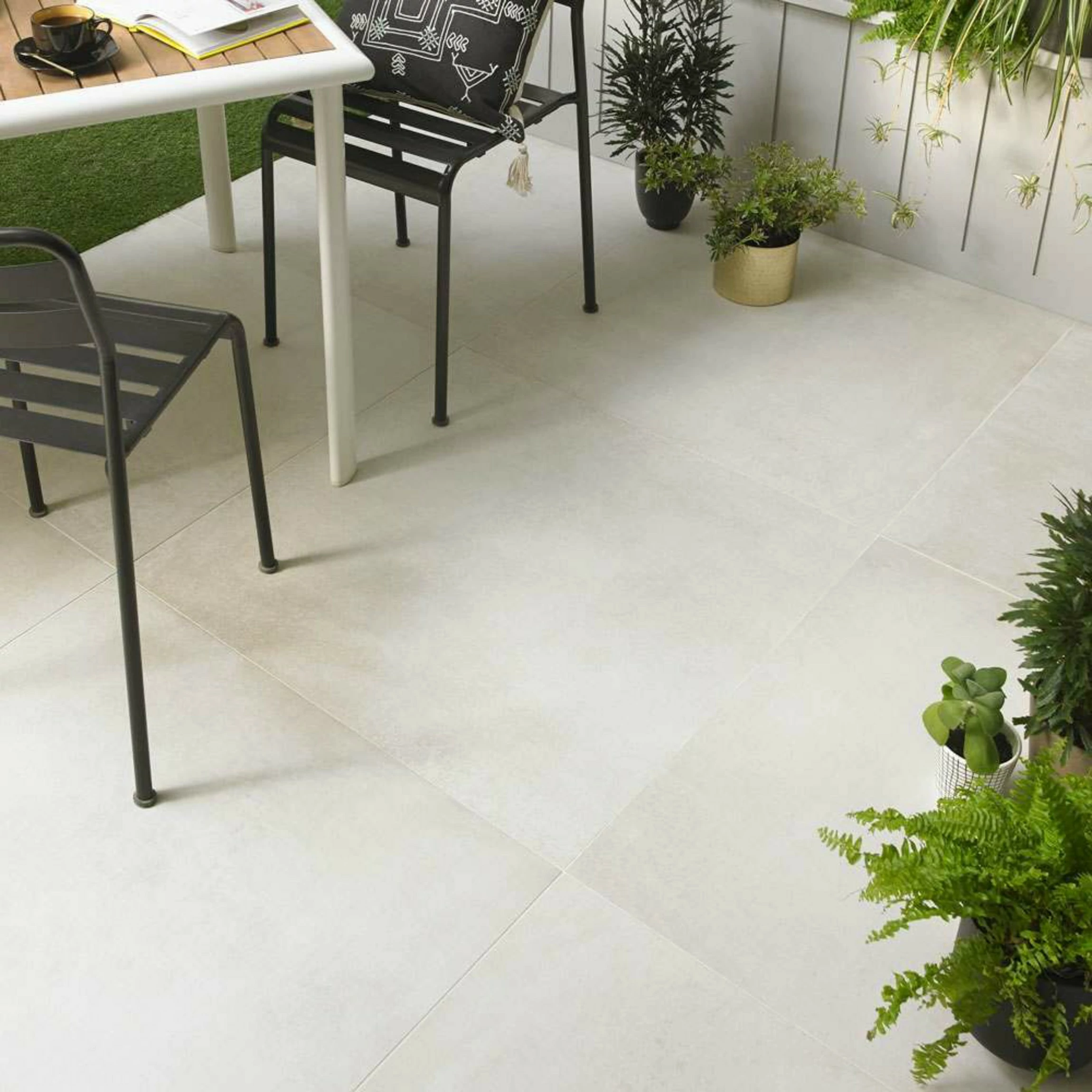
Concrete and porcelain paving slabs are safe to pressure wash at 100–150 bar, while natural stone paving slabs need a lower pressure of 80–100 bar to avoid surface damage and joint erosion. Pressure washing is one of the fastest and most effective ways to clean paving slabs in the UK.
The recommended pressure washing settings for each paving slab type are listed below:
- Concrete Paving Slabs: 100–150 bar with a 25-degree fan nozzle.
- Porcelain Paving Slabs: 100–150 bar with a 25-degree fan nozzle.
- Sandstone Paving Slabs: 80–100 bar with a 40-degree fan nozzle.
- Limestone Paving Slabs: 80–100 bar with a 40-degree fan nozzle.
- Slate Paving Slabs: 80 bar maximum with a 40-degree fan nozzle.
Pressure washing above 150 bar blasts jointing compound out of the joints, needing re-jointing after cleaning. Keep the lance at least 300mm from the slab surface at all times to avoid damage.
Can Paving Slabs Be Painted?
Concrete paving slabs accept specialist patio paint or masonry paint, while natural stone and porcelain paving slabs are not suitable for painting as paint fails to bond onto low-porosity surfaces within 1–2 seasons. Painted concrete paving slabs last 2–4 years before repainting is needed.
The 3 paint options for concrete paving slabs in the UK are listed below:
- Patio Paint: A water-based masonry paint in 20+ colours, priced from £15 per 2.5 litre tin covering approximately 5m².
- Anti-Slip Patio Paint: A textured masonry paint with fine aggregate particles, delivering a PTV of 36+ on painted surfaces.
- Concrete Floor Paint: A solvent-based paint more durable than water-based patio paint, suited to high-traffic areas.
Painting paving slabs needs a clean, dry surface, one primer coat, and 2 topcoats applied 24 hours apart. UV exposure, frost, and foot traffic cause painted paving slabs to peel within 2–4 years outdoors.
What Building Regulations Affect Paving Slabs?
Paving more than 5m² of front garden with an impermeable surface such as concrete or porcelain requires planning permission under the Town and Country Planning Act 2008, unless the surface drains to a lawn or border. Permeable surfaces like resin-bound paving are exempt from this rule.
The 3 main UK building regulations affecting paving slab installation are listed below:
- Town and Country Planning Act 2008: Front garden paving over 5m² with impermeable slabs needs planning permission unless water drains to a permeable area.
- Building Regulations Part H — Drainage: Paving slabs must be laid at a 1:60 fall to direct water away from buildings into an approved drainage system.
- Building Regulations Part M — Accessibility: Paving slabs in accessible areas must carry a PTV of 36 and above with a maximum 1:20 cross-fall gradient.
Rear garden paving does not need planning permission under Permitted Development rights for most UK homes. Homes in conservation areas, listed buildings, and Article 4 Direction areas need planning permission for all new paving regardless of location or size.
How Do Paving Slabs Compare With Decking?
Paving slabs last 20–100 years and cost less to maintain long-term than timber decking, which lasts 10–20 years and needs oiling or staining every 1–2 years to avoid rot and warping in the UK climate. The right choice depends on budget, style preference, and how much maintenance the homeowner is willing to do.
The main differences between paving slabs and decking are listed below:
- Lifespan: Paving slabs last 20–100 years, timber decking lasts 10–20 years.
- Maintenance: Paving slabs need cleaning every 6–12 months, decking needs oiling or staining every 1–2 years.
- Cost: Paving slabs cost £40–£170 per m² installed, timber decking costs £60–£120 per m² installed.
- Slip Resistance: Textured paving slabs carry a PTV of 36–60, wet timber decking carries a PTV of 20–30, making decking a moderate slip risk.
- Planning Permission: Front garden paving over 5m² needs planning permission, raised decking over 300mm in height needs planning permission in most UK areas.
Paving slabs suit homeowners who want a long-lasting, low-maintenance, all-weather outdoor surface. Decking suits homeowners who prefer a warm, natural look and are happy to carry out regular annual maintenance.
What Should I Check Before Buying Paving Slabs?
Before buying paving slabs, check 7 things: material type, thickness, slip resistance rating, frost resistance, size availability, colour consistency, and total quantity including a 10% wastage allowance. Checking all 7 prevents costly returns, mismatched slabs, and installation delays.
The 7 things to check before buying paving slabs are listed below:
- Material Type: Match the material to the job — porcelain for low-maintenance patios, concrete for budget driveways, natural stone for traditional gardens.
- Thickness: Confirm 35mm minimum for pedestrian areas and 50mm minimum for driveways.
- Slip Resistance Rating: Confirm a PTV of 36 and above for all UK outdoor areas, especially wet or shaded spots.
- Frost Resistance: Confirm the slab is frost resistant, particularly for exposed UK locations.
- Size Availability: Confirm enough stock is available from a single batch to cover the whole project.
- Colour Consistency: Order all slabs from the same production batch to avoid colour variation across the finished surface.
- Total Quantity: Calculate the total m² needed and add 10% wastage before ordering.
Buying all paving slabs in one order from a single supplier guarantees batch consistency and avoids the colour mismatching that happens when topping up from a different production run.
