
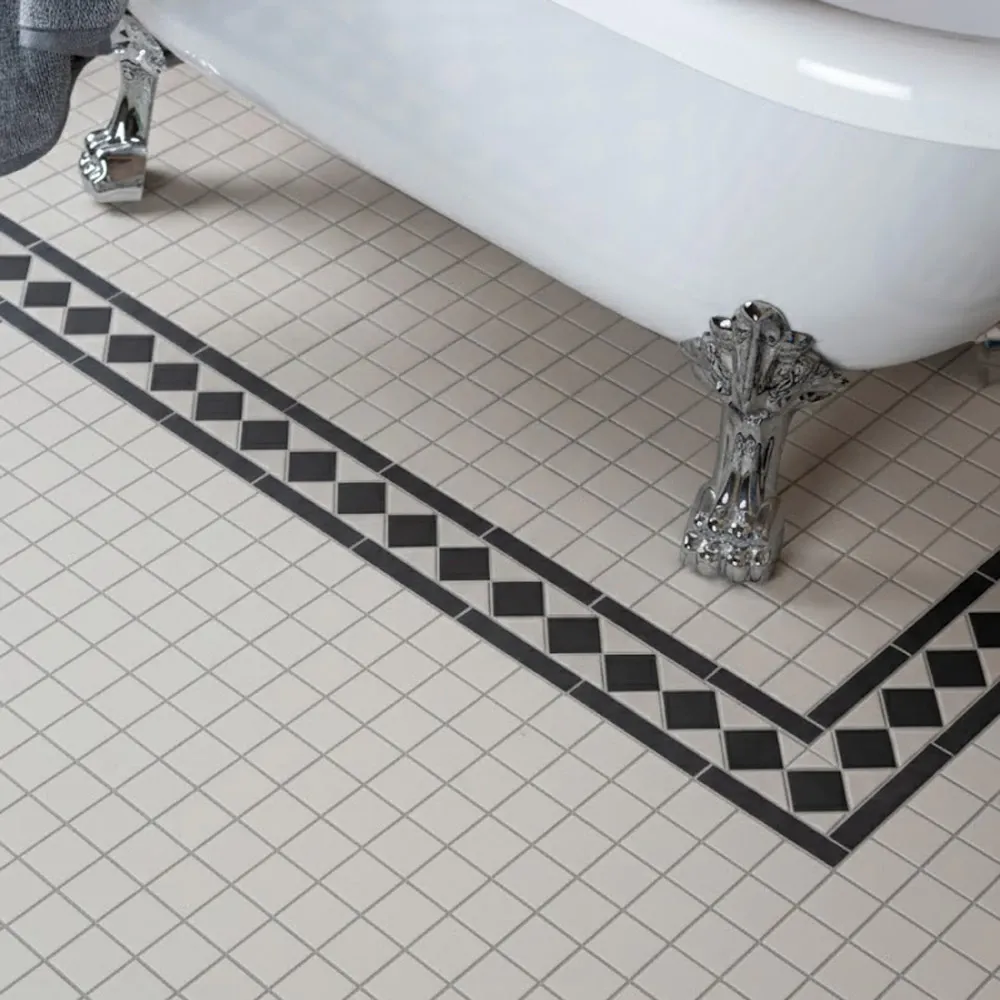
R ratings classify the slip resistance of floor surfaces tested on an inclined ramp, ranging from R9 to R13. Higher R numbers represent greater resistance under the specified test conditions, but the highest rating does not automatically represent the best tile for every room.
Choosing floor tiles involves more than colour, size and finish. Slip resistance becomes particularly important in bathrooms, kitchens, entrances, patios, wet rooms and other areas where water or other contaminants can reach the floor.
Several terms appear on tile specifications, including R9, R10, R11, R12, R13, PTV, Pendulum Test Value and A, B or C classifications. Each classification comes from a particular testing method and describes performance under defined conditions.
Understanding the differences helps homeowners, designers and professional specifiers select flooring based on the actual environment rather than relying on a single number.
Table of Contents
What Does Slip Resistance Mean for Floor Tiles?
Slip resistance describes the level of friction available between a floor surface and a person walking across the surface. Greater friction generally provides greater resistance to slipping, while water, oil, soap, dirt and other contaminants can reduce available grip.
Tile material alone does not determine slip resistance. Surface texture, glaze, finish, contamination, footwear, drainage, floor gradient, cleaning and wear all affect real-world performance.
A textured porcelain tile and a polished porcelain tile, for example, can provide very different levels of grip despite sharing the same base material.
The term slip resistant provides a more accurate description than slip proof. No floor surface remains completely resistant to slipping under every combination of contamination, footwear and environmental conditions.
What Is a Non Slip Tile?
An anti-slip tile is a floor tile designed or finished to provide increased surface grip under specified conditions. Anti-slip performance should be established through relevant test data rather than appearance, texture or marketing terminology alone.
Non slip tiles often have a matt, structured or textured surface. Greater texture can help maintain contact between footwear and the floor when contamination is present.
Surface appearance alone provides insufficient evidence of slip resistance. Two visually similar tiles can achieve different test results.
Anti-slip performance therefore needs to be considered alongside the intended location, expected contaminants and available manufacturer test data.
What Is an R Rating on Tiles?
An R rating is a slip-resistance classification historically associated with the DIN 51130 shod ramp test. The classification runs from R9 to R13, with R9 representing the lowest classification and R13 representing the highest classification within the R-rating system.
The traditional test involves operators wearing specified footwear and walking across a flooring sample on an inclined ramp with oil used as the contaminant. The ramp angle increases until the limit of safe walking is reached.
The resulting angle determines the classification.
R ratings therefore do not work like a score out of 13. An R9 tile does not provide “9 out of 13” slip resistance. R9 represents the first and lowest classification in the R scale.
What Do R9, R10, R11, R12 and R13 Mean?
R9, R10, R11, R12 and R13 represent progressively higher classifications within the traditional shod ramp system. R9 covers the lowest acceptance-angle range, while R13 covers surfaces maintaining safe walking at angles above 35° during the specified test.
| R Rating | Ramp Angle | Relative Slip Resistance | Typical Selection Context |
| R9 | 6°–10° | Lowest R classification | Primarily dry environments |
| R10 | >10°–19° | Moderate | Areas with occasional moisture |
| R11 | >19°–27° | Increased | Wetter or more demanding environments |
| R12 | >27°–35° | High | Higher-risk working environments |
| R13 | >35° | Highest R classification | Very demanding contaminated environments |
The classification describes performance under the specified ramp-test conditions. The classification does not establish universal suitability for every bathroom, kitchen, patio or commercial floor.
R9 Rating
R9 represents the lowest classification in the R-rating scale.
R9 surfaces generally provide less slip resistance under ramp-test conditions than R10, R11, R12 or R13 surfaces.
Smoother surfaces often appear within the R9 category, making cleaning easier in suitable dry environments.
Regular exposure to water, grease or other contamination requires additional assessment because an R9 classification alone does not establish wet-floor suitability.
R10 Rating
R10 represents a higher classification than R9 and covers acceptance angles above 10° and up to 19°.
R10 frequently appears on tiles intended for general residential and light commercial flooring.
Occasional moisture can form part of the intended use, but R10 alone does not automatically establish suitability for wet rooms, showers or other continuously wet areas.
R11 Rating
R11 covers acceptance angles above 19° and up to 27°.
R11 surfaces generally provide greater ramp-test resistance than R9 and R10 surfaces.
Many outdoor and higher-grip floor tiles carry an R11 classification.
Greater surface texture can increase cleaning requirements, so slip resistance and maintenance need to be considered together.
R12 Rating
R12 covers acceptance angles above 27° and up to 35°.
R12 surfaces are generally associated with demanding environments where water, grease, food debris or other contaminants create increased slip risk.
Commercial kitchens, food preparation areas and some industrial environments frequently require higher levels of slip resistance than standard domestic rooms.
R13 Rating
R13 represents the highest classification within the R-rating scale.
R13 applies to acceptance angles above 35° during the relevant ramp test.
R13 surfaces usually feature aggressive textures designed for demanding contaminated environments.
Ordinary residential floors rarely require the maximum R classification because highly textured surfaces can increase cleaning effort and reduce barefoot comfort.
Is a Higher R Rating Always Better?
A higher R rating is not automatically better because the most suitable flooring balances sufficient slip resistance with cleanability, comfort, appearance and maintenance requirements. Maximum grip can create unnecessary practical disadvantages in low-risk environments.
The R-rating hierarchy is:
R9 → R10 → R11 → R12 → R13
Higher classifications represent greater resistance within the ramp-test system.
A dry bedroom and an industrial kitchen face very different risks.
Selecting R13 for both environments would ignore the different levels of contamination, foot traffic, cleaning and comfort required.
Appropriate specification matters more than choosing the highest number.
How Are R Ratings Tested?
R ratings originate from a ramp test in which operators wearing specified footwear walk across a contaminated test surface while the platform angle increases. The angle reached at the limit of safe walking determines the resulting classification.
The traditional DIN 51130 procedure used oil as the contaminant.
The important variables include:
- Standardised footwear.
- A controlled walking procedure.
- A specified contaminant.
- An inclined test surface.
- A progressively increasing angle.
- A measured acceptance angle.
The R classification therefore represents performance within controlled test conditions rather than a direct recreation of every household or commercial environment.
What Is a Pendulum Test Value?
A Pendulum Test Value, usually shortened to PTV, is a numerical measurement of slip resistance produced using a pendulum friction tester. Higher PTV results generally indicate greater resistance to slipping under the specified test conditions.
Pendulum Testing
A standard rubber slider travels across the test surface.
Contact between the slider and the floor reduces the movement of the pendulum arm.
Greater friction produces a higher numerical result.
Pendulum testing can be performed in wet or dry conditions and can also be carried out on installed flooring.
The ability to assess existing floors makes pendulum testing particularly useful when actual in-service performance needs to be investigated.
What Does a PTV of 36 Mean?
A wet Pendulum Test Value of 36 or above is commonly used as an important benchmark for identifying low slip potential on level pedestrian flooring, although gradient, contamination, surface condition and test methodology still require consideration.
PTV values should always be read alongside the test conditions.
A dry result does not describe wet performance.
A result measured on level flooring does not automatically describe performance on a slope.
A laboratory result on a new tile can also differ from performance after installation, wear or contamination.
Is an R Rating the Same as a PTV Rating?
No. R ratings and Pendulum Test Values come from different testing methods and should not be treated as equivalent measurements. R testing uses an inclined ramp, while pendulum testing measures surface friction using a rubber slider.
| Factor | R Rating | PTV |
| Test method | Ramp | Pendulum |
| Result | R9 to R13 | Numerical PTV |
| Contact method | Specified footwear | Rubber slider |
| Typical condition | Defined ramp contamination | Wet or dry testing |
| Installed-floor testing | Primarily product testing | Can be carried out in situ |
| Direct conversion | No | No |
Both systems provide useful information.
The measurements answer different questions and should be interpreted separately.
Can You Convert R Ratings Into PTV Ratings?
No reliable direct conversion exists between R9 to R13 classifications and Pendulum Test Values because the testing methods use different equipment, contact materials, contaminants and procedures.
An R11 tile, for example, cannot automatically be assigned a specific PTV.
Any conversion chart suggesting that every R10, R11 or R12 surface equals one fixed PTV oversimplifies the relationship.
Use the actual PTV result where pendulum performance matters.
What Are A, B and C Non Slip Ratings?
A, B and C classifications relate to barefoot wet-area ramp testing, with A representing the lowest classification and C representing the highest classification within the traditional barefoot system.
| Barefoot Classification | Acceptance Angle | Relative Classification |
| A | 12° or greater | Lower |
| B | 18° or greater | Increased |
| C | 24° or greater | Highest |
Barefoot Ramp Testing
Barefoot testing differs from traditional R-rating testing.
The operator walks barefoot across a wet test surface rather than wearing specified footwear on an oil-contaminated ramp.
The ABC system therefore has greater relevance to environments such as:
- Shower areas.
- Pool surrounds.
- Changing rooms.
- Barefoot circulation areas.
What Is the Difference Between R Ratings and A, B and C Ratings?
R ratings assess shod slip resistance under ramp-test conditions, while A, B and C classifications assess barefoot performance on a wet ramp. The two systems address different walking conditions and should not be treated as interchangeable.
A shower floor provides a clear example.
Most users enter a shower barefoot.
Water, shampoo and soap can also reach the floor.
A rating generated using footwear therefore measures different conditions from a barefoot wet-area test.
The most relevant performance data should reflect the expected use of the floor.
What Non Slip Rating Is Best for a Bathroom?
Bathroom floor tiles should provide slip resistance appropriate to water exposure, barefoot use, surface gradient and cleaning conditions. One R rating does not suit every bathroom because the level of moisture varies between general floor areas, shower zones and wet rooms.
General Bathroom Floors
A standard bathroom floor can remain relatively dry outside the bath or shower area.
Occasional splashes still create greater slip risk than in dry living spaces.
Relevant wet-slip information therefore adds useful evidence when choosing bathroom flooring.
Shower Areas
Shower floors experience more regular water exposure.
Barefoot use, soap contamination, drainage and floor falls also become important.
Barefoot performance and wet test information can therefore provide more relevant evidence than an R classification alone.
What Non Slip Rating Is Best for a Wet Room?
Wet room tiles require slip resistance suited to frequent water exposure, barefoot traffic, cleaning products and floor gradients. Wet-slip test data and barefoot performance deserve particular attention because the entire floor can be exposed to moisture.
Wet-Room Conditions
Wet rooms often include:
- Continuous or frequent water exposure.
- Bare feet.
- Soap and shampoo contamination.
- Drainage falls.
- Larger wet zones than standard bathrooms.
Surface grip therefore needs to form part of the complete wet-room specification alongside drainage and installation.
What Non Slip Rating Is Best for a Kitchen?
Kitchen flooring should be selected according to the type and frequency of contamination. Domestic kitchens mainly experience occasional water, food and cooking spills, while commercial kitchens can experience frequent grease, oil and intensive cleaning.
Domestic Kitchens
Domestic kitchen floors need a practical balance between grip and easy cleaning.
Heavy texture is often unnecessary where contamination remains occasional and manageable.
Commercial Kitchens
Commercial kitchens face greater slip risk because grease, oil, food waste and water can reach the floor repeatedly.
Higher slip-resistance classifications are therefore more relevant in commercial food environments than in ordinary residential kitchens.
What Non Slip Rating Is Best for Outdoor Tiles?
Outdoor tiles require slip resistance suited to rain, dirt, organic contamination and changing weather conditions. Wet performance, drainage, gradient and maintenance should be considered alongside the stated R rating.
Outdoor Conditions
Outdoor flooring can encounter:
- Rainwater.
- Leaves.
- Soil.
- Algae.
- Frost.
- Poor drainage.
- Surface slopes.
External steps, pathways and sloping patios require particular attention because changing weather can increase slip risk.
An outdoor product label alone does not provide enough information to judge every installation.
What Non Slip Rating Is Best Around Swimming Pools?
Poolside flooring requires slip resistance suitable for regular wetting and barefoot traffic. Barefoot slip-resistance information is particularly relevant around swimming pools, changing facilities and communal shower areas.
Poolside Areas
Different zones can include:
- Pool surrounds.
- Changing rooms.
- Communal showers.
- Steps.
- Ramps.
- Barefoot circulation routes.
Different areas can require different performance levels.
One classification should not automatically be applied across an entire leisure facility.
Are Porcelain Tiles Slip Resistant?
Porcelain tiles can provide low, moderate or high slip resistance depending on the individual surface finish and tested performance. Porcelain describes the tile body rather than guaranteeing one level of grip.
Porcelain Surface Finishes
Porcelain tiles can have:
- Polished surfaces.
- Matt surfaces.
- Structured finishes.
- Outdoor textures.
A heavily textured outdoor porcelain tile can behave very differently from polished porcelain despite sharing the same base material.
Always assess the exact finish.
Are Ceramic Tiles Slip Resistant?
Ceramic tiles can provide suitable slip resistance when the individual surface has been designed and tested for the intended environment. Ceramic construction alone does not establish anti-slip performance.
Glaze, texture and surface treatment influence grip.
Product-specific technical information therefore matters more than material type alone.
Are Polished Tiles Slippery When Wet?
Polished tiles can provide less grip when wet because smooth surfaces offer fewer surface features to interrupt the lubricating layer between the floor and the foot. Actual performance still depends on the individual product.
Polished surfaces can remain suitable for appropriate dry interior environments.
Regular wet exposure requires a different specification.
Can Slip Resistance Change After Installation?
Slip resistance can change after installation because wear, contamination, cleaning residues, sealers and surface treatments alter the interaction between the floor and pedestrian contact surface.
Installation and Maintenance Factors
Performance can be affected by:
- Grout haze.
- Adhesive residue.
- Sealers.
- Surface coatings.
- Construction dirt.
- Grease.
- Soap.
- Limescale.
- Wear.
Slip-resistance performance therefore depends on maintenance as well as initial tile selection.
Can Non Slip Tiles Become Slippery Over Time?
Anti slip tiles can provide reduced grip when dirt, grease, soap or cleaning residue fills the surface texture. Wear and inappropriate coatings can also change surface performance.
Long-Term Surface Condition
Textured tiles rely partly on the surface profile remaining exposed.
Contamination can fill recessed areas and reduce the benefits provided by the texture.
Regular cleaning should therefore match the type of contamination present.
Does Cleaning Affect Tile Slip Resistance?
Cleaning affects slip resistance because grease, soap, detergent residue and loose contamination can reduce friction. Effective cleaning removes contaminants without leaving a film across the tile surface.
Cleaning Problems
Common causes of reduced grip include:
- Excessive detergent.
- Poor rinsing.
- Grease accumulation.
- Soap deposits.
- Limescale.
- Dirty cleaning equipment.
- Insufficient agitation on textured surfaces.
Anti-slip tiles can require more thorough cleaning than smoother tiles.
Can Sealers Affect Tile Slip Resistance?
Some sealers, coatings and surface treatments can change the friction characteristics of flooring. Manufacturer guidance should be checked before treatment where slip resistance forms an important performance requirement.
Surface Treatments
Natural stone and some specialist tile installations can require sealing.
The effect depends on the product, finish and treatment used.
Avoid assuming that every sealer leaves slip performance unchanged.
What Makes a Tiled Floor Slippery?
A tiled floor becomes more likely to cause slipping when available friction falls because of water, oil, soap, grease, dirt or other contamination. Gradient, footwear, drainage and surface condition can increase or reduce the resulting risk.
Common Slip Factors
The main contributors include:
- Water.
- Oil.
- Grease.
- Soap and shampoo.
- Food debris.
- Dust.
- Sand.
- Cleaning residue.
- Worn surfaces.
- Bare feet.
- Unsuitable footwear.
- Floor gradients.
- Poor drainage.
- Rain.
- Leaves.
- Algae.
Slip resistance therefore depends on the interaction between the floor, contaminant, pedestrian and environment.
How Do You Choose the Best Non Slip Tile for Your Room?
Choose the best anti-slip tile by assessing water exposure, contamination, footwear, indoor or outdoor location, floor gradient, maintenance requirements and verified slip-resistance data. Appropriate performance matters more than selecting the highest available R rating.
Water Exposure
Identify whether the floor remains mainly dry, experiences occasional splashes or becomes regularly wet.
Contamination
Consider likely substances such as soap, cooking oil, grease, food, soil, leaves and cleaning products.
Barefoot or Footwear Use
Shower floors and pool surrounds need different assessment from kitchens, hallways and commercial workplaces.
Indoor or Outdoor Installation
Rain, frost and organic contamination create additional external risks.
Floor Gradient
Steps, ramps and drainage falls increase the importance of slip resistance.
Cleaning Requirements
Highly textured surfaces can require more intensive maintenance.
Verified Test Data
Check the actual R classification, wet PTV or barefoot performance available for the exact product.
The best tile provides sufficient grip for the intended environment without creating unnecessary cleaning, comfort or maintenance problems.
What Are the Most Common Mistakes When Choosing Non Slip Tiles?
The most common mistakes include treating different test methods as interchangeable, assuming the highest rating is always best and choosing flooring without considering contamination, barefoot use, gradient and maintenance.
Common Selection Errors
Avoid:
- Treating R9 as a score of nine out of 13.
- Assuming R13 is automatically the safest choice for every room.
- Converting R ratings directly into PTV values.
- Relying only on dry test results for wet areas.
- Ignoring barefoot use in showers and wet rooms.
- Ignoring gradients and drainage.
- Assuming every matt tile is anti-slip.
- Assuming every textured tile provides identical grip.
- Ignoring cleaning requirements.
- Selecting purely from appearance.
What Is the Most Important Thing to Know About R Ratings?
R ratings describe performance within a specific ramp-test system and do not provide a universal measure of floor safety. The intended environment, contaminant, footwear, gradient, wet performance and maintenance requirements should guide final tile selection.
- R9 represents the lowest R classification.
- R13 represents the highest R classification.
- Higher numbers indicate greater performance under the relevant ramp-test conditions.
- PTV results come from a different testing method and should not be directly converted from R ratings.
- Barefoot wet areas require separate consideration because footwear-based ramp testing does not reproduce barefoot use.
Conclusion
R ratings provide a useful way to compare slip resistance, but the correct tile depends on the environment, expected contamination, footwear, water exposure and maintenance requirements. Higher R ratings indicate greater ramp-test resistance, not automatic suitability for every installation.
R9 sits at the lowest end of the classification scale, while R13 represents the highest. Bathrooms, wet rooms, kitchens, patios and commercial spaces all create different slip risks, so room use should guide the final choice.
PTV results and barefoot classifications can provide additional evidence where wet or barefoot conditions matter. R ratings, PTV values and A, B or C classifications should be interpreted as separate test systems rather than converted directly.
The best anti-slip tile is the surface that provides appropriate grip for the intended space while remaining practical to clean, maintain and use.
