
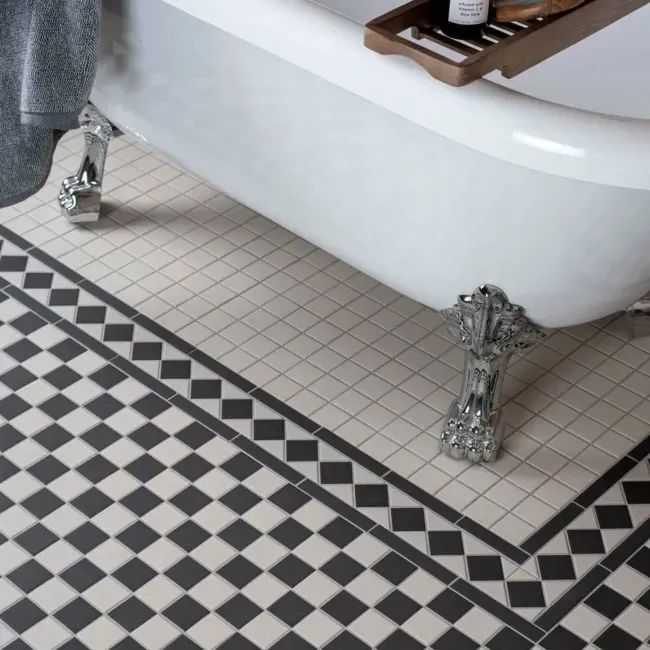
R11 is the rating generally specified for a wetroom floor, R9 is not suitable for one, and R10 sits in a genuine grey area that depends on what else you know about that specific tile. A wetroom is different from a standard bathroom in a way that changes the whole calculation: there is no shower tray containing the water, so the floor itself is the drainage surface and water runs across it every time the shower is used. R9 is built for dry interior floors and offers minimal grip once wet; R10 is built for splash-and-occasional-wetting bathrooms, not a floor that drains standing water every day.
This guide compares all three ratings side by side, sets out exactly when R10 is and isn’t defensible for a wetroom, and covers the factors beyond the rating that determine whether the floor is actually safe.
Table of Contents
Why a Wetroom Is Different
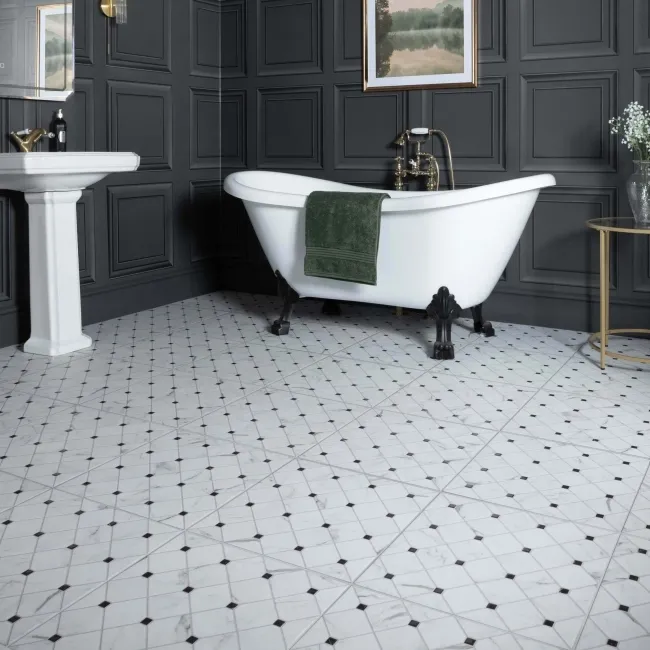
In a standard bathroom, water is contained by a bath or a shower tray; in a wetroom, the floor is the drainage surface. That single difference is what drives every decision that follows.
A wetroom is a fully tanked, level-access space where the floor itself falls toward a drain. There is no lip, no tray edge and no enclosure holding the water back, so the entire floor gets wet in normal use rather than catching occasional splashes. Water also sits on the surface for longer while it drains, and the area immediately around the showering position is wet every single day.
This is why a tile that performs perfectly well in a family bathroom can be the wrong specification for a wetroom. The bathroom tile only needs to handle splashes and the occasional wet footprint. The wetroom tile is the drainage surface.
R9 vs R10 vs R11 Compared
| R9 | R10 | R11 | |
| Slip resistance | Lowest of the R scale | Moderate | High |
| Typical use | Dry interior floors: living rooms, bedrooms, hallways | Standard bathrooms, kitchens, splash zones | Wetrooms, walk-in showers, pool surrounds, outdoor areas |
| Surface | Smooth; polished and gloss finishes common | Light texture; matt and satin finishes common | Textured or structured |
| Performance when wet | Minimal grip | Reasonable grip against splashes; not tested for standing, draining water | Meaningful grip retained |
| Feel underfoot | Smooth and comfortable | Comfortable, with a little texture | Noticeably textured |
| Cleaning | Easy; little texture to trap residue | Moderate; some texture to clean | More effort; texture holds soap and limescale |
| Style range | Widest, including polished finishes | Wide; the common domestic bathroom default | Narrower; few high-gloss options |
| Suitable for a wetroom floor | No | Only with supporting wet PTV (36+) or barefoot data for that tile | Yes |
Why R9 Does Not Work in a Wetroom
R9 is the lowest rating on the scale, and it describes a tile intended for interior floors that stay dry. The ramp angle at which an R9 tile was tested is shallow, and the smooth finishes that typically carry an R9 rating offer very little for a foot to grip once a film of water sits between skin and tile.
In a standard bathroom used with a bath mat, an R9 floor is a compromise some people accept. In a wetroom there is no equivalent mitigation: the wet area is not confined to one step-out point, water is present across the floor, and a mat placed in a wetroom sits in the drainage path. An R9 rating on its own is not an adequate basis for specifying a wetroom floor, whatever else is going for the tile.
Where R10 Fits
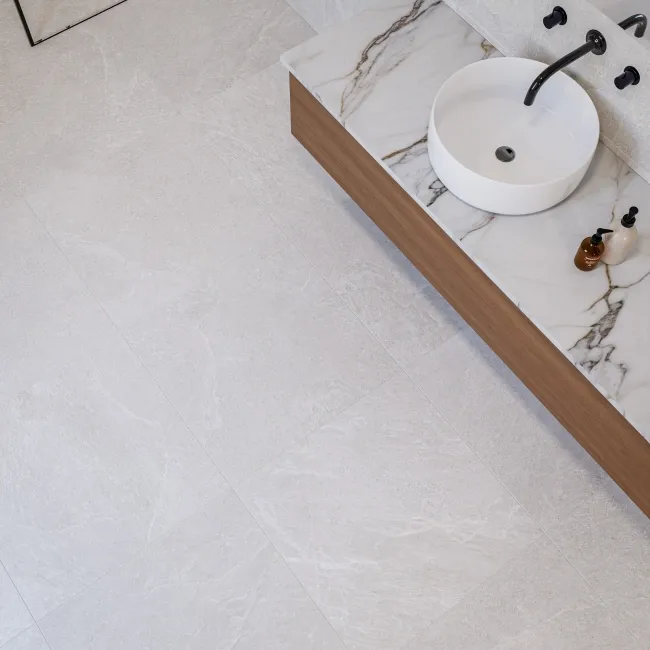
R10 is the common baseline for a standard bathroom floor, but for a wetroom it generally sits below what most suppliers recommend. The distinction is the one drawn above: R10 is specified for floors that see splashes and occasional wetting, not floors that carry draining water every day.
There is a legitimate exception. Where a tile carries an R10 rating and a published wet Pendulum Test Value of 36 or above, it has been tested under UK conditions and shown to have low slip potential when wet, which is stronger evidence than the R band alone. Some suppliers specify wetrooms on this basis. Where a barefoot classification is published, an R10 tile that also holds a Class B or Class C barefoot rating is similarly better evidenced than one with an R number alone.
The practical position: R11 is the straightforward answer for a wetroom floor. R10 can be defensible when supported by wet PTV or barefoot data for that specific tile, and should not be assumed adequate without it – R10 alone, with no supporting data, is a bathroom rating being asked to do a wetroom’s job.
The Problem With R Ratings in a Wetroom
R ratings come from a test carried out wearing shoes on an oil-covered ramp, and nobody uses a wetroom in shoes. This is the single most important caveat on this whole topic, and most tile listings never mention it, whichever of the three ratings they carry.
The DIN 51130 ramp test that produces R9 to R13 ratings is a shod-foot test using oil as the contaminant. It was developed for workplace environments. A wetroom is a barefoot space with water. A separate standard, DIN 51097, tests barefoot on a wet surface and produces Class A, B or C ratings, with Class C the highest and the one generally pointed to for wetrooms and pool surrounds.
Barefoot ratings are often available on request even when they are not published. Many manufacturers hold DIN 51097 data for tiles intended for wet areas and will supply it if asked. For a wetroom project specifically, asking the supplier whether a barefoot classification exists is a reasonable question and gives you information that matches how the room is actually used. Full detail on the barefoot standard is covered in our guide to bathroom floor safety and slip resistance.
None of this makes R ratings useless. They remain the most widely published figure, they allow quick comparison between tiles, and an R11 tile will generally outperform an R9 or R10 tile when wet. The point is to treat the R rating as a starting filter rather than the complete answer for a barefoot wet space.
Zoning a Wetroom Floor
Not every part of a wetroom floor faces the same conditions, and specifying by zone is a legitimate approach. The area under and immediately around the showerhead is wet daily and carries standing water as it drains. The far side of the room, near the door or a vanity, may be comparatively dry much of the time.
Two approaches work:
One tile throughout. Specifying R11 across the whole floor gives a continuous, seamless look and removes any judgement about where the wet zone ends. This is the simpler option and generally the safer one.
A higher rating in the shower zone. Using an R11 or more textured, smaller-format tile in the showering area, with an R10 tile beyond it, is common practice and can be a deliberate design feature – this is where R10 most legitimately earns a place in a wetroom, in the zone that isn’t the drainage path. The transition needs to be handled carefully so the junction does not become a trip point.
Where a mosaic or small-format tile is used in the shower zone, it brings a second benefit. Small tiles mean far more grout line per square metre, and grout provides more grip than a tile face. Small-format tiles also follow the fall toward a drain more easily than a large slab, which is why they are a common choice for the drainage area specifically.
Beyond the Rating: What Else Makes a Wetroom Safe
A correctly rated tile on a badly built wetroom floor is still a hazard, whichever of R9, R10 or R11 it carries. Four factors matter as much as the R number.
Fall and drainage. A wetroom floor must fall toward the drain so water runs away rather than pooling. Standing water defeats even a well-rated tile, and a flat or incorrectly falled floor is one of the most common wetroom failures. The correct gradient depends on the drainage system and tile format, so follow the drainage manufacturer’s specification rather than a general figure.
Tanking. A wetroom is a fully waterproofed structure, not simply a room with tiles in it. The substrate, junctions, corners and pipe penetrations all need an appropriate tanking system applied before tiling. Tile and grout are not a waterproofing layer.
Lippage. Adjacent tiles sitting at slightly different heights create a trip hazard on a wet floor and interrupt drainage. A level substrate and a tile levelling system during installation both help prevent it.
Installation quality generally. A wetroom is one of the more demanding tiling jobs in a domestic property, combining waterproofing, falls and drainage in a single floor. It is a common area for specialist installation, and getting the fall and tanking wrong is expensive to correct once tiled.
The Comfort and Cleaning Trade-Off
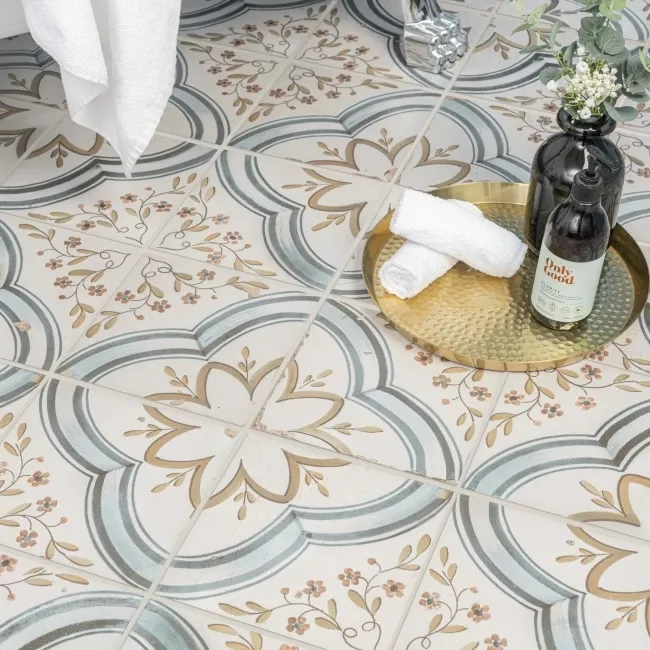
Moving up the scale from R9 to R10 to R11, texture increases at every step, and that texture is the trade-off for the grip. Most people find R11 perfectly comfortable underfoot in a domestic wetroom, but it is not the same smooth feel as a polished floor, and it is worth ordering samples of whichever ratings you’re comparing to stand on before committing.
The cleaning trade-off follows the same gradient. A textured surface holds soap residue, shampoo and limescale more readily than a smooth one, particularly in a hard water area. This matters beyond appearance: a build-up of residue on a textured tile reduces the grip the tile was specified for. A wetroom floor needs regular cleaning with a product suitable for the tile, and thorough rinsing so no film is left behind. Wax-based or polish-type cleaners should be avoided entirely, since they can leave exactly the slippery residue the tile was chosen to prevent. Our guide to cleaning anti-slip tiles covers this routine in full.
Grout needs the same attention. Worn or cracked grout loses texture, reduces the traction the joints contribute, and in a wetroom it also compromises the surface’s resistance to water penetration.
Common Wetroom Tiling Mistakes
- Specifying a bathroom tile for a wetroom. R9 and R10 are built for a different application, and a rating suitable for a splash zone is not automatically suitable for a drainage surface.
- Choosing a polished or gloss finish for the floor. Polished finishes look striking and are legitimate on wetroom walls, but they belong on walls rather than the drainage surface.
- Assuming an R rating covers barefoot use. It is a shod test at every band from R9 to R13; ask for barefoot data where it matters.
- Treating R10 as automatically wetroom-safe. It’s a defensible choice only with supporting wet PTV or barefoot data for that specific tile, not on the R number alone.
- Getting the fall wrong. Water that pools rather than drains undermines the tile specification entirely.
- Letting the cleaning slide. Slip resistance is not permanent; residue build-up gradually erodes the property you paid for.
Choosing Your Wetroom Floor Tile
Specify R11 for a wetroom floor unless you have wet PTV or barefoot classification data supporting R10 for that specific tile. R9 is a dry-floor rating and does not belong on a wetroom floor at all, regardless of finish or price point.
Beyond the number, get the fall and tanking right, keep the floor level to avoid lippage, consider a smaller format in the showering zone for the extra grout line, and plan for the cleaning a textured floor needs.
Browse the anti-slip tile range or the full bathroom floor tile selection, and see our Slip Ratings Explained guide for how the ratings are assessed. For a wetroom being built for someone with reduced mobility, an occupational therapist or specialist installer can advise on requirements specific to that person.
Frequently Asked Questions
What R rating do I need for a wetroom?
R11 is the rating generally specified for a wetroom floor, since water runs across the whole floor rather than being contained by a tray. R10 can be defensible where the specific tile also carries a published wet PTV of 36 or above, or a barefoot classification, but shouldn’t be assumed adequate on the R number alone. R9 is not suitable at all.
Can I use R9 tiles in a wetroom?
No, R9 is the lowest rating on the scale and describes a tile intended for dry interior floors. It offers minimal grip once wet, and a wetroom floor is wet every time the shower is used.
Is R10 enough for a wet room?
R10 is the usual baseline for a standard bathroom rather than a wetroom, and most suppliers point to R11 for wetroom floors. Where a specific R10 tile also has a wet PTV of 36 or above or a published barefoot class, it is better evidenced and some suppliers accept it, often in the drier zone of a floor specified by zone.
What’s the actual difference between R9, R10 and R11?
The difference is texture and tested grip when wet: R9 is smooth and designed for dry floors, R10 has light texture suited to splash zones like a standard bathroom, and R11 is noticeably textured and tested to perform when a surface is wet, which is why it’s the benchmark for wetrooms and walk-in showers.
Are R11 tiles uncomfortable to walk on barefoot?
R11 tiles are noticeably more textured than R9 or R10, but most people find them comfortable enough for domestic barefoot use. Ordering a sample and standing on it is the simplest way to judge before committing to a full order.
Do R ratings apply to barefoot use?
No, R ratings at every band come from a shod-foot ramp test using oil, while barefoot wet areas are covered by a separate standard producing Class A, B or C ratings. Many manufacturers hold barefoot data for wet-area tiles and will provide it on request, which is worth asking for on a wetroom project.
Are small tiles better for a wetroom floor?
Small-format and mosaic tiles have more grout line per square metre, and grout contributes grip, so they are a common choice for the showering zone regardless of which R rating is used. They also follow the fall toward a drain more easily than a large-format slab.
