

PTV 36+ means a surface scored 36 or above on the pendulum test, which the Health and Safety Executive treats as the threshold for low slip potential. PTV stands for Pendulum Test Value, and it is the measurement UK safety professionals rely on most when assessing how slippery a floor is likely to be. Unlike an R rating, a PTV is a single number produced by a test designed to replicate the way a heel actually strikes a wet floor.
This guide explains how the pendulum test works, what the 36 threshold does and does not mean, why the slider used in the test matters, and how to read a PTV figure on a product specification.
In short: PTV 36+ (tested wet) is the HSE’s benchmark for low slip potential – not a legal requirement, and not meaningful without knowing whether the test was wet or dry, which slider was used, and whether the figure came from a lab sample or an installed floor. Below 25 is classed as high slip potential, 25–35 as moderate. If a supplier gives you a PTV with no test conditions attached, ask before relying on it.
Table of Contents
What Is a Pendulum Test Value?
A Pendulum Test Value is a numeric measure of how much grip a floor surface provides, produced by a standardised test under BS 7976. The higher the number, the more friction the surface generates and the lower the slip potential. Unlike a class or a letter grade, a PTV is a continuous figure, which makes it possible to compare two surfaces directly rather than knowing only that both fall into the same band.
The pendulum test is the method the Health and Safety Executive and the UK Slip Resistance Group point to for assessing slip risk in this country, which is why PTV appears on specifications for commercial projects and increasingly on domestic product data too.
How the Pendulum Test Works

The pendulum test swings a weighted arm fitted with a rubber slider across the floor surface, and measures how much the surface slows it down. The slider is designed to replicate the way a heel strikes the ground as someone walks, including the moment of contact where a slip is most likely to begin.
As the arm swings through its arc, friction between the slider and the floor reduces its momentum. The equipment records that loss of momentum and converts it into a Pendulum Test Value. More friction produces a higher number; a smoother or more contaminated surface lets the arm swing further and produces a lower one.
The reason this method is preferred in the UK is that it reproduces the specific mechanism behind most real slips. When a heel lands on a wet floor, water is momentarily trapped between the shoe and the surface and has to be displaced before proper contact is made. A swinging slider recreates that dynamic moment, which a static measurement or a fixed ramp angle does not.
The PTV Scale
PTV results are interpreted using three bands, which the HSE uses to translate a number into a level of risk.
| PTV | Slip Potential | Interpretation |
| 0–24 | High | Significant slip risk under the tested conditions |
| 25–35 | Moderate | Elevated risk; may be acceptable in controlled dry areas |
| 36+ | Low | The commonly used benchmark for acceptable slip resistance |
You may occasionally see these bands quoted differently, so it is worth checking the source. Some suppliers publish alternative breakdowns, but the 0–24, 25–35 and 36+ bands above are the ones aligned with HSE guidance and the ones used across UK safety practice.
What PTV 36+ Actually Means
PTV 36 is the point at which the pendulum test classifies a surface as having low slip potential, most meaningfully when the test was carried out in wet conditions. It is the figure specifiers, insurers and safety assessors look for, and a tested 36+ under relevant conditions is considerably stronger evidence of a suitable floor than any marketing description.
Three things the number does not mean are worth being clear about. PTV 36+ is not a guarantee against slipping – it describes a low probability under the conditions tested, not an impossibility, and contamination, footwear, gradient and how someone is moving all still matter. PTV 36+ is not a legal requirement, since no UK statute specifies a numeric slip value (covered below) – it is a guidance benchmark that has become the de facto industry standard. And PTV 36+ on its own is not a complete specification: the figure needs to be read alongside the test conditions, the slider used, and whether the number came from a lab sample or an installed floor.
Higher thresholds are used where conditions are more demanding. A transport concourse, a commercial kitchen, or a sloped walkway will often be specified well above 36, since a ramp or a heavily contaminated floor erodes the margin that 36 represents on a level surface.
Wet PTV vs Dry PTV
A PTV figure is close to meaningless without knowing whether the test was run wet or dry, because most surfaces score far higher dry. Even a polished or relatively smooth floor can produce a good dry PTV under controlled conditions, which is why a headline figure with no stated conditions should be treated with caution.
A wet PTV is the figure that matters for any area where water is likely to be present. Water is introduced during the test to assess how much grip the surface retains once a film of liquid sits between the slider and the floor. For entrances, washrooms, bathrooms, wet rooms and external areas, the wet figure is the relevant one, and a dry-only figure does not tell you how the floor will behave when it matters most.
A dry PTV remains useful where a floor genuinely stays dry, such as an interior office or a retail aisle away from entrances. The question to ask is not which number is better but which condition matches the space.
The Slider Question: Shod or Barefoot?

The pendulum test can be run with different rubber sliders, and the choice changes what the resulting number represents. This detail is frequently omitted from product listings, and it matters more than almost any other footnote on a slip specification.
Broadly, one slider type is used to represent a shod foot, replicating the rubber of a shoe sole, and a different, softer slider is used to represent bare skin. The Four-S rubber slider (Slider 96) is the standard the UK Slip Resistance Group recommends for general shod assessment. For barefoot areas, a softer slider is used instead, because skin and shoe rubber behave differently against a wet surface.
This matters directly for any barefoot space. A bathroom, wet room, changing area or pool surround is used barefoot, so a PTV produced with a shod slider describes a scenario that does not occur in that room. When a supplier quotes a PTV for a bathroom application, it is entirely reasonable to ask which slider was used. Our separate guide to bathroom floor safety and slip resistance covers barefoot classification in more detail.
PTV vs R Ratings
R ratings and PTV measure slip resistance by fundamentally different methods, and they do not convert into one another. An R rating comes from the DIN 51130 ramp test, in which an operator wearing shoes walks on an oil-covered ramp that is gradually tilted until they slip. PTV comes from the pendulum test described above, usually with water.
| R Rating (DIN 51130) | PTV (BS 7976) | |
| Method | Tilting ramp, human operator | Swinging pendulum, rubber slider |
| Contaminant | Oil | Usually water |
| Condition | Shod | Shod or barefoot, depending on slider |
| Output | Band: R9 to R13 | Continuous numeric value |
| Origin | German workplace standard | UK standard, HSE preferred |
The core weakness of the R rating is that each band covers a wide range of actual friction performance. HSE technical guidance notes that two products carrying the same R rating can behave noticeably differently underfoot once wet, because the band is broad. A PTV gives a specific number rather than a range, which is why UK specifiers lean on it for wet slip risk.
Be cautious of any conversion table claiming to translate R ratings into PTV values. Some suppliers publish approximate equivalences, but the two tests measure different things under different contaminants, and treating one as a proxy for the other can produce a misleading result. If a supplier provides only an R rating and PTV genuinely matters for the project, ask whether pendulum data exists rather than converting the figure yourself.
Rz Microroughness
Rz microroughness measures the depth of a surface’s texture in microns, and it is used alongside PTV rather than instead of it. HSE technical guidance treats readings below around 10 microns as indicating high slip potential in wet pedestrian areas, roughly 10 to 20 microns as moderate, and above about 20 microns as low.
Roughness data is useful because it explains part of why a surface scores as it does, and because it can be measured on site relatively easily. It is not a substitute for a pendulum test: a surface can have adequate roughness and still perform poorly under other conditions, and different contaminants change what roughness is needed. Treat it as supporting evidence within a wider assessment.
The Legal Position in the UK
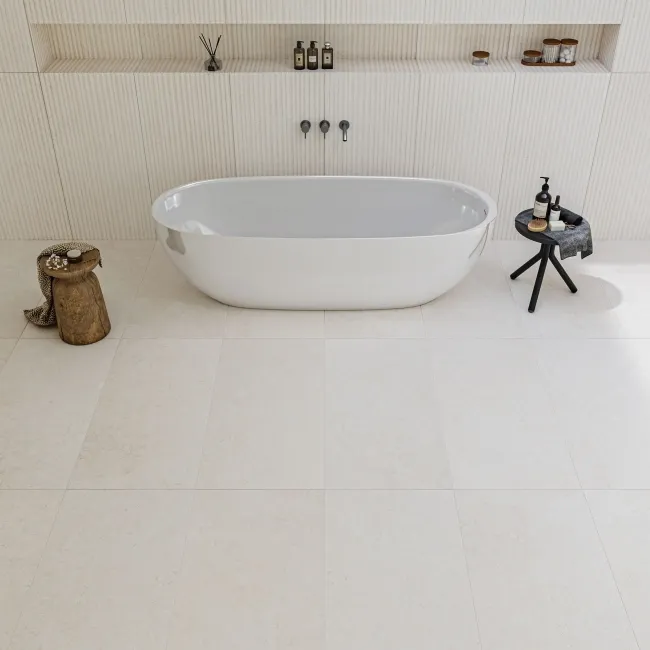
No UK legislation specifies a numeric slip resistance value that a floor must achieve. Regulation 12 of the Workplace (Health, Safety and Welfare) Regulations 1992 requires that floors are suitable for their purpose, in good condition, and free from anything likely to cause a slip or trip. It does not state a figure.
That absence of a statutory number is precisely why HSE and UK Slip Resistance Group guidance carries so much weight in practice. Where a dutyholder needs to demonstrate they acted reasonably, a dated pendulum test certificate showing 36+ under relevant conditions is substantially stronger evidence than a manufacturer’s general claim that a product is slip resistant.
For anyone specifying flooring in a workplace or public-facing space, the practical implications are straightforward: keep test certificates on file with dates, record cleaning and maintenance as it happens rather than retrospectively, and arrange a fresh assessment after a change of use, a significant increase in footfall, or any incident. This guide is general information rather than legal advice, and a suitably qualified professional should be consulted where compliance obligations are in question.
Lab Figures vs Real Floors
A PTV measured on a clean sample in a laboratory frequently differs from the same product measured after installation and use. This is one of the most consistently underestimated points in slip specification, and it applies to tiled floors as much as any other surface.
Several things change the figure between the factory and the finished floor: installation introduces grout lines, level variation and edge detail that a single test tile does not have; wear gradually smooths a trafficked surface, particularly along the main walking routes through a space; cleaning regimes can either maintain or degrade slip resistance, since residue from unsuitable products, polish build-up and limescale all reduce grip on a floor that tested well when new; and contamination in normal use, from soap in a washroom to grease in a kitchen, changes the conditions the floor actually faces.
For this reason, an in-situ pendulum test on the installed floor carries more weight than an ex-factory figure, and reputable testing bodies report the lowest reading recorded rather than the most flattering one. In high-traffic commercial environments, periodic re-testing is the recommended practice rather than treating a day-one figure as permanent.
What to Ask a Supplier
Five questions turn a headline PTV figure into information you can actually rely on.
- Was the test wet or dry? For any area that gets wet, a dry-only figure is not the relevant one.
- Which slider was used? Shod and barefoot sliders produce different figures for the same surface.
- Which standard was the test run to? BS 7976 is the UK pendulum standard; other methods exist and are not directly comparable.
- Is this a laboratory figure or an in-situ result? Both are useful, but they are not the same thing.
- What is the test date? A figure from several years ago on a heavily used floor tells you considerably less than a recent one.
What PTV Means for a Domestic Project
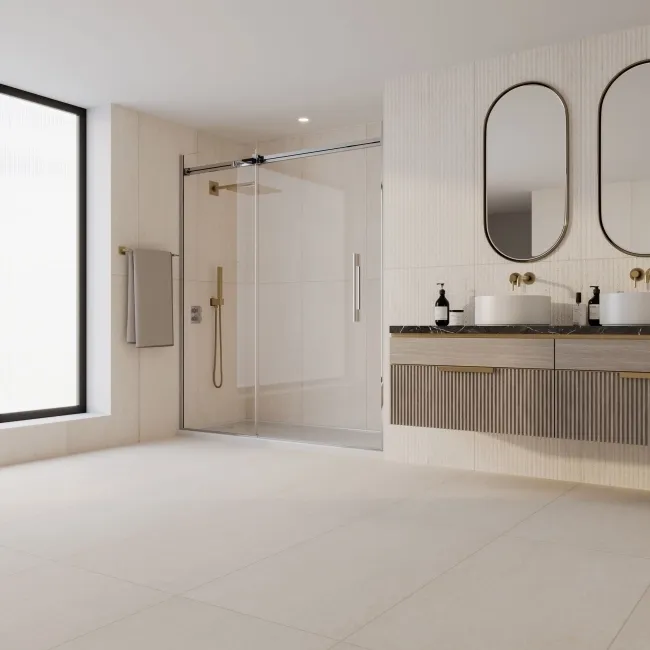
PTV data is more commonly published for commercial products than domestic ones, and a home project can often proceed sensibly without it. Most domestic tile ranges publish an R rating, and for a standard household bathroom, kitchen or hallway that is generally the figure available to work with.
PTV becomes worth actively seeking out in a few domestic situations: a wet room or open walk-in shower, where water runs across the floor itself rather than being contained; a bathroom being adapted for someone with reduced mobility, where the consequences of a fall are more serious; a property let to tenants or used as a holiday rental, where a landlord has duties toward occupants and documented evidence has value; or any space where a specifier, building control or an insurer has asked for it as part of a wider project.
Where PTV data is not published for a domestic tile, the practical approach is to use the published rating that does exist, choose a finish appropriate to the application, and pay attention to the factors covered above that affect a real floor rather than a test sample. Full detail on how gradings are assessed is covered in our Slip Ratings Explained guide.
Using PTV Properly
Read the conditions before the number. PTV 36+ is the UK benchmark for low slip potential, but the figure only means what its test conditions allow: wet or dry, shod or barefoot, lab sample or installed floor, and how recently it was measured.
Used properly, a pendulum test value is the most precise slip resistance information available in this country and considerably more useful than a broad R band. Used as a headline number stripped of context, it can give false confidence. Browse the anti-slip tile range or get in touch with our team if you need technical data for a specific project.
Frequently Asked Questions
What does PTV 36+ mean?
PTV 36 or above means a surface has been classified as having low slip potential under the pendulum test, and it is the benchmark UK safety guidance points to. The figure is most meaningful when the test was carried out in wet conditions, since most surfaces score considerably higher when dry.
Is PTV 36 a legal requirement in the UK?
No, UK legislation does not specify a numeric slip value. Regulation 12 of the Workplace (Health, Safety and Welfare) Regulations 1992 requires floors to be suitable and free from slip hazards without stating a figure, which is why the HSE’s 36 benchmark functions as the de facto industry standard rather than a statutory minimum.
What does PTV stand for?
PTV stands for Pendulum Test Value, a slip resistance measurement produced under BS 7976. A weighted pendulum fitted with a rubber slider swings across the floor surface, and the friction it meets produces the value.
Can I convert an R rating to a PTV?
No, the two tests use different methods and different contaminants, so one does not convert reliably into the other. Some suppliers publish approximate equivalences, but these can be misleading; ask whether pendulum data exists for the specific product rather than converting a figure yourself.
Does a floor keep its PTV rating forever?
No, slip resistance changes over time as a surface wears and as cleaning residue, polish or limescale build up. An in-situ test on the installed floor is more representative than an ex-factory figure, and periodic re-testing is recommended practice in high-traffic commercial environments.
Does PTV apply to barefoot areas like bathrooms?
Yes, but the slider used in the test determines whether the result represents a shod or a barefoot condition. A PTV produced with a shod slider does not describe barefoot use, so for a bathroom or wet room it is worth asking which slider was used, or checking whether a barefoot classification is published instead.
