
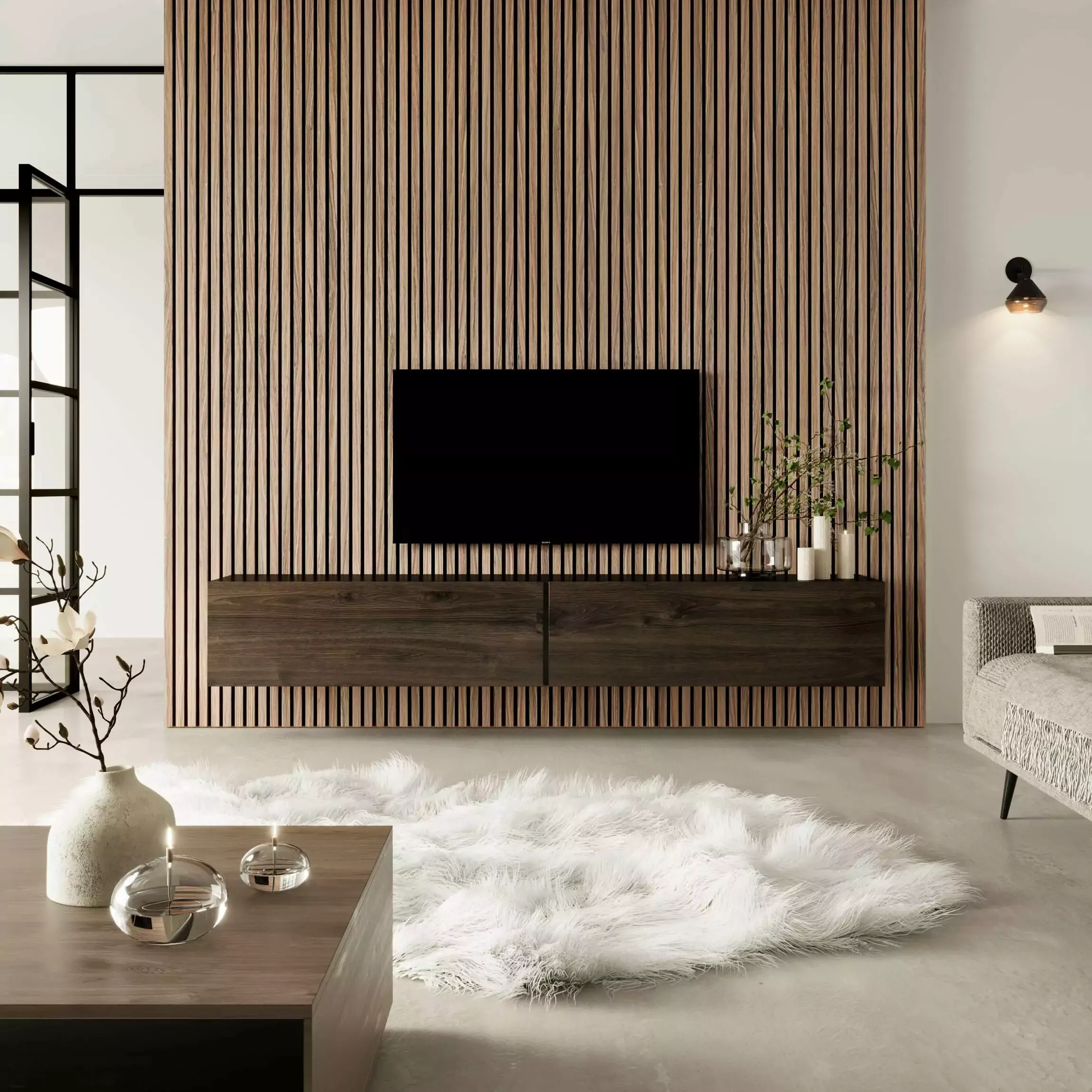
Acoustic wall panels are interior sound-absorbing treatments that reduce echo, shorten reverberation time, and improve speech clarity within a room. Acoustic wall panels work by allowing sound to pass into a porous core, usually made from open-cell foam, mineral wool, or fibreglass, where friction turns sound energy into low-level heat and reduces reflections from hard surfaces such as plasterboard, glass, tile, and concrete.
The three main acoustic wall panel types are foam panels, fabric-wrapped mineral wool panels, and perforated timber panels. Fabric-wrapped fibreglass and mineral wool panels deliver the strongest all-round acoustic performance across the widest frequency range, with NRC ratings from 0.85 to 1.00. Foam panels usually perform best at higher frequencies, with NRC ratings between 0.25 and 0.65.
Acoustic panels work well for reducing echo, flutter echo, and overall perceived room loudness, creating a calmer and more comfortable acoustic environment. For rooms that need greater sound separation between spaces, the most effective approach includes added mass, airtight sealing, and structural decoupling alongside acoustic treatment.
Acoustic panel performance depends on four factors: NRC rating, coverage area, targeted frequency range, and panel placement. Covering 15% to 25% of total wall and ceiling surface area delivers measurable acoustic improvement in most rooms. Stronger results come from placing panels at primary reflection points, including side walls at ear height, behind the sound source, and in corners for improved bass control.
This guide covers how acoustic panels work, which materials and types perform best, how many panels different room sizes need, where to place them, what to look for when buying in the UK, and how to tell when they are actually working.
Table of Contents
What Are Acoustic Wall Panels?
Acoustic wall panels are porous, sound-absorbing interior wall treatments made from open-cell foam, mineral wool, or fabric-wrapped fibreglass that reduce sound reflection and lower reverberation time inside a room. Acoustic wall panels improve speech clarity and reduce “echo” in bedrooms, living rooms, home offices, meeting rooms, classrooms, studios, restaurants, and reception areas because porous cores absorb reflected airborne sound energy.
The 3 principal acoustic wall panel types used in United Kingdom residential and commercial interiors are listed below:
- Foam Acoustic Panels: Open-cell polyurethane foam absorbs mid-to-high frequency sound mainly between 500 Hz and 4,000 Hz, with typical NRC ranges of 0.50 to 0.75 for common thickness profiles.
- Fabric Wrapped Mineral Wool Panels: Rockwool or fibreglass cores wrapped in acoustically transparent fabric achieve typical NRC ranges of 0.85 to 1.00 across a broad band from 125 Hz to 4,000 Hz when thickness and air gap support lower frequencies.
- Perforated Timber Panels: MDF or plywood faces with perforations and mineral wool backing target low-to-mid frequency control mainly between 100 Hz and 1,000 Hz, with performance governed by perforation ratio, cavity depth, and backing density.
Acoustic wall panels carry an NRC value on a 0.00 to 1.00 scale, where higher values indicate higher absorption within the rated test bands. Fabric wrapped mineral wool panels deliver the strongest broadband absorption in typical interiors because fibrous cores absorb a wider frequency range than thin foam.
How Do Acoustic Panels Work?
Acoustic panels work by letting sound enter a porous core, then converting sound movement into a small amount of heat through friction inside the material structure. Sound travels through air as pressure changes. Sound energy passes into open cells or fibres. Air particles rub against cell walls or fibres. Friction reduces reflected sound energy, so room echo decreases.
The 3 physical mechanisms that shape room sound with acoustic treatments are listed below:
- Absorption: Porous materials such as mineral wool and open-cell foam dissipate sound energy inside the core, reducing reflections and lowering reverberation time.
- Diffusion: Profiled surfaces scatter reflections across multiple directions, reducing flutter echo while keeping natural room “liveliness”.
- Damping And Blocking: Dense mass layers increase surface mass per square metre and reduce transmission through partitions, which relates to soundproofing rather than echo control.
Effectiveness is measured using Rt60, the time in seconds for sound level to drop by 60 dB after a sound source stops. Speech clarity targets in offices and meeting rooms align with Rt60 values around 0.4 to 0.6 seconds. Hard-surface rooms with plaster walls, concrete floors, and large glazing often sit around 1.0 to 2.5 seconds, which produces audible echo. Acoustic wall panels installation commonly reduces Rt60 by 40% to 65% when NRC rating, coverage area, placement, and room volume align.
The 4 factors that determine how effectively acoustic wall panels work are listed below:
- Nrc Rating: Higher NRC values near 0.85 to 1.00 deliver more absorption per square metre in the rated frequency bands.
- Coverage Area: Coverage around 15% to 25% of total wall surface area produces measurable Rt60 reduction in rooms up to 50 m², with higher coverage producing larger reductions.
- Frequency Range Targeted: Low-frequency sound below 250 Hz needs greater depth, commonly 75 mm or more total build-up, or dedicated bass trap geometries, because thin panels absorb mainly mid-to-high frequencies.
- Placement: Primary reflection point placement on side walls at ear height, commonly 1.2 m to 1.5 m above finished floor level, plus rear wall coverage, produces stronger reduction in flutter echo than random placement.
Acoustic wall panels manage sound behaviour inside one enclosed space. Sound transfer between rooms requires soundproofing systems such as acoustic plasterboard build-ups, resilient bars, mass-loaded vinyl, airtight perimeter sealing, and treated gaps around sockets, doors, and service penetrations.
What Can Acoustic Panels Do — and What Are Their Limitations?
Acoustic panels reduce room echo by absorbing reflected airborne sound and improving speech clarity, while acoustic panels do not soundproof a room because sound transmission control needs mass, airtightness, and structural decoupling. Acoustic panels change reverberation time inside one enclosed space. Acoustic panels reduce reflection intensity from hard surfaces such as plasterboard, glass, tile, painted walls, and concrete. Acoustic panels do not replace acoustic insulation inside partitions.
The 4 outcomes acoustic panels deliver are listed below:
- Reduce Echo: Acoustic panels absorb reflections and lower reverberation time, which reduces ringing after speech, claps, and footsteps.
- Improve Speech Clarity: Acoustic panels reduce early reflections that smear consonants, which increases intelligibility in conversation and calls.
- Reduce Flutter Echo: Acoustic panels reduce rapid parallel-wall reflections, which reduces “slap” and “ping” effects in rectangular rooms.
- Reduce Perceived Loudness: Acoustic panels reduce repeated reflection build-up, which reduces the feeling of a noisy room during multiple voices.

The 4 limitations of acoustic panels are listed below:
- No Soundproofing Effect: Acoustic panels do not stop neighbour noise, traffic noise, or TV noise passing through walls because transmission loss depends on surface mass, airtight seals, and decoupled structures.
- Limited Low-Frequency Control: Thin acoustic panels absorb mainly mid-to-high frequencies, so bass below 250 Hz needs deeper absorber thickness, larger air gaps, or dedicated bass trap designs.
- Coverage Requirement: Low panel coverage produces limited reverberation change, while higher coverage produces larger reverberation reduction across the room volume.
- Placement Requirement: Random placement reduces impact, while placement at primary reflection points increases reflection reduction and improves perceived clarity.
Which Type Of Acoustic Panel Works Best?
Fabric-wrapped fiberglass panels work best for most rooms, absorbing up to 95–100% of sound with an NRC rating of 0.95–1.0. Different panels solve different sound problems.
The main types of acoustic panels are listed below:
- Fabric Wrapped Fiberglass Panels: Soak up 95–100% of mid and high frequency sound, rated NRC 0.95–1.0, best for home studios, offices, and home theatres.
- Rockwool Mineral Wool Panels: Block a wide range of sounds including deep bass, rated NRC 0.80–0.95, best for recording studios with bass buildup.
- Foam Acoustic Panels: Catch high pitched sounds only, rated NRC 0.25–0.65, best for podcast setups and vocal booths on a budget.
- Perforated Timber Panels: Absorb and scatter sound at the same time, rated NRC 0.55–0.80, best for restaurants, offices, and commercial spaces.
- Bass Trap Panels: Target deep low sounds between 20 Hz and 300 Hz, rated NRC 0.80–1.0, best placed in room corners for home cinemas and recording rooms.
According to the Acoustical Society of America, fiberglass and mineral wool panels absorb 35–60% more sound than foam panels across the 500 Hz–4,000 Hz range.
Where Do Acoustic Panels Work Best In UK Homes And Businesses?
Acoustic panels work best on walls and ceilings where sound bounces the most. Hard surfaces such as bare walls, glass windows, concrete floors, and high ceilings reflect sound back into a room and create echo, reverb, and noise buildup.
The best locations for acoustic panels in UK homes and businesses are listed below:
- Home Studios: Place panels behind the listener, on both side walls at ear height, and fit bass traps in all four corners to stop sound reflecting between hard surfaces and muddying recordings.
- Home Cinemas: Mount panels on the wall behind the screen, on both side walls, and on the ceiling above seating so dialogue sounds clear and bass does not overpower the room.
- Home Offices: Fix panels behind the monitor, above the desk, and on the wall directly facing you to remove background echo and deliver clear, professional sound quality on video calls.
- Living Rooms: Fit panels on the largest wall and ceiling to reduce echo caused by hard floors, bare walls, and large glass windows that bounce sound around the room.
- Bedrooms: Mount panels on the wall behind the bed and on shared partition walls to reduce noise travelling from adjoining rooms and cut early morning street noise.
- Hallways And Staircases: Install wall panels along hallway walls and staircase landings where sound travels freely between floors and amplifies noise from foot traffic and closing doors.
- Dining Rooms: Place panels on upper walls and ceilings so conversation, cutlery noise, and background music stay contained without bouncing off hard furniture and flooring.
- Childrens Playrooms: Fix panels low on walls and across ceilings to absorb high pitched noise from toys and hard plastic surfaces that amplify sound quickly in smaller rooms.
- Open Plan Offices: Install panels across large ceiling areas and on dividing walls between desks so noise from conversations, phones, and keyboards does not travel across the entire floor.
- Meeting Rooms And Boardrooms: Mount panels on all four walls and the ceiling to keep conversations private, reduce echo, and deliver clear speech during presentations and conference calls.
- Restaurants And Cafés: Fit panels across upper walls and ceilings so noise from multiple conversations, cutlery, and background music does not build into one overwhelming level of sound.
- Classrooms And Lecture Halls: Mount panels on back walls and both side walls so every student hears the teacher clearly without sound reflecting back and forth across the room.
- Recording Studios: Cover all side walls, the full ceiling, and all four corners with absorbing panels and bass traps so every recorded sound stays tight, clean, and completely echo free.
- Podcast And Broadcast Studios: Place panels directly behind and beside the microphone, on the wall facing the presenter, and on the ceiling to remove all room noise from recordings.
- Music Practice Rooms: Install thick panels across all walls and the ceiling to contain instrument noise inside the room and stop sound leaking into neighbouring rooms or flats.
- Gyms And Fitness Studios: Fix panels high on walls and across ceilings to absorb impact noise from weights, equipment, and loud music reflecting off rubber flooring and bare concrete walls.
- Churches And Worship Spaces: Mount panels on side walls and upper sections of the building to reduce long reverb time that makes speech difficult to understand during services.
- Hotels And Hospitality Spaces: Install panels in corridors, lobbies, and function rooms to stop noise travelling between guest rooms and shared spaces throughout the building.
- Healthcare Waiting Rooms: Place panels on walls and ceilings to lower background noise levels so patients feel calm and private conversations between staff remain contained.

How Many Acoustic Panels Do You Need?
The number of acoustic panels needed depends on room size, ceiling height, and the level of sound treatment required. As a general rule, acoustic panels cover 15–25% of total wall and ceiling surface area for balanced sound treatment in most rooms.
The recommended acoustic panel coverage for common UK room sizes is listed below:
- Small Rooms (Up To 10 sqm): 4–6 panels of 600mm x 900mm size cover enough surface area to reduce echo and improve sound clarity in home offices, vocal booths, and small bedrooms.
- Medium Rooms (10–25 sqm): 6–10 panels of 600mm x 1200mm size treat enough wall and ceiling surface to control reverb in living rooms, dining rooms, and mid-sized home studios.
- Large Rooms (25–50 sqm): 10–16 panels of 1200mm x 1200mm size provide sufficient coverage to absorb sound across open plan offices, classrooms, and large home cinemas.
- Commercial Spaces (50 sqm And Above): 20 or more panels combined with ceiling baffles and hanging absorbers treat the full surface area of restaurants, gyms, lecture halls, and large meeting rooms.
The 3 key factors that determine how many acoustic panels a room needs are listed below:
- Room Surface Area: Larger rooms have more hard surfaces for sound to bounce off, requiring more panels to achieve the same level of sound absorption as a smaller room.
- Ceiling Height: Rooms with ceilings above 2.7 metres accumulate more reflected sound than standard height rooms, requiring additional panels on upper walls and ceiling surfaces.
- Room Purpose: Recording studios and home cinemas require 20–25% panel coverage for professional sound quality, while offices and classrooms need 15–20% coverage for comfortable speech clarity.
- Existing Soft Furnishings: Rooms with carpets, sofas, curtains, and bookshelves already absorb some sound, reducing the number of acoustic panels needed compared to bare, hard surfaced rooms.
- Panel Thickness: Thicker panels of 100mm absorb low frequencies more effectively than 25mm panels, meaning fewer thick panels achieve the same result as a larger number of thin panels.
A standard UK living room of 20 sqm with bare walls and a hard floor needs 8–10 panels of 600mm x 1200mm to reduce reverb time to a comfortable level. The same room fitted with carpet, curtains, and a sofa needs only 4–6 panels to achieve the same result.
How Do Acoustic Panels Compare To Other Acoustic Solutions?
Acoustic panels control sound inside a room better than most other solutions, absorbing 75–95% of reflected sound. Other acoustic solutions block sound from entering or leaving a room but do little to fix echo and noise buildup already inside it.
The main acoustic solutions compared to acoustic panels are listed below:
- Acoustic Panels vs Soundproof Curtains: Acoustic panels absorb up to 95% of reflected sound while soundproof curtains reduce noise by only 10–20%. Curtains help near windows but do not fix echo inside a room.
- Acoustic Panels vs Acoustic Foam: Acoustic foam only catches high pitched sounds, rated NRC 0.25–0.65, while acoustic panels absorb a full range of sounds, rated NRC 0.85–1.0. Panels absorb 35–60% more sound than foam across most room types.
- Acoustic Panels vs Mass Loaded Vinyl: Mass loaded vinyl stops sound passing through walls and floors, rated STC 25–32, while acoustic panels stop sound bouncing around inside the room. Both solve different problems and work best when used together.
- Acoustic Panels vs Acoustic Plasterboard: Acoustic plasterboard blocks sound moving through walls, rated STC 45–55, while acoustic panels fix echo and reverb inside the room. Plasterboard suits new builds and renovations while panels suit existing rooms with no building work needed.
- Acoustic Panels vs Double Glazing: Double glazing cuts external noise through windows by 30–35 dB while acoustic panels treat noise already inside the room. Double glazing keeps outside noise out while panels clean up the sound inside.
- Acoustic Panels vs Acoustic Underlay: Acoustic underlay reduces impact noise through floors by 15–30 dB while acoustic panels treat sound bouncing off walls and ceilings. Both target different sound paths and work well together in rooms with hard flooring.
- Acoustic Panels vs Soft Furnishings: Sofas, carpets, and bookshelves absorb sound at NRC 0.15–0.35 while acoustic panels absorb sound at NRC 0.85–1.0. Acoustic panels deliver 2–3 times more sound absorption than soft furnishings alone.
- Acoustic Panels vs Acoustic Ceiling Tiles: Ceiling tiles treat sound bouncing from above, rated NRC 0.55–0.80, while wall mounted acoustic panels treat sound bouncing off vertical surfaces. Using both together reduces reverb time by up to 70% compared to untreated rooms.
- Acoustic Panels vs Soundproofing Insulation: Soundproofing insulation such as Rockwool RW3 blocks sound through walls and ceilings by 45–60 dB while acoustic panels clean up echo inside the room. Insulation suits structural sound blocking while panels suit internal sound treatment with no construction work required.

Does It Matter Where You Place Acoustic Panels?
Placement of acoustic panels matters significantly, as incorrectly placed panels reduce effectiveness by up to 50%. Sound reflects off the nearest hard surface first, so panels placed at these first reflection points absorb the most sound and deliver the greatest improvement in room acoustics.
The 5 most important acoustic panel placement rules are listed below:
- First Reflection Points: Place panels on the side walls at the exact point where sound from the speakers or sound source bounces directly towards the listener. First reflection points deliver the biggest improvement in sound clarity of any placement position in the room.
- Behind The Sound Source: Mount panels directly behind speakers, microphones, and instruments to absorb sound before it bounces off the back wall and returns as echo. Panels placed behind the sound source reduce direct reflection by 60–80%.
- Opposite Hard Surfaces: Fix panels on the wall directly opposite the largest hard surface in the room, such as a bare wall, glass window, or tiled surface, where sound bounces back and forth most frequently.
- Room Corners: Place bass trap panels in all four floor to ceiling corners of the room where low frequency sound accumulates the most. Corner placement treats bass buildup more effectively than any other position in the room.
- Ceiling Reflection Points: Mount panels on the ceiling directly above the listening or working position where sound reflects downward and adds to overall room noise. Ceiling panels reduce reverb time by 30–40% in rooms with hard flooring.
The 4 most common acoustic panel placement mistakes are listed below:
- Placing All Panels On One Wall: Covering a single wall with panels leaves the remaining three walls and ceiling untreated, creating an uneven acoustic environment where sound still bounces freely between untreated surfaces.
- Placing Panels Too High Or Too Low: Panels mounted above or below ear height miss the primary reflection zone where most sound bounces, reducing their effectiveness by up to 40% compared to correctly positioned panels.
- Ignoring Room Corners: Skipping corner bass traps leaves low frequency sound untreated, resulting in boomy, muddy sound quality even when all other wall surfaces are fully covered with panels.
- Covering Too Much Surface Area: Treating more than 30% of total wall and ceiling surface area removes too much sound from the room, creating an unnaturally dead acoustic environment that sounds uncomfortable and unnatural.
Which Acoustic Panel Materials Work Best?
Fiberglass and mineral wool are the best acoustic panel materials, absorbing 85–100% of sound across a full frequency range with NRC ratings of 0.85–1.0. The best material depends on the type of sound problem and the room being treated.
The best acoustic panel materials are listed below:
- Fiberglass Core: Absorbs 85–100% of mid and high frequency sound, rated NRC 0.90–1.0, best for home studios, home cinemas, and offices where broad frequency absorption matters most.
- Mineral Wool (Rockwool): Absorbs 80–95% of broadband sound including deep bass, rated NRC 0.80–0.95, best for recording studios and music rooms with noticeable bass buildup.
- Melamine Foam: Absorbs high frequency sound only, rated NRC 0.25–0.65, best for podcast booths and vocal recording spaces on a tighter budget.
- Polyester Fibre: Absorbs mid and high frequency sound, rated NRC 0.70–0.90, and contains no loose fibres or irritants, best for classrooms, childrens spaces, and healthcare environments.
- Perforated Timber: Absorbs and scatters sound at the same time, rated NRC 0.55–0.80, best for restaurants, open plan offices, and commercial spaces where appearance matters as much as performance.
- Fabric Wrapped Panels: Use fiberglass or mineral wool wrapped in acoustically transparent fabric, rated NRC 0.85–1.0, best for any room where a clean and finished look is as important as sound absorption.
- Mass Loaded Vinyl Composite: Blocks and absorbs sound at the same time, rated STC 25–32 and NRC 0.55–0.75, best for partition walls and ceilings where both sound blocking and absorption are needed together.
The 3 key factors that determine which material works best are listed below:
- Frequency Range: Fiberglass and mineral wool treat the full frequency range from 125 Hz to 4,000 Hz while foam and melamine treat high frequencies above 1,000 Hz only. Matching the panel material to the dominant sound problem in the room delivers the most effective result.
- Panel Thickness: A 100mm mineral wool panel absorbs bass frequencies up to 40% more effectively than a 50mm panel of the same material. Thicker panels treat a wider range of frequencies and deliver stronger results in rooms with deep bass buildup.
- Room Environment: Damp spaces such as kitchens and bathrooms need moisture resistant materials such as polyester fibre or treated mineral wool, as standard fiberglass panels lose performance in high humidity conditions.

How Can You Tell If Acoustic Panels Are Working?
Acoustic panels are working when echo disappears, speech sounds clearer, and background noise feels less overwhelming inside the room. The difference is noticeable within the first 24–48 hours of installation, particularly in rooms with hard floors, bare walls, and high ceilings.
The 6 clearest signs that acoustic panels are working are listed below:
- Echo Disappears: Clap your hands once in the centre of the room. A sharp, clean clap with no lingering repeat means panels are absorbing reflected sound correctly. A hollow, repeating echo means more coverage is needed.
- Speech Sounds Clearer: Conversation inside a treated room sounds direct and natural without words blurring into each other. Untreated rooms make speech sound distant and difficult to follow, particularly in rooms above 25 sqm.
- Reverb Time Drops: Reverb time measures how long sound lingers in a room after the source stops. A well treated room achieves reverb times of 0.3–0.6 seconds, compared to 1.5–3.0 seconds in a completely untreated room of the same size.
- Video Call Quality Improves: Background echo and room noise disappear from recordings and video calls, making the speaker sound close, clear, and professional without any post processing or noise cancellation software.
- Music Sounds Balanced: Bass frequencies no longer overpower mid and high frequencies in a treated room. Each instrument and vocal sits clearly in the mix without low end buildup muddying the overall sound.
- Background Noise Feels Lower: Ambient noise from outside traffic, neighbouring rooms, and building systems feels quieter inside a treated room because reflected sound no longer amplifies background noise around the space.
The 3 quickest ways to test whether acoustic panels are working are listed below:
- The Clap Test: Stand in the centre of the room and clap sharply once. A short, clean decay with no flutter echo confirms panels are absorbing reflected sound across the room effectively.
- The Voice Test: Speak at normal volume facing the largest wall in the room. A natural, contained sound with no noticeable echo or reverb confirms panels are treating first reflection points correctly.
- The Recording Test: Record 30 seconds of audio in the room using a smartphone. Compare the recording to one taken before panels were installed. A reduction in background hiss, echo, and room noise confirms the panels are working as intende
What Should You Look For When Buying Acoustic Panels In The UK?
When buying acoustic wall panels in the UK, check three factors first: NRC rating, panel thickness, and core material. Panels with an NRC rating of 0.85 or above, a thickness of at least 50mm, and a fibreglass or mineral wool core deliver strong sound absorption in most homes and commercial spaces.
The key things to look for when buying acoustic panels in the UK are listed below:
- NRC Rating: Shows how much sound a panel absorbs on a scale of 0 to 1.0. Always choose panels rated NRC 0.85–1.0 for the best results in homes, offices, and commercial spaces.
- Panel Thickness: 25mm panels only treat high pitched sounds, 50mm panels treat mid and high sounds, and 100mm panels treat everything including deep bass. Pick the thickness that matches the main sound problem in the room.
- Core Material: Fiberglass and mineral wool absorb the widest range of sounds, rated NRC 0.85–1.0. Foam absorbs high pitched sounds only, rated NRC 0.25–0.65, and suits smaller budgets.
- Panel Size: Standard UK sizes of 600mm x 600mm, 600mm x 1200mm, and 1200mm x 1200mm fit most walls and ceilings. Larger panels cover more surface area and mean fewer panels are needed overall.
- Fire Safety Rating: UK building regulations require commercial acoustic panels to meet Class B or Class C fire ratings under BS EN 13501-1. Schools, offices, and public buildings need panels with a valid UK fire safety certificate.
- Fabric Cover: Acoustically transparent fabric lets sound pass straight through to the absorbing core. Non transparent fabric blocks sound before reaching the core and cuts panel performance by up to 30%.
- Mounting System: Z clips suit heavier panels above 5kg and adhesive pads suit lighter panels below 3kg on smooth plastered walls. Choosing the right mounting system keeps panels secure and properly positioned on the wall.
- Panel Density: Denser panels of 60–100 kg per cubic metre absorb deep bass sounds far better than lighter panels of 24–40 kg per cubic metre. Higher density means sound goes deeper into the panel and more of it gets absorbed.
- Room Humidity: Standard fiberglass panels lose performance in rooms above 70% relative humidity. Polyester fibre and treated mineral wool panels suit kitchens, bathrooms, and gyms where moisture levels stay high.
- Certifications: Panels tested to ISO 354 and ISO 11654 carry independently verified NRC ratings. Panels without certification carry manufacturer ratings only, which overstate real world performance by 15–25%.
The 3 most common mistakes UK buyers make when purchasing acoustic panels are listed below:
- Choosing Panels By Appearance Only: Decorative wall panels with dense, non transparent fabric coverings reduce sound absorption performance by up to 30% compared to panels with acoustically transparent fabric coverings of the same core material.
- Buying Panels That Are Too Thin: 25mm foam or fiberglass panels treat high frequencies only and leave mid and low frequency sound completely untreated. A minimum thickness of 50mm is needed to treat the full mid frequency range in most UK rooms.
- Ignoring Fire Safety Ratings: Acoustic panels installed in UK commercial spaces, rented properties, and public buildings without valid BS EN 13501-1 fire safety certification breach UK building regulations and create legal liability for the property owner.
Ready To Fix Your Room Sound With Walls and Floors?
Stop putting up with echo, muffled calls, and noisy rooms. Walls and Floors makes it easy to fix it, with a range of acoustic panels that improve how your room sounds and how it looks.
- Trusted Since 1987: Over 35 years of experience supplying quality wall panels to UK homes and businesses
- Over 44,000 Positive Reviews: Thousands of verified customers across the UK trust Walls and Floors for panels that deliver real results
- Next Day Delivery: Order before 3pm and get your panels delivered the next day, UK-wide
- Free Delivery Over £399: Stock up and save on delivery across the full acoustic panel range
- Try Before You Buy: Order a sample before committing so you can see the finish and feel the quality in your own space
- Flexible Payment: Spread the cost with Pay in 3 — choose PayPal at checkout with no extra hassle
- 79 Panels to Choose From: Oak, walnut, black, curved, wide slat, and more — styles that improve your room sound and your room look at the same time
