
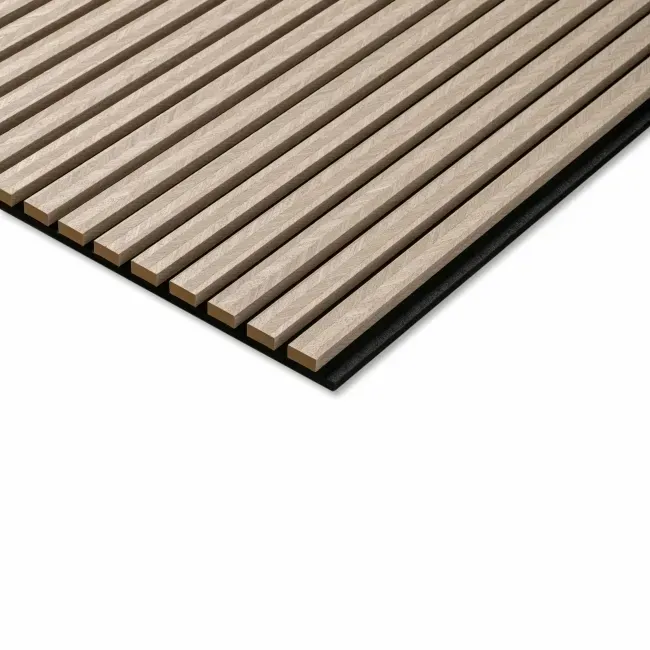
Acoustic wall panels come in 4 standard size formats — full panels at 2400 × 600mm, XL panels at 3000 × 600mm, half panels at 1200 × 600mm, and square panels at 600 × 600mm — with thickness ranging from 10mm to 100mm depending on panel type and acoustic requirement.
Wrong size selection is the most common buying mistake. A panel shorter than ceiling height leaves a visible gap. A panel narrower than the wall width leaves an uneven cut edge. A panel thinner than the acoustic requirement fails to absorb the target sound frequencies.
Ceiling height determines panel format. Rooms at 2.4 metres use full panels at 2400 × 600mm. Rooms above 2.4 metres use XL panels at 3000 × 600mm. Partial walls use half panels at 1200 × 600mm. Thickness determines acoustic performance. Panels at 21mm reduce echo in residential rooms. Panels at 50mm to 100mm absorb mid and low frequencies in studios and home cinemas.
This guide covers standard sizes, thickness differences, wall measurement, panel quantity calculation, room-specific size selection, and custom sizing — everything needed to choose the correct acoustic wall panel size before buying.
Table of Contents
What Are the Standard Sizes for Acoustic Wall Panels?
Acoustic wall panels measure 2400 × 600mm as the UK standard size, with a thickness of 21mm. Sizes range from 300 × 300mm modular tiles to 3000 × 600mm extended full-height panels, varying by panel type, construction material, and installation format.
The standard acoustic wall panel sizes available across the UK market are given below:
- Full Panel: 2400 × 600mm with 21mm thickness, covering 1.44 m² per panel and suiting standard UK ceiling heights of 2.4 metres.
- XL Panel: 3000 × 600mm with 21mm thickness, covering 1.80 m² per panel and reducing visible join lines in rooms with ceiling heights above 2.4 metres.
- Half Panel: 1200 × 600mm with 21mm thickness, covering 0.72 m² per panel and suiting dado-height installations, stairwells, and partial feature walls.
- Square Panel: 600 × 600mm with 21mm thickness, covering 0.36 m² per panel and suiting modular, geometric, and mixed-layout feature wall arrangements.
- Narrow Flex Panel: 2400 × 300mm with 12mm thickness, suiting column wrapping, pole cladding, and architectural features requiring a tighter bend radius.
- Large Format Panel: 2400 × 1200mm with thickness ranging from 25mm to 50mm, common in commercial interiors, recording studios, and open-plan office installations requiring broad surface coverage.
- Fabric-Wrapped Panel: 1200 × 600mm and 1200 × 1200mm with 25mm or 50mm thickness, used in offices, conference rooms, and educational settings where a fabric face finish is specified.
- Foam Acoustic Panel: 300 × 300mm, 600 × 300mm, and 600 × 600mm with 25mm, 50mm, or 100mm thickness, used in recording studios and home cinema rooms where maximum sound absorption depth is required.
- Curve Panel: 2400 × 600mm with 24mm thickness, accommodating the curved slat profile for use on bay walls, alcoves, and architectural curved surfaces.
- Lite Flexible Panel: 2400 × 600mm with 10mm thickness, suiting curved walls and installations where minimal projection from the wall surface is required.
What Is the Difference Between a Full Panel, Half Panel, and an XL Panel?
Full panels, half panels, and XL panels differ in height: full panels measure 2400mm, half panels measure 1200mm, and XL panels measure 3000mm. All 3 formats share a standard 600mm width and 21mm thickness, with the height dimension determining wall coverage, join frequency, and suitability for different ceiling heights.
The key differences between each acoustic wall panel size are given below:
- Full Panel: Measures 2400 × 600 × 21mm, covers 1.44 m² per panel, and suits standard UK ceiling heights of 2.4 metres with a single floor-to-ceiling run requiring no horizontal joins.
- Half Panel: Measures 1200 × 600 × 21mm, covers 0.72 m² per panel, and suits dado-height installations, stairwells, split-level walls, and spaces where only partial wall coverage is required.
- XL Panel: Measures 3000 × 600 × 21mm, covers 1.80 m² per panel, and suits rooms with ceiling heights above 2.4 metres, reducing the total panel count and eliminating horizontal join lines across taller walls.
How Thick Are Acoustic Wall Panels — and Does Thickness Matter?
Acoustic panel for walls range from 10mm to 100mm in thickness, and thickness directly affects sound absorption performance. Thicker panels absorb lower sound frequencies more effectively, with 50mm and 100mm panels capturing mid and low frequency sound waves that thinner 10mm to 25mm panels do not address.
Thickness varies across panel types in the following way:
- 10mm Thickness: Found in flexible and lite panel formats, suited to curved surfaces and installations requiring minimal wall projection, with limited sound absorption depth.
- 12mm Thickness: Found in narrow flex formats used for column wrapping and pole cladding where structural flexibility is prioritised over absorption depth.
- 20mm to 21mm Thickness: The standard thickness across wood slat acoustic wall panels, balancing aesthetic profile with functional sound absorption for residential living rooms, bedrooms, and home offices.
- 24mm Thickness: Found in curved slat panels, where the additional depth accommodates the curved slat construction without compromising structural integrity.
- 25mm Thickness: Common in fabric-wrapped and foam acoustic panels used in offices, meeting rooms, and educational environments, providing effective mid-frequency absorption.
- 50mm Thickness: Used in professional recording studios, home cinemas, and commercial spaces where broad-spectrum sound absorption across mid and low frequencies is required.
- 100mm Thickness: Specified for professional acoustic treatment in broadcast studios and high-performance recording environments, absorbing the widest range of sound frequencies including deep bass below 250Hz.
How Do You Choose the Right Acoustic Wall Panel Size for a Room?
The right acoustic wall panel size is determined by ceiling height, wall dimensions, and the intended acoustic function of the room. Rooms with standard 2.4 metre ceilings suit full panels at 2400 × 600mm, while rooms exceeding 2.4 metres in ceiling height require XL panels at 3000 × 600mm to achieve a seamless floor-to-ceiling installation.
The size selection process for acoustic wall panels follows the criteria given below:
- Ceiling Height: Select full panels at 2400mm for standard 2.4 metre ceilings, XL panels at 3000mm for ceilings above 2.4 metres, and half panels at 1200mm for dado-height or partial wall installations.
- Wall Width: Divide the total wall width in metres by 0.6 to calculate the number of 600mm-wide panels required per row, rounding up to the nearest whole panel to account for edge cuts.
- Room Function: Specify 20mm to 21mm wood slat panels for residential rooms requiring aesthetic sound absorption, 25mm to 50mm fabric-wrapped panels for offices and meeting rooms, and 50mm to 100mm foam panels for recording studios and home cinemas.
- Surface Type: Select 10mm Lite panels or 12mm Flex panels for curved walls, columns, and bay surfaces where standard rigid panels do not conform to the wall profile.
- Coverage Target: Cover 15% to 30% of the total wall surface area for general residential echo reduction, and 30% to 50% for home offices, media rooms, and studios where higher sound control is required.
- Panel Format: Use 600 × 600mm square panels for modular and geometric arrangements, 1200 × 600mm half panels for stairwells and split-level walls, and 2400 × 300mm narrow flex panels for architectural column features.
What Is the Coverage Area of Standard Acoustic Wall Panel Sizes?
A standard full acoustic wall panel measuring 2400 × 600mm covers 1.44 m² per panel. Coverage varies across panel sizes from 0.09 m² for small foam tiles to 1.80 m² for XL panels at 3000 × 600mm.
The coverage area for each standard acoustic wall panel size is given below:
- Full Panel — 2400 × 600mm: 1.44 m² per panel, requiring 7 panels to cover a standard 10 m² feature wall.
- XL Panel — 3000 × 600mm: 1.80 m² per panel, requiring 6 panels to cover the same 10 m² wall area with fewer joins.
- Half Panel — 1200 × 600mm: 0.72 m² per panel, requiring 14 panels to cover a 10 m² wall in a dado-height configuration.
- Square Panel — 600 × 600mm: 0.36 m² per panel, requiring 28 panels to cover a 10 m² wall in a fully modular arrangement.
- Narrow Flex Panel — 2400 × 300mm: 0.72 m² per panel, suited to column and pole cladding where full 600mm-wide panels are not applicable.
- Large Format Panel — 2400 × 1200mm: 2.88 m² per panel, requiring 4 panels to cover a 10 m² wall and reducing installation time in commercial settings.
- Foam Tile — 300 × 300mm: 0.09 m² per tile, requiring 112 tiles to cover a 10 m² surface in a studio foam treatment configuration.
- Foam Tile — 600 × 300mm: 0.18 m² per tile, requiring 56 tiles to cover 10 m² with a standard staggered foam layout.
- Foam Tile — 600 × 600mm: 0.36 m² per tile, requiring 28 tiles to cover 10 m² in a uniform square foam grid arrangement.

Are Acoustic Wall Panels Available in Custom Sizes?
Yes, acoustic wall panels are available in custom sizes, with most UK manufacturers and suppliers cutting panels to specific width, height, and thickness dimensions on request. Custom sizing suits rooms with non-standard ceiling heights, awkward wall dimensions, or architectural features that standard 2400 × 600mm panels do not fit without excessive cutting on site.
Here is what custom sizing covers for acoustic wall panels:
- Custom Height: Panels cut to heights between 1200mm and 3600mm suit rooms where standard 2400mm or 3000mm panels fall short or require trimming to fit ceiling height precisely.
- Custom Width: Panels cut to widths below the standard 600mm suit end-of-row fills, chimney breast returns, and alcove walls where a full-width panel leaves an uneven gap.
- Custom Thickness: Thickness specified between 25mm and 100mm suits projects where a precise acoustic performance target, such as a specific NRC (Noise Reduction Coefficient) rating, drives the panel specification.
- On-Site Cutting: Standard acoustic wall panels cut on site using a fine-tooth saw, allowing width and height adjustments without ordering bespoke panels, reducing cost and lead time for most residential installations.
Which Panel Size Works Best for Each Room?
The best acoustic wall panel size for each room depends on ceiling height, room size, and how much of the wall is being covered. Think of it this way — a tall room needs a taller panel, a small room needs a smaller panel, and a feature wall needs the size that fills the space cleanly without lots of joins.
The best acoustic wall panel size for each room type is given below:
- Living Room: Full panels at 2400 × 600 × 21mm suit standard living room ceiling heights of 2.4 metres and cover a typical feature wall of 10 m² with 7 panels, creating a clean unbroken slat finish.
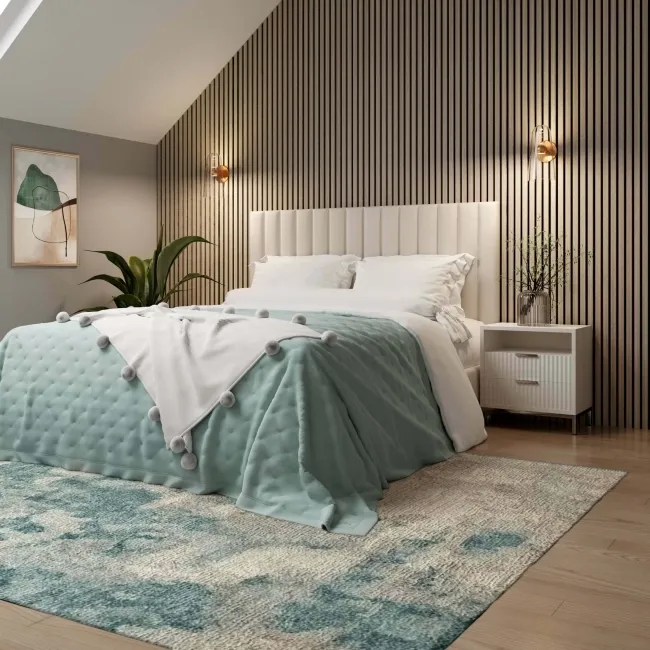
- Bedroom: Full panels at 2400 × 600 × 21mm suit behind-the-bed feature walls, with half panels at 1200 × 600mm suiting lower headboard-height installations where full floor-to-ceiling coverage is not required.
- Home Office: Full panels at 2400 × 600 × 21mm with 20mm to 25mm thickness suit the wall behind a desk or monitor, reducing echo during video calls and improving speech clarity across the working day.
- Media Wall: Full panels at 2400 × 600 × 21mm frame a media unit cleanly, with XL panels at 3000 × 600mm suiting open-plan rooms where the media wall extends above standard ceiling height.
- Home Cinema: 50mm thick fabric-wrapped panels at 1200 × 600mm or 1200 × 1200mm suit dedicated cinema rooms where mid and low frequency absorption across 30% to 50% of wall surface area is required.
- Recording Studio: Foam panels at 600 × 600mm with 50mm to 100mm thickness suit studio walls and ceilings, with 100mm panels targeting low-frequency bass absorption below 250Hz.
- Hallway: Half panels at 1200 × 600 × 21mm or narrow flex panels at 2400 × 300mm suit narrow hallway walls and stairwell surfaces where full-width 600mm panels do not fit the available wall space.
- Open-Plan Room: XL panels at 3000 × 600 × 21mm suit high-ceiling open-plan spaces, covering 1.80 m² per panel and reducing the total panel count across large unbroken wall surfaces.
What Are the Different Size Formats Available — and When Should You Use Each?
Acoustic wall panels come in 4 primary size formats: full, half, XL, and square, each serving a specific wall height, coverage area, and installation purpose. Beyond these 4 formats, flexible, narrow flex, large format, and foam tile sizes extend the range to curved surfaces, columns, commercial spaces, and studio environments.
The available acoustic wall panel size formats and their correct applications are given below:
- Full Format — 2400 × 600mm: The everyday choice. Use full-format acoustic wall panels on any standard UK wall where the ceiling sits at 2.4 metres and a single floor-to-ceiling panel run is the goal.
- XL Format — 3000 × 600mm: The tall-room choice. Use XL acoustic wall panels in rooms where the ceiling exceeds 2.4 metres, removing the need for a horizontal join midway up the wall.
- Half Format — 1200 × 600mm: The partial-wall choice. Use half-format acoustic wall panels for dado-height features, stairwell walls, behind-sofa installations, and anywhere a full-height panel is more than the space requires.
- Square Format — 600 × 600mm: The modular choice. Use square acoustic wall panels for geometric layouts, patterned feature walls, and accent areas where panels are arranged in a grid or mixed configuration.
- Lite Flexible Format — 2400 × 600 × 10mm: The curved-wall choice. Use Lite panels on bay walls, alcoves, and curved surfaces where a rigid 21mm panel does not bend to follow the wall profile.
- Narrow Flex Format — 2400 × 300mm: The column choice. Use narrow flex acoustic panels to wrap columns, structural posts, and poles where the 600mm standard width is too wide for the surface being clad.
- Large Format — 2400 × 1200mm: The fast-cover choice. Use large-format acoustic panels in commercial offices, conference rooms, and open-plan environments where broad surface coverage with minimal joins is the priority.
- Foam Tile Format — 300 × 300mm, 600 × 300mm, 600 × 600mm: The studio choice. Use foam acoustic tiles in recording studios, podcast rooms, and home cinemas where deep sound absorption at 50mm to 100mm thickness targets mid and low frequency control.

How Do I Choose the Right Panel Size for Each Room in My Home?
Choose acoustic wall panel size by measuring ceiling height first — rooms at 2.4 metres use full panels, rooms above 2.4 metres use XL panels, and partial walls use half panels. Width and coverage follow from there, with 600mm-wide panels covering most standard UK wall layouts.
Follow these 4 steps to choose the right acoustic wall panel size for any room:
- Step 1 — Measure Ceiling Height: Measure floor to ceiling. A height of 2.4 metres confirms full panels at 2400 × 600mm. A height above 2.4 metres confirms XL panels at 3000 × 600mm. A dado or partial wall installation confirms half panels at 1200 × 600mm.
- Step 2 — Calculate Wall Width: Divide total wall width by 0.6 to find the number of 600mm-wide panels needed per row. A 3-metre-wide wall requires 5 full panels per row. Round up to the nearest whole number and cut the final panel to fit.
- Step 3 — Set Coverage Target: Cover 15% to 20% of total wall surface area for light echo reduction in living rooms and bedrooms. Cover 25% to 35% for home offices and media rooms. Cover 40% to 50% for home cinemas and recording spaces.
- Step 4 — Match Panel Format to Surface Type: Flat walls take standard rigid panels at 21mm thickness. Curved walls, bay windows, and columns take Lite panels at 10mm or narrow flex panels at 12mm. Studios and cinema rooms take foam panels at 50mm to 100mm thickness for deep frequency absorption.
Does the Shape of an Acoustic Panel Affect the Size I Should Choose?
Yes, the shape of an acoustic wall panel directly affects which size suits the installation, as curved, square, and flexible panel shapes each carry different dimension constraints. A curved panel at 2400 × 600 × 24mm requires more depth than a flat panel at 2400 × 600 × 21mm, and a square panel at 600 × 600mm changes the layout grid entirely compared to a rectangular full panel.
Panel shape affects size selection in the following ways:
- Rectangular Flat Panels: The most common shape, available in full, half, and XL sizes from 600mm to 3000mm in height. Rectangular acoustic wall panels suit flat, uninterrupted wall surfaces and follow a standard vertical installation pattern.
- Square Panels: Fixed at 600 × 600mm, square acoustic wall panels suit modular grid layouts and geometric feature walls where the equal height and width dimensions create a symmetrical tiled pattern across the surface.
- Curved Panels: Available at 2400 × 600 × 24mm, with the additional 3mm thickness over the standard 21mm accommodating the curved slat construction. Curved acoustic wall panels suit alcoves, bay walls, and concave or convex architectural surfaces where flat rigid panels produce visible gaps at the edges.
- Flexible Lite Panels: Available at 2400 × 600 × 10mm, with the reduced 10mm thickness allowing the panel to follow a curved wall profile without cracking or splitting. Lite acoustic wall panels suit bay windows, curved partition walls, and column faces where a rigid panel does not conform to the surface.
- Narrow Flex Panels: Available at 2400 × 300mm and 1200 × 600mm in 12mm thickness, with the reduced width and flexible construction suiting tight-radius curves on columns, structural posts, and architectural poles where a standard 600mm wide panel produces buckling under bending force.

How Do I Measure My Wall Before Buying Acoustic Panels?
Measure wall width and height in millimetres, multiply the two figures to get total wall area in m², then divide by the coverage area of the chosen panel size to calculate the number of panels required. A wall measuring 3600mm wide by 2400mm high gives a total area of 8.64 m², requiring 6 full panels at 1.44 m² each.
Follow these steps to measure a wall accurately before buying acoustic wall panels:
- Step 1 — Measure Wall Width: Measure the full width of the wall in millimetres from corner to corner at skirting level. Record this figure, as width at floor level is the most accurate reference point for panel layout planning.
- Step 2 — Measure Wall Height: Measure from finished floor level to ceiling in millimetres. A measurement of 2400mm confirms full panels without cutting. A measurement above 2400mm confirms XL panels at 3000mm or on-site trimming of XL panels to the exact ceiling height.
- Step 3 — Subtract Fixed Obstructions: Subtract the width and height of any windows, doors, sockets, or recesses from the total wall area. Deducting obstruction areas from total m² gives the net coverage area requiring panels.
- Step 4 — Divide by Panel Coverage: Divide net wall area in m² by the coverage per panel of the chosen size. Divide by 1.44 for full panels, 1.80 for XL panels, 0.72 for half panels, and 0.36 for square panels.
- Step 5 — Add 10% Wastage: Add 10% to the total panel count to account for edge cuts, trimming around sockets, and any panels damaged during installation. A calculation returning 10 panels requires an order of 11 panels minimum.
Can Acoustic Panels Be Cut to Size on Site?
Yes, acoustic wall panels cut on site using a fine-tooth hand saw, circular saw, or jigsaw, allowing width and height adjustments to fit exact wall dimensions without ordering bespoke custom-sized panels. Wood slat acoustic panels with MDF construction cut cleanly along both the horizontal and vertical axis, producing straight edges suitable for corner returns, ceiling trims, and socket cutouts.
The key points on cutting acoustic wall panels to size on site are given below:
- Tool Required: Use a fine-tooth hand saw or circular saw with a fine-tooth blade for straight cuts along panel width and height. Use a jigsaw for curved cuts around sockets, pipes, and architectural features.
- Cut Direction: Cut acoustic wall panels from the face side down when using a circular saw to prevent the blade from chipping the slat surface finish. Cut from the face side up when using a hand saw for the same reason.
- Width Cuts: Trim panels along the vertical axis to reduce 600mm width for end-of-row fills, corner returns, and alcove side walls where a full-width panel leaves an uneven gap at the wall edge.
- Height Cuts: Trim panels along the horizontal axis to reduce 2400mm or 3000mm height to match ceiling height precisely, removing excess from the bottom of the panel to keep the slat pattern consistent from the top of the installation downward.
- Felt Backing: The felt backing on wood slat acoustic wall panels cuts cleanly alongside the MDF core. Seal any cut felt edges with a small amount of PVA adhesive to prevent fraying at the panel perimeter after installation.
- Socket and Switch Cutouts: Mark socket positions directly onto the panel reverse using a template, then cut the opening with a jigsaw before mounting the panel to the wall, ensuring electrical fittings align flush with the finished panel face.

What Is the Difference Between Panel Size and Panel Coverage?
Panel size is the physical dimension of the panel in millimetres, while panel coverage is the area of wall surface the panel occupies in square metres. A full acoustic wall panel measuring 2400 × 600mm has a physical size of 2400mm by 600mm and a coverage area of 1.44 m² — these are two different figures used at two different stages of planning.
The distinction between panel size and panel coverage matters in the following ways:
- Panel Size refers to the length, width, and thickness of the acoustic wall panel as a physical object, expressed in millimetres such as 2400 × 600 × 21mm. Panel size determines whether the panel fits the wall height, suits the ceiling, and requires on-site cutting.
- Panel Coverage refers to the area of wall surface the panel fills once installed, expressed in square metres. Panel coverage determines how many panels are required to cover a given wall area and is calculated by multiplying panel length by panel width in metres.
- Why Both Figures Matter: A room with a 10 m² feature wall requires 7 full panels based on 1.44 m² coverage per panel — but the physical size of 2400 × 600mm confirms those panels fit the 2.4 metre ceiling height without cutting. Using coverage alone without checking physical size produces incorrect orders.
- Coverage Across Panel Sizes: Full panels at 2400 × 600mm cover 1.44 m², XL panels at 3000 × 600mm cover 1.80 m², half panels at 1200 × 600mm cover 0.72 m², square panels at 600 × 600mm cover 0.36 m², and large format panels at 2400 × 1200mm cover 2.88 m² per panel.
- Wastage Allowance: Coverage figures assume full uncut panels. Add 10% to the total coverage requirement before dividing by panel coverage per unit, accounting for edge cuts and trimming losses that reduce the usable coverage of perimeter panels.
What Should I Consider Beyond Size When Choosing Acoustic Wall Panels?
Beyond size, acoustic wall panel selection requires consideration of material, thickness, NRC rating, finish, installation method, and room function. Size determines coverage, but these 6 factors determine whether the panel performs correctly and suits the space acoustically and aesthetically.
The key considerations beyond size when choosing acoustic wall panels are given below:
- Material: Wood slat MDF panels with felt backing suit residential interiors requiring both sound absorption and visual warmth. Fabric-wrapped panels suit offices and meeting rooms. Foam panels suit recording studios and home cinemas requiring deep frequency absorption.
- NRC Rating: NRC (Noise Reduction Coefficient) measures sound absorption on a scale of 0 to 1. An NRC of 0.85 absorbs 85% of sound that contacts the panel surface. Specify panels with an NRC above 0.80 for studios and home cinemas, and above 0.55 for residential living rooms and bedrooms.
- Thickness: Thicker panels absorb lower sound frequencies. Panels at 21mm suit general residential echo reduction. Panels at 50mm to 100mm suit professional acoustic treatment targeting mid and low frequencies below 250Hz.
- Finish and Colour: Oak, walnut, noir black, ash grey, and slate effect finishes each carry a different visual weight within a room. Darker finishes recede visually and suit larger rooms. Lighter finishes open smaller spaces.
- Slat Style: Standard slat, wide slat, multi-width slat, and curved slat profiles each produce a different shadow line and textural depth across the panel face. Wide slat panels create a bolder horizontal rhythm. Standard slat panels produce a finer, more uniform surface pattern.
- Installation Method: Adhesive fixing suits dry, flat plasterboard surfaces. Screw fixing suits uneven or damp-prone walls. Check wall substrate before selecting fixing method, as incorrect fixing reduces panel stability and long-term performance.
- Room Humidity: Standard wood slat acoustic wall panels suit dry indoor environments. Bathrooms and high-humidity kitchens require moisture-resistant panel construction to prevent MDF swelling and felt backing degradation over time.
What Is the Weight of Different Acoustic Wall Panel Sizes?
A standard full acoustic wall panel measuring 2400 × 600 × 21mm weighs approximately 7kg to 9kg, depending on MDF density and felt backing weight. Panel weight increases proportionally with size and thickness, directly affecting the fixing method, wall substrate requirement, and whether a single installer handles the panel safely during fitting.
The approximate weights for each acoustic wall panel size are given below:
- Full Panel — 2400 × 600 × 21mm: 7kg to 9kg per panel. Standard plasterboard walls accept this weight with panel adhesive and a minimum of 4 fixing points per panel.
- XL Panel — 3000 × 600 × 21mm: 9kg to 12kg per panel. The additional 600mm height increases weight by approximately 25% over a full panel, requiring screw fixing into wall studs for secure long-term installation.
- Half Panel — 1200 × 600 × 21mm: 3.5kg to 4.5kg per panel. The reduced height produces a lighter panel suited to adhesive-only fixing on sound plasterboard surfaces.
- Square Panel — 600 × 600 × 21mm: 1.5kg to 2kg per panel. The compact size and low weight suit single-handed installation without assistance.
- Lite Flexible Panel — 2400 × 600 × 10mm: 3kg to 4kg per panel. The 10mm MDF core reduces weight by approximately 55% compared to the standard 21mm full panel, easing installation on curved and angled surfaces.
- Narrow Flex Panel — 2400 × 300 × 12mm: 2kg to 3kg per panel. The reduced width and 12mm thickness produce a lightweight panel suited to column and pole cladding without overloading the fixing substrate.
- Large Format Panel — 2400 × 1200 × 21mm: 14kg to 18kg per panel. The doubled width requires 2-person installation and mechanical fixing into wall studs rather than adhesive-only application.
- Foam Acoustic Tile — 600 × 600 × 50mm: 0.3kg to 0.6kg per tile. Foam construction produces a significantly lighter panel than MDF-based formats, suiting ceiling installation where weight directly affects fixing load.
What Are the Size Considerations for Small Rooms vs Large Rooms?
Small rooms require smaller panel formats such as 600 × 600mm square or 1200 × 600mm half panels, while large rooms suit full panels at 2400 × 600mm or XL panels at 3000 × 600mm. Panel size relative to room scale affects visual proportion, coverage efficiency, and the number of joins visible across the installed wall surface.
The size considerations for small and large rooms are given below:
- Small Rooms — Under 12 m²: Use half panels at 1200 × 600mm or square panels at 600 × 600mm. Full-height 2400mm panels in a small room produce a visually heavy installation that reduces the perceived ceiling height and overwhelms the wall proportions.
- Small Rooms — Coverage Target: Cover 15% to 20% of total wall surface area in small rooms. Over-panelling a small room above 30% wall coverage increases sound deadness, producing a flat and acoustically uncomfortable environment.
- Large Rooms — Over 25 m²: Use full panels at 2400 × 600mm or XL panels at 3000 × 600mm. Larger panel formats reduce the number of vertical joins across wide walls, producing a cleaner and more continuous slat finish across the full installation.
- Large Rooms — Coverage Target: Cover 25% to 40% of total wall surface area in large rooms and open-plan spaces. Hard parallel surfaces in large rooms produce long reverberation times, requiring greater panel coverage to achieve audible echo reduction.
- Ceiling Height Below 2.4m: Use half panels at 1200 × 600mm or cut full panels to the exact ceiling height. Installing an uncut 2400mm panel in a room with a ceiling below 2.4 metres requires trimming, producing cut slat ends at the top of the installation.
- Ceiling Height Above 2.4m: Use XL panels at 3000 × 600mm to avoid a horizontal mid-wall join. A full panel at 2400mm in a 3-metre ceiling room leaves a 600mm gap at the top requiring a second cut panel, breaking the slat continuity of the installation.
- Narrow Walls — Under 1.2m Wide: Use narrow flex panels at 2400 × 300mm or cut standard 600mm-wide panels to 300mm. A full-width 600mm panel on a wall narrower than 1.2 metres produces fewer than 2 panel widths, creating an uneven layout with a visually dominant cut edge.
